Capybara Court: The AI App Where a Capybara Judge Gently Settles Your Petty Disputes

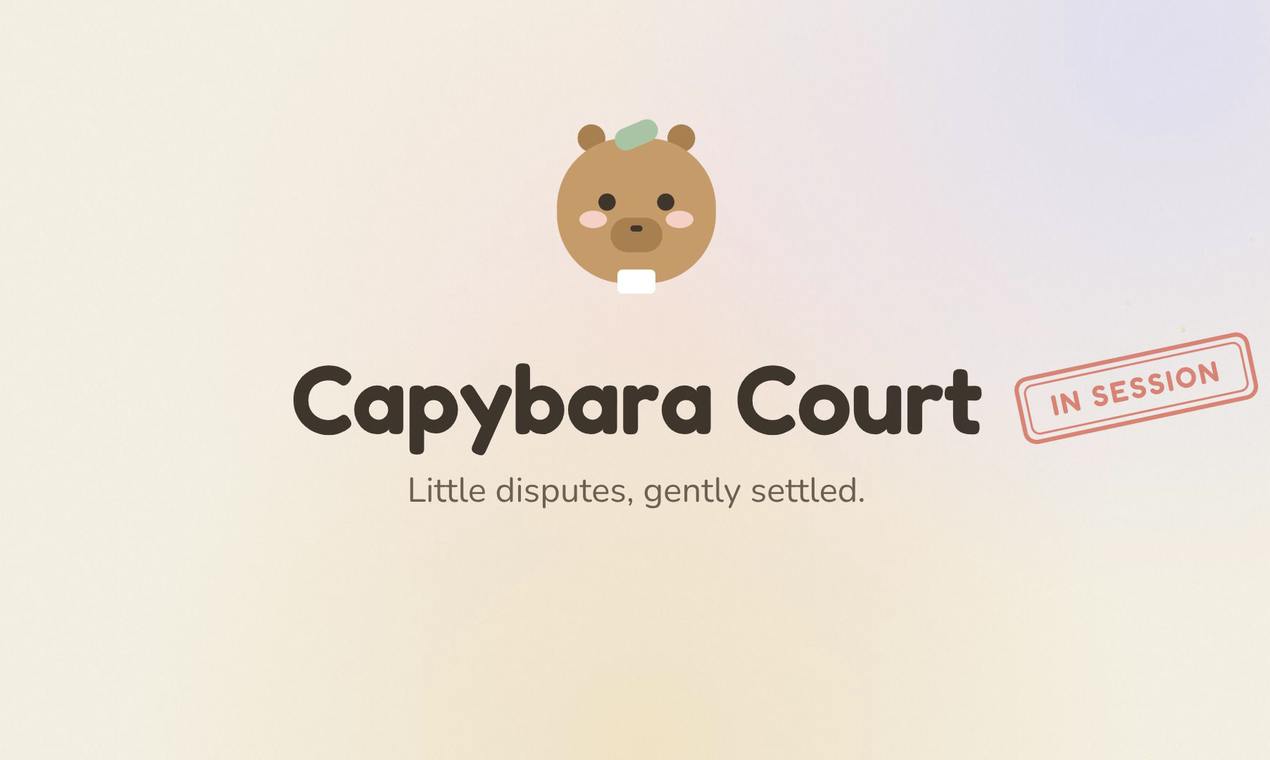
Capybara Court uses an AI capybara judge to gently settle everyday disputes between couples, roommates, and friends.
Capybara Court is a lightweight lifestyle app on Product Hunt built by developer Jungsik Byun. Both parties independently answer four identical questions, and AI judge Judge Cappy reveals the verdict to both phones simultaneously. The app is designed around a "fault is never 100-0" principle to avoid polarizing outcomes and encourage reconciliation. Additional features include an anonymous gallery for one-sided venting and automatic 30-day content deletion for privacy. The capybara's "chill" internet persona serves as an emotional buffer, framing AI mediation as a low-pressure, non-confrontational experience — though retention and community engagement remain open questions.
A Capybara Judge for Life's Little Conflicts
Who should do the dishes, who used the last of the milk, who showed up late — these trivial yet quietly infuriating little disputes rarely have a proper outlet. Capybara Court, a new app that landed on Product Hunt, aims to give these micro-conflicts a resolution through an experience that's lighthearted yet just ceremonial enough to feel meaningful.
The tagline says it all: "Tiny disputes, gently settled by a capybara judge." Listed under the Lifestyle category on Android and iOS, the app was built by developer Jungsik Byun and earned 68 upvotes on launch day, ranking 13th on the daily charts.
How It Works
Capybara Court's core mechanics are refreshingly restrained — and surprisingly clever. The whole process breaks down into a few key moments:
Both Sides Answer Independently
Each party answers the same four questions about the dispute on their own. Every response is "sealed" — your counterpart can't see what you wrote. This sidesteps the emotional escalation that comes with face-to-face confrontation and eliminates the distortion that comes from mirroring or pre-emptively rebutting the other side. Only Judge Cappy — the capybara AI arbitrator — gets to read both sides of the story.
The Verdict Drops Simultaneously — and Never Goes 100-0
The ruling is revealed on both phones at the same time. That synchronized reveal matters: it prevents one party from seeing the result first and immediately seizing the narrative. There's also a notable design commitment — the app explicitly promises that "fault is never 100 to 0." Judge Cappy won't pin all the blame on one person. The rulings are calibrated to acknowledge both sides.
This actually captures something true about interpersonal friction. Most small disputes aren't black and white, and a verdict that deliberately avoids taking sides is often easier for both parties to accept — and move on from.
From a behavioral psychology standpoint, the "never 100-0" rule echoes findings from psychologist John Gottman's marriage research: absolute blame attribution ("it's entirely your fault") is a major warning sign of relationship breakdown. The AI here acts less like a judge and more like a mediator — the goal isn't to declare a winner, but to help both parties arrive at a mutually acceptable narrative. By algorithmically compressing the space for "one side is completely right," the app nudges both users into a mental state of shared responsibility, laying the cognitive groundwork for reconciliation.
Flying Solo? There's an Anonymous Gallery
If the other party isn't available — or you just want to vent and get some validation — you can post your dispute to the gallery, with names hidden. This opens up a community use case where one-sided frustrations still have somewhere to go.
The anonymous gallery borrows from the psychology of social validation. When you're deep in a conflict, it's hard to self-assess who's in the right; a stranger's outside perspective offers a low-cost form of third-party legitimacy. This kind of community-driven dispute-sharing has already been validated at scale by Reddit's r/AITA (Am I the Asshole), which generates thousands of posts daily — clear evidence that people have a genuine, ongoing need to have everyday conflicts judged by strangers. If Capybara Court's gallery can spark similar community dynamics, it could become a key driver of long-term retention.
Everything Self-Destructs After 30 Days
All content is automatically shredded after 30 days. This ephemeral design lowers the privacy barrier — nobody wants a record of their argument with their partner or roommate sitting on a server forever. The short data lifespan also fits the lightweight, emotionally charged nature of this kind of content.
Why the Design Is Worth Paying Attention To
At its core, Capybara Court uses an endearingly chubby capybara as an "emotional intermediary" — wrapping AI mediation in a low-pressure, de-escalatory experience. Every design decision points toward the same goal: reducing the hostility of conflict and raising the odds of resolution.
Sealed answers prevent mutual provocation. Synchronized reveals ensure procedural fairness. Refusing to deliver 100-0 verdicts dissolves the winner-loser dynamic. Automatic deletion removes privacy anxiety. And the capybara itself — a symbol of calm, unbothered energy in internet culture — naturally disarms the people being judged. It's hard to stay furious at a verdict delivered by a soft, round swamp rodent.
As a product, it's best understood as an AI-powered "relationship micro-tool," targeting the low-intensity, recurring friction that shows up in romantic relationships, shared living situations, and close friendships. Compared to serious communication tools or therapy, the barrier to entry is much lower — and it's actually fun.
A Few Thoughts on Its Limitations
As a freshly launched small app, Capybara Court still has plenty to prove. The quality of its verdicts depends heavily on whether the AI can understand the nuances of each dispute — can four fixed questions really cover enough types of conflict? And will the "never 100-0" principle feel like fence-sitting in cases where one party genuinely is at fault?
Retention is another open question for this type of product. Micro-disputes aren't a high-frequency need. Once a conflict is resolved, what brings users back? Can the anonymous gallery build a sticky enough community? These are the variables that will determine how far it goes. For now, there's only 1 comment on Product Hunt, so user feedback is still thin.
That said, as an attempt to make AI mediation feel light and quietly healing, Capybara Court's product instincts are sound. It doesn't try to replace genuine communication — it offers a ceremonial step that lets both sides walk away from a fight with their dignity intact. For a lot of small disagreements, that might be exactly what's needed.
Related articles

Workbuddy for Absolute Beginners: How a Desktop AI Agent Fits Into Real Workflows
A beginner's guide to the Workbuddy desktop AI agent: installation, claiming credits, file management, and building automated workflows—compared with CodeX for fit and cost, helping professionals shift from AI question-askers to AI managers.

OpenAI's New Agent Stack: Computer Use, Decisions API, and Ultra-Fast Workflows
OpenAI Dev Day unveiled a new agent stack: Computer Use outperforms humans, Decisions API delivers ultra-low-latency classification via Luna, Agents API opens the same Computer Use capabilities, and GPT-6.1 Sol costs only one-seventh of Astra. Core updates, benchmark data, and developer insights.

Liang Wenfeng Open-Sources DeepInfo Inference Framework, Takes On U.S. Ban
DeepSeek open-sources its DeepInfo inference framework after its models, featuring GPU/CPU cross-pipelining, small-model prediction with large-model verification, and full Huawei Ascend and NVIDIA chip support—facing the U.S. federal ban head-on. This article analyzes its significance for AI deployment and open-source strategy.