Career Guide for Reinforcement Learning Graduates: Is RL a Dead End or a Narrow Gate of Opportunity?

A practical guide for RL graduates navigating the high-barrier, narrow-entry job market in the age of LLMs.
This article analyzes the reinforcement learning job market for new graduates, revealing its 'barbell' structure split between elite research roles and LLM post-training engineering positions. It explains what companies truly value—mathematical depth, engineering ability, and RLHF expertise—and offers actionable advice: combine RL with domain knowledge, prioritize the RLHF/LLM alignment direction for faster employment, build demonstrable projects, and start lab connections early if pursuing research.
A Real Dilemma Facing New Graduates
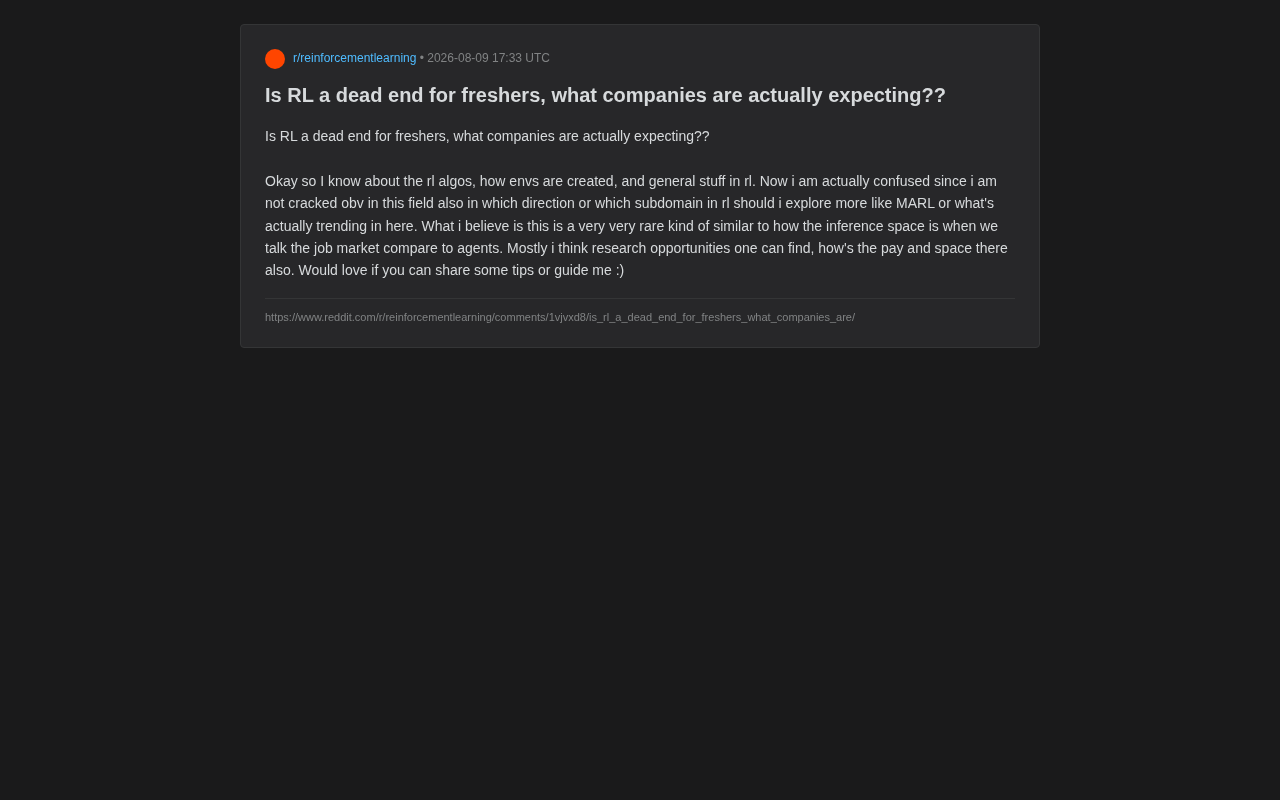
Recently on Reddit, a job seeker graduating with a focus on Reinforcement Learning (RL) posed a question that resonated widely: "Is RL a dead end for new graduates? What do companies actually expect?"
The poster's situation is quite representative: they've mastered fundamental RL algorithms, environment building, and general domain knowledge, but feel lost when it comes to job hunting—unsure which sub-direction to dive into, whether to choose Multi-Agent Reinforcement Learning (MARL) or chase currently hotter branches. They also made a sharp observation: the RL job market resembles the Inference field in that both are "small but specialized" rare tracks, and compared to today's booming Agents direction, opportunities seem more concentrated in research positions.
Behind this question lies a structural shift in the entire AI job market—one worth serious consideration for anyone looking to enter the RL field.
Current State of the RL Job Market: A High-Barrier, Narrow-Entry Track
First, let's correct a misconception: RL has never been a dead end, but it is indeed a high-barrier, narrow-entry track.
To understand this, we need to clarify reinforcement learning's unique position in the machine learning landscape. RL is one of the three major machine learning paradigms (alongside supervised learning and unsupervised learning), with its core philosophy rooted in the reward-punishment mechanism from behavioral psychology. In the RL framework, an Agent interacts with an Environment, selects Actions based on the current State, and receives Reward signals from the environment, with the goal of learning an optimal Policy to maximize long-term cumulative reward. The mathematical foundation of this paradigm is built on Markov Decision Processes (MDP), involving Bellman equations, policy gradient theorems, and other core theories. It's precisely this deep mathematical foundation that gives RL its inherently high learning and application threshold.
The "Polarization" of the Job Market
The poster's intuition is actually quite sharp. Current RL job demand exhibits a clear "barbell" structure:
- One end is elite research positions: Primarily concentrated in top labs like DeepMind, OpenAI, and Meta AI, plus a handful of autonomous driving and robotics companies. These positions often require a PhD or exceptional research output, with extremely small hiring volumes. Among these labs, DeepMind has the deepest RL expertise—from AlphaGo to AlphaFold, their core competitiveness is built on deep reinforcement learning; OpenAI pushed RL technology to the center of the large model era through RLHF; Meta AI (FAIR) has made significant contributions to open research, releasing multiple RL-related open-source frameworks. In autonomous driving, companies like Waymo and Tesla use RL for planning and decision-making; in robotics, Google DeepMind's RT series and companies like Figure AI are exploring RL applications in the real physical world—this is also considered RL's next major industrialization direction.
- The other end is engineering deployment positions: As RLHF (Reinforcement Learning from Human Feedback) has become standard in the large model era, engineers with RL expertise have found new roles in LLM post-training pipelines.
The middle ground—positions for "pure RL applications" in the traditional sense—is actually the scarcest. This is why new graduates feel "at a loss": the market doesn't need large numbers of generalists who can only run Gym environments and tune PPO parameters.
It's worth explaining the roles of PPO and Gym in the RL ecosystem. PPO (Proximal Policy Optimization) is a policy gradient algorithm proposed by OpenAI in 2017 that ensures training stability by limiting the magnitude of policy updates (using a clipped objective function). Due to its simple implementation and robust performance, it has become one of the most widely used algorithms in RL. Gym (now renamed Gymnasium) is a standardized RL environment interface library developed by OpenAI, providing a series of benchmark environments ranging from the simple CartPole to complex Atari games—it's the standard tool for RL researchers to get started and validate algorithms. However, there's an enormous gap between getting an algorithm to work in standard Gym environments and deploying an RL system in real industrial scenarios—this is precisely why companies don't buy into "basic skills alone."
The Key Difference Between RL and the Agents Track
The poster's comparison of RL with Agents is quite interesting. In fact, the two are rapidly converging. Today's hottest agent research increasingly incorporates RL thinking to optimize decision-making pipelines. In other words, "classical RL" in its pure form indeed offers limited opportunities, but RL as a core methodology is permeating into much broader domains.
Agents in the current hype cycle typically refer to autonomous decision-making systems based on large language models that can invoke tools, decompose tasks, and interact with environments. From a technical essence perspective, this is highly consistent with the RL paradigm where agents interact with environments and learn through trial and error. The difference is: traditional RL agents learn through numerical reward signals, while LLM Agents rely more on prompt engineering and in-context learning. But as research deepens, more and more work is using RL to train Agents' decision-making capabilities—for example, teaching models when to invoke tools and how to plan multi-step reasoning—the boundaries between the two tracks are blurring.
What Do Companies Actually Look For When Hiring RL Talent?
For new graduates looking to break in, rather than agonizing over "which sub-direction to choose," it's better to first understand companies' real needs.
Capability Matters More Than Direction
When hiring RL-related talent, companies typically value the following:
- Solid mathematical and optimization foundations: RL is fundamentally a decision-making and optimization problem. Deep understanding of probability theory, dynamic programming, and control theory is often what differentiates candidates. Specifically, understanding how function approximation errors propagate in value function approximation, how to mitigate variance in policy gradients, and the theoretical trade-offs in Exploration vs Exploitation—these mathematical intuitions are indispensable foundational capabilities for solving real problems.
- Engineering implementation ability: Can you reproduce papers? Can you get algorithms to converge stably in real (not toy) environments? This matters far more than memorizing algorithm terminology. RL is notoriously "hard to tune, hard to reproduce," and people who've weathered these challenges are extremely valuable. The instability of RL training is a widely acknowledged industry pain point—sparse reward signals, delayed environment feedback, hyperparameter sensitivity, and low sample efficiency mean that getting from paper to engineering deployment often requires extensive debugging experience and engineering tricks.
- Adaptability to the large model ecosystem: Understanding RLHF, DPO, and PPO applications on LLMs is practically a "door opener" for entering top companies today.
Regarding RLHF and DPO, a more detailed technical background is warranted. RLHF (Reinforcement Learning from Human Feedback) is a technical approach that uses human preferences as reward signals to fine-tune large language models. It was first systematically described in the InstructGPT paper and later became the key technology behind products like ChatGPT. The process has three steps: first, train a base model with supervised fine-tuning (SFT); then train a Reward Model to simulate human preference judgments; finally, use RL algorithms like PPO to optimize the language model so its outputs better align with human expectations. DPO (Direct Preference Optimization) is a simplified approach proposed by a Stanford team in 2023, with the core insight that reward modeling and RL optimization can be merged into a single step—directly optimizing the policy from preference data, skipping the explicit reward model training step, significantly reducing engineering complexity and computational overhead. Understanding the principles, trade-offs, and applicable scenarios of both technical approaches is an essential skill for today's RL engineers.
The Salary Reality: Research vs Engineering Positions
The poster cares about compensation, and here's a rough assessment: RL-related positions generally offer higher salaries, but the bar is correspondingly higher. In top labs, RL research scientists sit at the peak of the compensation pyramid; in industry, algorithm engineers with RLHF expertise can command competitive offers due to their scarcity. However, one must soberly recognize that high compensation presupposes you can get through that "narrow gate."
Practical Job-Hunting Advice for RL Graduates
Combining insights from the post's discussion with industry realities, here are several actionable recommendations.
1. Don't Study RL in Isolation
Treat RL as a tool, not an end in itself. Bind it to an application domain that interests you—robotics, recommendation systems, large model alignment, game AI. Pure RL skills are hard to monetize, but the combination of "RL + domain knowledge" is extremely competitive.
Take robotics as an example: the most cutting-edge research direction is Sim-to-Real (simulation-to-reality transfer), where policies are trained with RL in simulated environments and then deployed on real robots. This requires researchers to understand not only RL algorithms but also physics simulation, Domain Randomization, robot kinematics, and other cross-disciplinary knowledge. Similarly, applying RL in recommendation systems requires understanding user behavior modeling and long-term value optimization; in game AI, it involves handling enormous state spaces and opponent modeling.
2. Prioritize RLHF and LLM Post-Training Directions
This is currently the largest growth area for RL employment. Compared to more academic directions like MARL, the LLM alignment field has clear industrial demand and sufficient positions. For new graduates looking to find employment quickly, this is the highest-ROI entry point.
Multi-Agent Reinforcement Learning (MARL) studies the problem of multiple agents simultaneously learning and interacting in a shared environment, involving cooperation, competition, and mixed-game scenarios. Core challenges facing MARL include: environmental non-stationarity (other agents' changing strategies cause learning target drift), credit assignment problems (how to attribute team rewards to individual contributions), and communication and coordination mechanism design. DeepMind's AlphaStar and OpenAI Five are landmark MARL achievements. While MARL is academically fascinating with long-term application potential (multi-robot collaboration, traffic signal control, decentralized finance, etc.), its industrial deployment is still in early stages, with related positions mainly concentrated in research institutions—making it a narrow employment path for new graduates.
3. Let Your Work and Projects Speak
In this field, a working open-source project, a blog post reproducing a paper, or hands-on experience from Kaggle or competitions far outweighs a list of algorithm buzzwords on a resume. RL's tuning and engineering experience can't be fast-tracked, which is precisely the opportunity for new graduates to build differentiated advantages.
Specifically, high-quality RL project demonstrations can include: training robots to complete complex tasks on physics simulation platforms like MuJoCo or Isaac Gym, reproducing RLHF pipelines using the TRL (Transformer Reinforcement Learning) library and comparing different reward models, participating in RL-related competitions at NeurIPS or ICML (such as MineRL, Procgen), or designing and validating RL solutions in real business scenarios. These projects demonstrate not only technical ability but also engineering judgment in solving open-ended problems.
4. If You Aim for Research, Connect with Labs Early
If you're determined to pursue the research path (such as MARL), you should actively reach out to advisors, participate in projects, and strive for paper publications during your undergraduate or master's studies. Competition for research positions is fundamentally a competition of academic accumulation—the earlier you start, the better.
It's worth noting that the frontier hotspots in RL research are shifting rapidly. Beyond traditional sample efficiency and stability issues, current academic focus includes: Offline RL (learning policies from fixed datasets without interacting with the environment), World Model-based RL (improving sample efficiency by learning environment dynamics models), and deep integration of RL with foundation models (such as using large models as policy networks or reward functions). For students aspiring to academic research, choosing a sub-direction with both theoretical depth and application potential, then consistently producing high-quality papers in that area, is the most reliable path to entering top labs.
Conclusion: Scarcity Doesn't Mean Dead End—RL Is Both a Narrow Gate and an Opportunity
Returning to the original question—is RL a dead end for new graduates? The answer is: It's a narrow path, but by no means a dead end.
RL's scarcity is both a challenge and an opportunity. It means the market doesn't need people who've "studied broadly but shallowly," but it's hungry for those who can truly solve problems. For the Reddit poster and all new graduates facing similar confusion, the best strategy may not be to keep deliberating "which sub-direction to choose," but rather to find a specific scenario where RL can be deployed to generate value as quickly as possible, and produce demonstrable results within it.
In today's rapidly evolving AI landscape, direction certainly matters, but what matters more than direction is continuously building hard-to-replace hardcore capabilities. As the bridge connecting perception and decision-making, RL's core value won't disappear with shifting trends—from game AI in the AlphaGo era, to human alignment in the large model era, to autonomous decision-making in the future embodied intelligence era, RL remains the most fundamental framework for solving sequential decision-making problems. The real question has never been "does RL have a future," but rather "can you become the irreplaceable person in this field."
Related articles

Getting Started in Machine Learning Research: Essential Paper Reading List and Research Internship Application Path
A complete path from zero to research internship for ML beginners, covering essential classic papers (AlexNet, ResNet, Transformer), paper reading methods, reproduction tips, and practical advice for research internship applications.

Claude Code Hands-On Tutorial: Complete Guide from Installation to Automated Development
Complete guide to Claude Code covering environment setup, permission configuration, Go Goals autonomous loops, Skills system, MCP protocol integration, and version control for automated development.

Gemini 3.7 Flash Release and GPT-5.6 Ultra-Fast Mode: AI Open Source Enters the Ecosystem Era
Google releases Gemini 3.7 Flash for coding and Agent optimization while OpenAI launches GPT-5.6 Ultra-Fast mode with 14x speed gains. AI open source shifts from open models to open ecosystems.