Career Pivot at 47: Midlife Job Anxiety and Redefining Competence in the Age of AI

A 47-year-old data science career changer confronts AI-era ability anxiety, age bias, and the gap between interview culture and real-world work.
A Reddit post by a 47-year-old data scientist reveals a dilemma many tech workers face: real industrial experience but gaps in end-to-end deployment, fluency with AI coding tools but fear of syntax-focused interviews, and the age barrier that traps midlife career changers between junior and senior roles. The article unpacks these tensions and offers practical, actionable advice.
A Real-World Career Anxiety Case Study
On Reddit's data science community, a 47-year-old professional posted something that sparked widespread reflection. The title was deceptively simple: "I'm not ready." There was no flashy technical discussion — just an honest account that cut straight to a fear many tech workers share: ability anxiety, age pressure, and the question of what it truly means to be "qualified" in an era of rapidly evolving AI.
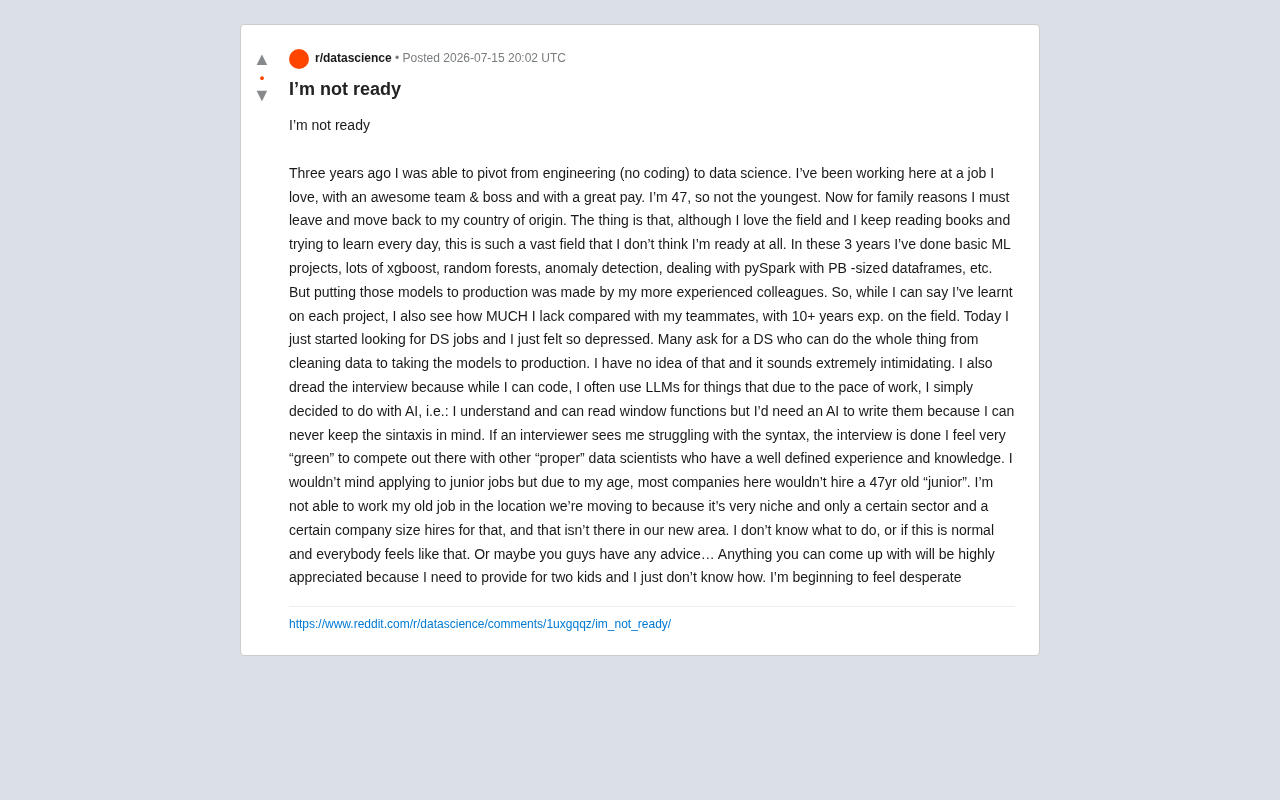
Three years ago, this person successfully transitioned from an engineering background (with no prior coding experience) into data science, landing a job he loved — a great team, a supportive manager, and solid pay. Then a family situation forced him to resign and relocate back to his home country. When he opened job boards again, a wave of "deep discouragement" hit him.
Three Years In — Why Still Feel "Green"?
By his own account, those three years weren't wasted. He'd worked on foundational machine learning projects, made heavy use of XGBoost, random forests, and anomaly detection, and processed PB-scale data using PySpark DataFrames.
The Industrial Value of XGBoost and Random Forests
XGBoost (Extreme Gradient Boosting) and random forests are among the most widely used supervised learning algorithms in industry today. XGBoost was introduced by Tianqi Chen in 2014 and quickly became a staple in data science after dominating Kaggle competitions. Its strengths lie in the regularization mechanisms within its gradient boosting framework, its ability to handle missing values, and its parallel computation efficiency. Random forests, a classic ensemble learning method, reduce variance through bagging and improve generalization — and remain a production-environment favorite in fields like financial risk management, medical diagnosis, and industrial anomaly detection. Reliably running these models at PB scale requires mastery of feature engineering, hyperparameter tuning, class imbalance handling, and other engineering details that no classroom project can replicate.
PySpark and Large-Scale Data Processing
PySpark is the Python API for Apache Spark, designed for distributed large-scale data processing. Spark originated in 2009 at UC Berkeley's AMPLab to address performance bottlenecks in iterative computation with Hadoop MapReduce. PySpark's DataFrame API lets data scientists manipulate distributed datasets using SQL-like syntax and integrates seamlessly with the MLlib machine learning library. Working with PB (Petabyte) -scale DataFrames requires understanding data partitioning, shuffle mechanics, lazy evaluation, and cluster resource scheduling — this isn't just a coding skill, it reflects a deep understanding of distributed computing paradigms. Most small and mid-sized companies never reach this data scale, making such experience a genuinely rare competitive advantage.
On paper, this résumé is quite solid for many job requirements.
But he was stuck at the "last mile" — getting models into production was always handled by more senior colleagues. Today's mainstream roles increasingly demand data scientists who can handle the full pipeline end-to-end, from data cleaning to model deployment. For someone who focused primarily on the modeling phase, this gap felt crushing.
A New Kind of Anxiety in the Age of AI
What makes this post most thought-provoking is the distinctly AI-era flavor of the anxiety it reveals.
The author admitted: he can understand window functions, but in the fast pace of his job, he routinely used LLMs to write code — "because I can never remember the syntax." His fear: if an interviewer catches him stumbling on syntax, "the interview is over."
Does "Using AI" Count as "Knowing How to Code"?
Window Functions and the Whiteboard Interview Culture
Window functions are an advanced SQL feature that allows grouped calculations without collapsing rows — common uses include ranking (RANK/DENSE_RANK), rolling aggregates (SUM OVER), and row offset access (LAG/LEAD). They're nearly ubiquitous in data science interviews as a test of logical and data manipulation skills. However, the whiteboard interview culture itself has long been controversial. This practice — requiring candidates to write code by hand without any tools — traces back to Silicon Valley's technical screening traditions. Critics argue it's more of a memory and stress-tolerance test than a true measure of job performance. Google, Meta, and others have conducted internal studies suggesting that algorithmic interview scores correlate only weakly with actual on-the-job performance, fueling growing skepticism about the format.
This dilemma is highly representative of a broader shift. With tools like Copilot and ChatGPT now widespread, more and more practitioners have entered a mode of "understand but don't memorize" — they grasp the logic and principles, but outsource specific syntax recall to AI.
The State of AI-Assisted Coding Tools
AI coding assistants — led by GitHub Copilot (launched 2021) and ChatGPT's Code Interpreter — have evolved in just a few years from "controversial novelties" to standard fixtures in mainstream development workflows. A 2023 GitHub report found that developers using Copilot completed specific tasks 55% faster on average, accelerating widespread enterprise adoption. In this context, "understanding the logic while relying on AI for specific syntax" is no longer a sign of incompetence — it's a workflow optimization. The real differentiator is whether you can evaluate the correctness of AI-generated code, spot edge case errors, and course-correct when AI produces wrong answers. This "AI output quality control" skill actually requires solid foundational understanding and is harder to acquire than memorizing syntax. Stack Overflow's 2023 developer survey found over 70% of respondents already using or planning to use AI coding tools at work, and industry norms are rapidly reshaping.
This surfaces a question the industry is actively redefining:
- Traditional interviews still test whiteboard coding and syntax recall;
- Real-world work environments have almost universally embraced AI assistance.
This mismatch between "interview standards" and "job reality" is generating anxiety in people like this author — professionals who can deliver results at work but falter during the performative ritual of the interview. Does reciting window function syntax actually measure a data scientist's value? That's a question the entire industry should reflect on.
Age: An Invisible Barrier
Beyond technical anxiety, age is another heavy reality.
The author is 47, with two children to support. He said he doesn't mind applying for junior roles — but the problem is that in the region he's moving to, very few companies will hire a 47-year-old as a "junior" data scientist. On the other side, his original field has almost no openings in the new region, because it's an extremely niche industry that only specific companies at specific scales would ever hire for.
This "too senior for junior, too junior for senior" predicament is a shared struggle among many midlife career changers:
- Apply for senior roles: gaps in full-pipeline capability mean competing against veterans with 10+ years of experience;
- Apply for junior roles: age and salary expectations become barriers;
- Return to the old field: geographic constraints have completely closed that door.
Is This Really "Lack of Ability"?
As outside observers, we can see some things the author may be overlooking.
He's Underestimating His Own Hands-On Experience
Processing PB-scale PySpark data, building anomaly detection systems, solid modeling experience — these are precisely the industrial-scale, real-world skills that many "formally trained" data scientists lack. Being able to actually run models through real business problems and deliver value is rarer than being able to recite window function syntax.
End-to-End Deployment Is a Skill Gap You Can Close
Getting models into production (MLOps) may look daunting, but it's fundamentally a matter of engineering workflows and toolchains — not the kind of "intuitive" capability that requires years of slow accumulation.
MLOps and the Full Picture of Model Productionization
MLOps (Machine Learning Operations) applies DevOps principles to ML workflows, with the core goal of achieving reliable, reproducible deployment from research to production. A typical MLOps pipeline covers: data versioning (DVC), experiment tracking (MLflow, Weights & Biases), model packaging (Docker containerization), serving interfaces (FastAPI, TorchServe), CI/CD automated testing and deployment (GitHub Actions, Jenkins), and online monitoring with drift detection (Evidently, Prometheus). MLOps emerged because companies discovered that many ML models "died in the lab" — the gap between research and production environments prevented stable deployment or led to rapid model degradation. For data scientists with an engineering background, concepts like containerization, API design, and automated testing in MLOps are often more intuitive than for peers with purely statistical backgrounds, making it a strong area for differentiated competitive positioning.
Docker, CI/CD, model serving (e.g., FastAPI + model endpoints), and cloud deployment all have clear learning paths. For someone with an engineering background, this could actually be a competitive advantage.
Anxiety Itself Is Universal
Data science is a field with virtually no defined boundaries — statistics, programming, machine learning, big data, cloud engineering, business understanding… No one masters all of it. Even seasoned practitioners have their own knowledge blind spots. Feeling "green" is practically the default experience in this field, especially when technology is evolving this fast.
Practical Advice for Anyone Facing the Same Anxiety
Drawing from this case, here are some actionable ideas for tech professionals in similar situations:
1. Reframe your positioning. Don't call yourself "junior." Position yourself as "a data scientist with hands-on, industrial-scale big data experience," and highlight the real data volumes and business impact you've worked with.
2. Close the deployment gap with one small project. Do the full pipeline yourself — data cleaning → modeling → packaging → deploying to production. It's both a learning exercise and the most compelling evidence you can bring to an interview.
3. Be upfront about AI-assisted coding. More and more companies already accept — or actively encourage — the use of AI tools. Rather than hiding it in interviews, demonstrate how you use AI to solve problems efficiently and how you validate its outputs. That is itself a core competency in the new era.
4. Explore remote and contract opportunities. Geographic constraints can be partially bypassed through remote work. Secure cash flow first, then plan for the longer term.
Conclusion
"I'm not ready" resonated so widely because it captured a quiet pain that many tech workers share in this era: in a world exploding with information and skills, we perpetually feel unprepared.
But the truth is often this — no one is fully ready before they start. This 47-year-old career changer has an engineering background, three years of solid modeling experience, and a habit of continuous learning. What he's missing isn't ability — it's a clear action plan before anxiety consumes him. For every professional feeling unsettled by the AI wave, the answer may not be "get ready, then go" — but rather "get ready on the way."
Key Takeaways
Related articles

Felix Rieseberg Personal Homepage
Felix Rieseberg's personal homepage sparks attention on Hacker News. This article covers the Slack engineer's technical background, the rise and fall of nativefier, and the value of a developer homepage as a tech calling card.

@ai-sdk/vue 3.0.306 Patch Release Syncs with [email protected] Update
@ai-sdk/vue 3.0.306 released, synced with [email protected]. A routine patch release for the Vercel AI SDK ecosystem with no public API changes; the Vue adapter layer stays version-aligned with the core package.

Gemini 4 Argon API Launches: The Era of Million-Token Output Begins
Google launches Gemini 4 Argon with sparse MoE architecture, up to 1M output tokens, and a 68.90% Vals Index score, available across API, AI Studio, and the Gemini app.