Career Prospects for LLM Development Engineers: Job Categories, Education Requirements, and Learning Paths

Complete guide to LLM engineer job categories, education requirements, and learning paths
LLM development engineers fall into three directions: Application Engineer, R&D Engineer, and Algorithm Engineer. Unlike traditional AI algorithm engineers, LLM algorithm engineers only need to master 7-8 core algorithms (centered on Transformer), a bachelor's degree is sufficient, and salaries can reach 20-25K × 13-16 months. The learning path has three tiers: application tools (Dify, Coze, etc.), application development (Spring AI, LangGraph, RAG), and deep algorithm work.
Introduction
With the explosive growth of large model products like ChatGPT and ERNIE Bot, "LLM Development Engineer" has become one of the most sought-after technical positions in 2024-2025. However, many developers remain confused about the specific job categories, education thresholds, and learning paths for this role.
Based on insights shared by an instructor with years of AI teaching experience, this article systematically outlines the current employment landscape for LLM development engineers, job requirements, and a complete learning roadmap from entry-level to high-paying positions.
Three Major Career Directions for LLM Development Engineers
LLM development engineer is not a single role — it's divided into three distinct directions, each with notably different skill requirements and salary levels:
- LLM Application Engineer: Focuses on building applications using existing large model capabilities; lowest barrier to entry
- LLM R&D/Development Engineer: Responsible for engineering and productionizing large model systems; requires solid programming fundamentals
- LLM Algorithm Engineer: Involves model fine-tuning, training, and other algorithm-level work; highest salary ceiling
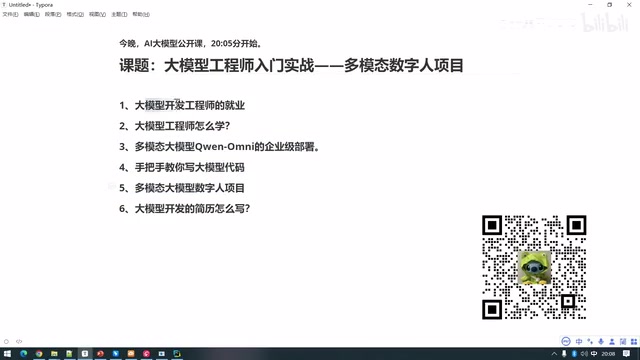
Many people shy away when they see "Algorithm Engineer," assuming a master's or even a doctoral degree is required. But the reality is quite different — LLM algorithm engineers are fundamentally different from traditional AI algorithm engineers.
Key Differences Between LLM Algorithm Engineers and Traditional AI Algorithm Engineers
Dramatically Fewer Algorithms to Master
Traditional AI algorithm engineers need to master 50-60 algorithm models, not only implementing them in code but also understanding the complete mathematical derivations. LLM algorithm engineers, on the other hand, only need to master 7-8 core algorithms:
- Linear Regression
- Logistic Regression
- Decision Trees (including variants like CatBoost)
- Neural Networks
- Deep Neural Networks (DNN)
- Recurrent Neural Networks (RNN)
- Convolutional Neural Networks (CNN)
- Transformer

Among these, Transformer is the core cornerstone of the entire large model technology stack. It was proposed by Google in the 2017 paper "Attention Is All You Need," and its revolutionary innovation lies in the "Self-Attention" mechanism — capable of processing dependencies across all positions in a sequence in parallel, completely overcoming the vanishing gradient problem that plagued RNN/LSTM on long sequences. Nearly all modern large language models, including GPT, BERT, and LLaMA, are built on the Transformer architecture. For this reason, understanding how Transformer works is the key knowledge point that distinguishes LLM algorithm engineers from traditional AI engineers.
Why Only These Few Algorithms?
The reason is straightforward: only these algorithms are directly relevant to large model technology. Common algorithms from traditional AI fields — such as clustering algorithms and YOLO object detection models — are simply not used in LLM development. The number of required algorithms drops from 50+ to 7-8, nearly an order of magnitude reduction.
This also means that if you're already an AI algorithm engineer, transitioning to an LLM algorithm engineer is essentially a "playing on easy mode" scenario.
A Bachelor's Degree Is Sufficient
Searching on recruitment platforms like Boss Zhipin, whether in Wuhan, Guangzhou, or other emerging first-tier cities, a large number of LLM algorithm engineer positions only require a bachelor's degree, with listings spanning multiple pages. This stands in stark contrast to traditional AI algorithm engineer positions that routinely require master's or doctoral degrees.
Education and Experience Requirements for LLM Positions
What "Work Experience" Really Means
An important insight: it's virtually impossible to have more than two years of LLM development experience. LLM positions in China didn't truly take off until around 2024, so if a resume claims "three years of large model experience," it would actually raise red flags with HR.
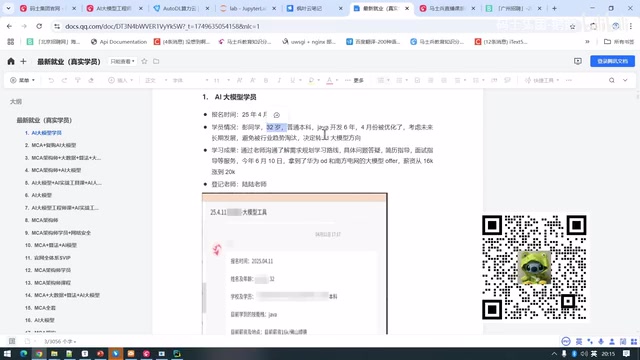
What "work experience requirements" actually refer to is prior development experience — Java, front-end, big data, and similar backgrounds all count. Fresh graduates can break in through internships.
Salary Benchmarks
Based on recent employment data, it's not uncommon for candidates with a standard bachelor's degree, around 26 years old, to receive offers like:
- 20K × 16 months (annual salary ~320,000 RMB / ~$44,000)
- 25K × 13 months (annual salary ~325,000 RMB / ~$45,000)
These are highly competitive salary levels for emerging first-tier cities.
Learning Path for LLM Engineers
Three-Tier Progressive Framework
The entire knowledge system for LLM engineers can be divided into three tiers, progressing from basic to advanced:

Tier 1: LLM Application Tools (Entry Level, 15-20 days to learn)
Includes tools like Dify, Coze, N8N, RAGFlow, and Milvus. Each platform has its own focus: Dify is an open-source LLM application development platform that supports visual Prompt orchestration and private deployment, widely used in enterprise scenarios; Coze is ByteDance's AI Bot development platform with a rich built-in plugin ecosystem; N8N is an open-source workflow automation tool that seamlessly integrates large model capabilities with hundreds of third-party services. This tier requires minimal coding — you mainly work through visual interfaces, drag-and-drop operations, and simple configurations to leverage large model capabilities, making it ideal for beginners to get started quickly.
Tier 2: LLM Application Development (Intermediate Difficulty, Core Competitive Advantage)
Key frameworks include:
- Spring AI: An LLM development framework in the Java ecosystem. Launched by the official Spring team in late 2023, this AI integration framework provides a unified API abstraction layer supporting quick switching between multiple model providers such as OpenAI, ERNIE Bot, and Tongyi Qianwen. It also includes built-in vector database integration and RAG pipeline capabilities for enterprise use. For engineers with a Java development background, Spring AI offers the lowest-cost path into LLM application development.
- LangGraph: The current mainstream framework for AI agent and workflow development (note: it's LangGraph, not LangChain, that represents the trend). LangChain was the most popular early LLM application framework, but its linear chain structure revealed insufficient flexibility when handling complex multi-step workflows. LangGraph is the upgraded product from the LangChain team, using a Directed Acyclic Graph (DAG) structure to describe complex multi-agent collaboration and conditional branching flows. It's better suited for building modern AI Agent systems with loop reasoning and state management capabilities, making it the industry's mainstream choice.
- RAG Development: Retrieval-Augmented Generation is the key technique for addressing the "hallucination" problem in large models.
Related articles
 Tutorials
ChatGPT Plus Subscription Guide: Are GPT-5.5, image-2, and Codex Worth the Upgrade?
A detailed look at ChatGPT Plus features — GPT-5.5, image-2, and Codex — with a Plus vs Pro comparison and a complete step-by-step subscription guide for users outside the US.
 Tutorials
Harness AI Engineering in Practice: Using Claude Code to Master Enterprise-Level E-Commerce Development
Deep dive into Harness AI Engineering: master enterprise e-commerce development with Claude Code using the Rules, Skills, Wiki, and Changes framework.
 Tutorials
Cursor + Codex Dual-IDE Collaboration: A Practical Methodology for Open-Source Project Customization
A complete methodology for open-source project customization based on real-world experience, detailing the Cursor+Codex dual-IDE workflow, seven-stage process, MVP validation, and AI source code reading techniques.