Career Switch to LLM Development: A Four-Level Skill Progression Roadmap

A four-level roadmap for career switchers entering LLM development, from basics to RAG, fine-tuning, and Agents.
Breaking into LLM development requires more than knowing buzzwords. This article outlines a four-level progression: foundational model knowledge, API integration, prompt engineering, and the advanced paths — RAG, fine-tuning, Agent development, and multimodal — where real hiring demand and high salaries exist. Most career switchers stall at level two; this roadmap helps you go further.
Why So Many People Study AI But So Few Actually Get Paid for It
The AI wave is sweeping across industries, and more people than ever want to break into large language model (LLM) development. But the reality is that many people dabble here and there without ever making real progress. The root cause: companies don't want people who know a few buzzwords — they want people who can turn models into systems.
In other words, what enterprises look for in LLM developers is the engineering ability to translate model capabilities into real business systems. If you're still at the "I know LLMs exist" stage, you'll struggle to land a good offer in today's competitive AI job market.
Let's break the LLM development learning path into four levels so you can see exactly where you need to be.
Level 1: Foundational Knowledge — Understand the Basics or Get Left Behind
This is the foundation. At a minimum, you need to understand how large models work and what major models like GPT, DeepSeek, and Qwen are each good at.
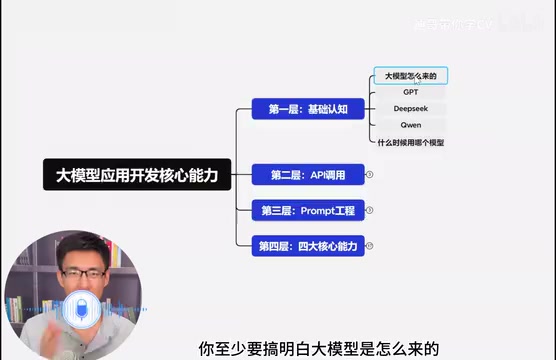
LLM fundamentals and architectural differences: Large Language Models (LLMs) are built on the Transformer architecture and acquire language understanding and generation capabilities through pre-training on massive text corpora. The Transformer was introduced by Google in the 2017 paper Attention Is All You Need. Its core mechanism — Self-Attention — allows the model to dynamically attend to all other tokens in context when processing each word, fundamentally solving the long-range dependency bottleneck of RNNs/LSTMs. Unlike recurrent networks that pass information step by step (causing distant relationships to weaken), self-attention enables direct interaction between any two positions in a single step.
GPT (OpenAI) uses autoregressive decoding — predicting the next token one at a time — excelling at creative writing and code generation. DeepSeek stands out for inference efficiency through its Mixture of Experts (MoE) architecture, which distributes parameters across multiple "expert" sub-networks and activates only a subset per inference pass, decoupling parameter count from actual compute. It also benefits from deep optimization on Chinese corpora. Qwen (Alibaba) excels at Chinese long-text comprehension and multi-turn instruction following, thanks to its Chinese pre-training data mix and RLHF alignment strategy.
The key here isn't memorizing concepts — it's knowing which model to use for which scenario. Code generation, Chinese long-text understanding, and multi-turn dialogue all have meaningfully different results across models. Model selection is itself a professional skill. This level may seem simple, but it underpins everything that follows — you can't make sound technical decisions without understanding model characteristics.
Level 2: API Integration — The Line Between Knowing and Doing
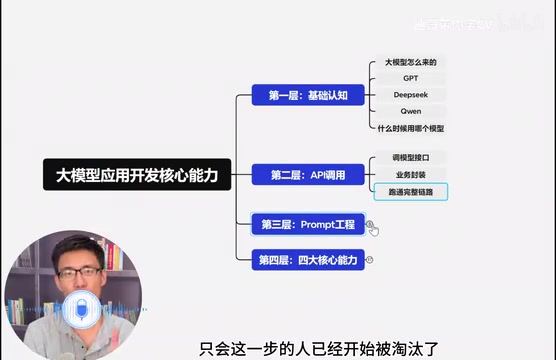
At this level, you can call model APIs, do basic business wrapping, and run a complete end-to-end pipeline.
You need to be able to: call a model API, process returned results, build basic business abstractions, and take a requirement all the way through.
But here's an important warning: people who only know how to call APIs are already becoming obsolete. As tooling matures, simple API calls become increasingly commoditized, and pure "wrapper developers" can't build a competitive edge. This level is necessary — but it's nowhere near sufficient.
Level 3: Prompt Engineering — Whether You Actually Know How to Use Models
This is where a lot of people get stuck. Prompt engineering covers core techniques like Zero-shot, Few-shot, and Chain of Thought (CoT).
The technical nature of prompt engineering: Prompt Engineering is a methodology for systematically guiding LLM outputs by designing input text — essentially maximizing a model's latent capabilities through context, without modifying its weights. Zero-shot means issuing instructions directly without any examples, relying on the model's generalization from pre-training. Few-shot includes a small number of demonstration examples in the prompt to help the model understand the task format and output style; typically 3–8 examples can significantly boost accuracy by leveraging the model's In-Context Learning capability — adapting to new tasks without any gradient updates.
Chain of Thought (CoT), formally introduced by Google researchers in 2022, guides models to reason step by step ("Let's think step by step") rather than jumping to answers. On complex tasks like math reasoning and logical inference, it can improve accuracy by 10–30 percentage points. Its effectiveness comes from making intermediate reasoning explicit, essentially allocating more "compute budget" for the model to work through difficult problems. Structured output constraints (e.g., enforcing JSON format), role-setting via System Prompts, and Temperature control are all key engineering tools for reducing hallucinations and improving stability. Lower Temperature pushes the model toward higher-probability tokens (more deterministic); higher Temperature leads to more random sampling (more varied output). In production, Temperature is typically set between 0.0–0.3 for stability. Self-Consistency — sampling multiple times and taking a majority vote — further improves reasoning robustness and is an important enhancement to CoT.
The real goal isn't memorizing these terms — it's solving three practical problems:
- How to get stable outputs — preventing the same input from producing wildly different results;
- How to reduce hallucinations — lowering the probability of fabricated content;
- How to get controllable outputs — generating content in the expected format and logic.
Mastering prompt engineering is what separates people who genuinely know how to use LLMs from those who are frustrated by their unpredictability. This level determines whether you're someone who can truly wield model capabilities.
Level 4: Four Core Paths That Set You Apart
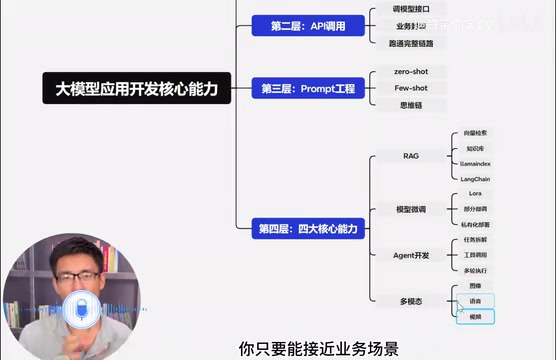
This is where companies actually compete for talent, and where high-salary offers come from. There are four main directions in advanced LLM development.
1. RAG — Retrieval-Augmented Generation
The full RAG stack (vector retrieval + knowledge base + LlamaIndex + LangChain) solves the problem of models lacking proprietary knowledge.
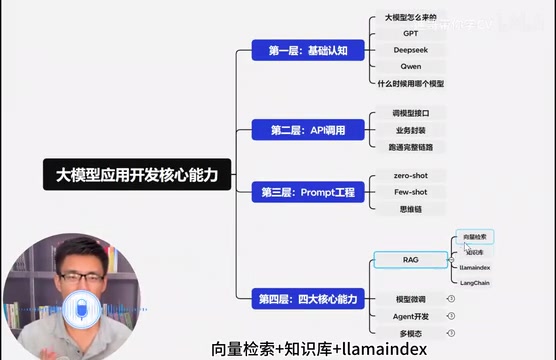
How RAG works and how to build it: RAG (Retrieval-Augmented Generation) was formally proposed in a 2020 paper by Meta AI. The core idea is to decouple information retrieval from text generation — first retrieve relevant passages from an external knowledge base, then inject them into the model's context to generate an answer, overcoming the LLM's limitation of relying only on knowledge fixed at training time.
In practice: documents are first chunked (the chunking strategy — fixed-length, semantic, or paragraph-based — directly affects retrieval quality); chunks are then converted to high-dimensional semantic vectors using an Embedding model (e.g., BGE series, text-embedding-ada-002) and stored in a vector database (e.g., Faiss, Milvus, Chroma, Weaviate); at query time, the most relevant chunks are retrieved using cosine similarity or Approximate Nearest Neighbor (ANN) algorithms, concatenated into the prompt, and sent to the LLM for a final answer.
RAG's core value is solving two major LLM pain points simultaneously: training data cutoff dates (knowledge freshness) and missing proprietary knowledge — at far lower cost and with much more flexibility than full fine-tuning. Adding new documents simply requires re-indexing, no retraining needed. Advanced techniques include hybrid retrieval (dense vectors + BM25 sparse retrieval, combining semantic similarity with keyword precision), Reranking (a second-pass relevance sort on retrieved results), and HyDE (Hypothetical Document Embeddings — generating a hypothetical answer first, then using its vector to retrieve). LlamaIndex focuses on data indexing and query pipeline abstractions; LangChain provides a more complete chain-based calling framework. GraphRAG represents a frontier direction that incorporates knowledge graphs to capture entity relationships and improve complex multi-hop reasoning.
RAG is one of the most widely deployed LLM technology paths in enterprise, and demand is strong.
2. Model Fine-Tuning
If you've worked with LoRA, partial parameter fine-tuning, or private deployment, that's a significant resume differentiator.
Fine-tuning techniques: from full parameter to parameter-efficient methods: Full fine-tuning updates all model weights during backpropagation, offering the highest performance ceiling but at enormous cost — training a 7B parameter model typically requires at least four A100 (80G) GPUs, which is out of reach for most teams. LoRA (Low-Rank Adaptation), proposed by Microsoft Research in 2021, is based on the intuition that weight update matrices have low intrinsic rank — most useful information is concentrated along a small number of principal directions. LoRA adds two small low-rank matrices (A and B) alongside the original frozen weights and trains only those, reducing trainable parameters to as little as 0.1% of the original, making it feasible to fine-tune a 7B model on a single RTX 4090 (24G).
The advanced variant QLoRA further quantizes the base model to NF4 precision (4-bit Normal Float), cutting memory requirements by another 50%+, while preserving near-full-precision fine-tuning quality through double quantization and paged optimizers — making it possible to fine-tune 65B parameter models on consumer GPUs. For private deployment, vLLM uses PagedAttention (analogous to OS virtual memory paging) to dramatically improve KV-Cache memory efficiency, boosting inference throughput 10–20x over naive implementations. Ollama lowers deployment barriers through a unified local runtime, making it practical to run proprietary fine-tuned models efficiently in enterprise intranet environments.
Fine-tuning tailors models to specific business domains — purpose-tuned models typically outperform general-purpose LLMs on target tasks while also reducing inference costs.
3. Agent Development
The core of Agent development isn't the tools — it's three capabilities: task decomposition, tool calling, and multi-step execution.
Agent internals and multi-agent frameworks: AI Agents represent a paradigm shift from passive question-answering to active task execution. The theoretical basis traces back to the "Perception–Decision–Action" loop in cognitive psychology. Modern LLM Agent architecture draws primarily on the ReAct (Reasoning + Acting) framework, jointly published by Princeton and Google in 2022. The model alternates between reasoning (Thought) and action (Action) at each step, observing environmental feedback (Observation) in a closed-loop iteration until the task is complete. This approach is more error-tolerant than pure reasoning chains or pure action sequences, because environmental feedback allows the model to correct course in real time.
Task decomposition relies on Planning capabilities — breaking complex tasks into ordered sub-step sequences using strategies like Task Decomposition and sub-goal setting. Tool calling (Function Calling / Tool Use) is a core capability of modern LLMs, allowing them to trigger external APIs, database queries, code execution, or even browser operations via structured JSON output — essentially converting language output into executable program calls. Multi-step execution requires Memory management, including short-term session memory (bounded by context window length) and long-term vector memory (persisted to external vector databases).
For multi-agent collaboration: MetaGPT introduces software engineering role division (product manager, architect, programmer, etc.) to achieve team-based completion of full software projects. CrewAI provides declarative multi-agent role orchestration. LangGraph uses a State Graph model to support complex conditional branching and loop execution — representing the current frontier of production-ready agentic systems.
Candidates with Agent project experience rarely struggle to get interviews. Agents represent the leap from "answering questions" to "autonomously completing tasks" — one of the hottest and most market-valuable directions right now.
4. Multimodal Development
Image, audio, and video capabilities — when tied closely to real business use cases — can immediately separate you from other candidates.
Multimodal tech landscape and business applications: Multimodal LLMs break the text-only boundary of language models by processing heterogeneous signals — images, audio, video — within a unified architecture. The key technical challenge is aligning different modalities into a shared semantic space. The mainstream vision-language approach uses a "visual encoder + cross-modal alignment layer + language model" architecture. CLIP (OpenAI, 2021) aligns image and text embeddings through large-scale contrastive learning on image-text pairs, bringing the vector of an image and the vector of its caption close together — laying the groundwork for open-vocabulary visual understanding. ViT (Vision Transformer) treats images as sequences of fixed-size patches processed directly by a Transformer, unifying visual and language processing and removing CNN inductive biases.
Representative models include GPT-4V/4o (OpenAI, supporting mixed image-text input and real-time voice interaction), Claude 3 (Anthropic, strong at long document visual understanding), the open-source LLaVA series, and InternVL, which leads on Chinese-language multimodal tasks. On the audio side, OpenAI's Whisper provides high-accuracy speech recognition across 50+ languages; paired with neural TTS models like CosyVoice (Alibaba) or Fish-Speech, you can build a complete end-to-end voice interaction pipeline — from understanding speech to generating spoken responses.
Deep integration of multimodal capabilities with specific business scenarios — automated medical imaging reports, e-commerce product image review, industrial defect detection, intelligent document parsing and structured extraction — is what creates differentiated competitive value, and why enterprises are willing to pay a premium for it.
Multimodal extends the frontier of LLM capabilities and is becoming a new competitive battleground for enterprises.
90% of People Are Stuck in the First Two Levels — But Offers Come from the Last Two
Here's a hard truth: 90% of career switchers stay in the first two levels, while the people landing offers have already gone deep into the last two.
Foundational knowledge and API integration are just the entry ticket. Prompt engineering is the baseline. RAG, fine-tuning, Agent development, and multimodal are where real competitive advantage lives. To truly establish yourself in AI, you must keep pushing into those last two levels.
Closing: The Biggest Fear Isn't Difficulty — It's Not Knowing How Far to Go
The biggest obstacle to learning LLM development usually isn't the difficulty of the content — it's the lack of a clear sense of direction. Not knowing how far you need to go makes it easy to fall into scattered, aimless learning.
The value of this four-level framework is giving career switchers a clear map: start with foundational knowledge, cross the API integration threshold, sharpen your prompt engineering, and ultimately build core competitiveness across RAG, fine-tuning, Agent, and multimodal development. Find where you are right now, and climb level by level — that's how you genuinely break into LLM development.
Related articles

Network Doctor: An Open-Source Terminal Tool for Network Fault Diagnosis
Network Doctor is an open-source terminal network diagnostic tool that integrates ping, dig, curl, and traceroute, automatically detecting connectivity in stages and outputting fault conclusions in natural language.

LangChain Guardrails Explained: Building Safe and Controllable AI Agents
A detailed guide to LangChain Guardrails covering layered ecosystem architecture, middleware implementation, deterministic and model-driven protection for building production-grade secure AI Agents.

Deep Dive into Microsoft's AI Security Tools: Does Performance Really Surpass the Competition?
Microsoft launches enterprise AI security tools claiming superior performance. This deep analysis examines core capabilities, ecosystem advantages, and risks to guide enterprise security decisions.