CARTBench: Evaluating Shopping AI on Complex Requests with Rubrics

CARTBench evaluates shopping assistants with case-specific rubrics, revealing a gap where models understand well but execute poorly.
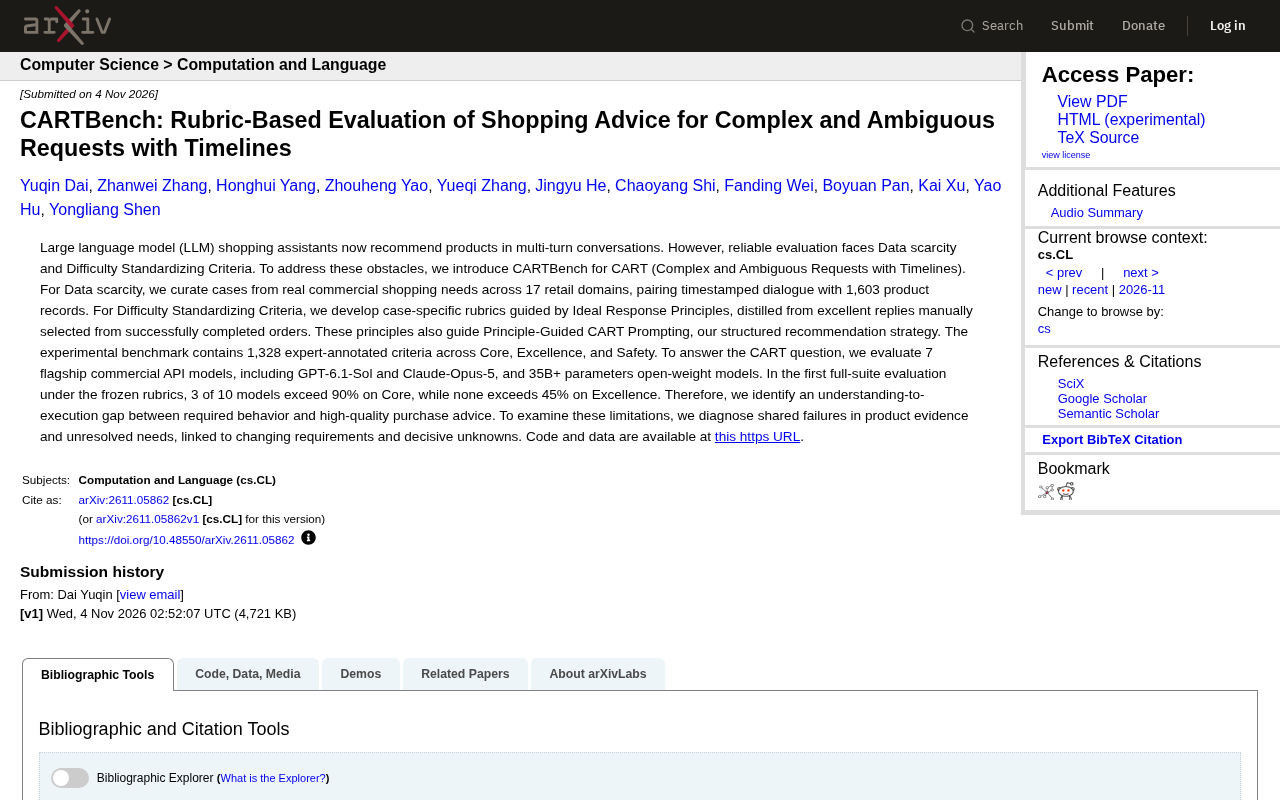
CARTBench is a new benchmark for LLM shopping assistants focused on complex, ambiguous shopping requests with timelines (CART scenarios). It curates cases from real commercial needs across 17 retail domains, pairs timestamped conversations with 1,603 product records, and uses case-specific rubrics guided by "Ideal Response Principles," yielding 1,328 expert-annotated criteria across Core, Excellence, and Safety dimensions. In a frozen-rubric full evaluation, 3 of 10 models exceeded 90% on Core, but none exceeded 45% on Excellence, exposing a clear "understanding-to-execution" gap. Failure modes mainly involve insufficient product evidence and unresolved needs, linked to dynamic requirement changes and key unknown information.
Large language model (LLM) shopping assistants can now recommend products across multi-turn conversations, but reliably evaluating the quality of their suggestions has remained a challenge. The recently proposed CARTBench benchmark attempts to systematically measure model performance on complex, ambiguous shopping requests with timelines using a rubric-based approach.
Why Are Shopping Assistants Hard to Evaluate?
The paper identifies two major obstacles to reliable evaluation: data scarcity and difficulty in standardizing criteria. Real shopping conversations often involve multi-turn interactions, ambiguous user needs, and time pressure (e.g., "I need it before my business trip next week"). Such data is rare in public corpora, and judging whether a suggestion is "good" is highly context-dependent, making it hard to score with a single set of generic metrics.
CARTBench targets precisely the CART scenario—Complex and Ambiguous Requests with Timelines.
Where the Data Comes From: Real Commercial Needs + Timestamped Conversations
To mitigate data scarcity, the research team curated cases from real commercial shopping needs across 17 retail domains, pairing timestamped conversations with 1,603 product records. This means evaluation looks not only at what the model says, but also at whether it provides appropriate product evidence at the right point in time.
How Rubrics Are Defined: Distilling Principles from Excellent Responses
To address the difficulty of standardizing criteria, CARTBench adopts case-specific rubrics. These rubrics are guided by "Ideal Response Principles," which are themselves distilled from manually selected excellent responses from successfully completed orders.
This set of principles also in turn guides a structured recommendation strategy—Principle-Guided CART Prompting. The final experimental benchmark contains 1,328 expert-annotated rubric criteria spanning three dimensions: Core, Excellence, and Safety.
Case-specific rubrics, unlike traditional generic metrics (such as BLEU, ROUGE, or a single human preference score), define a set of checkable scoring items individually for each specific conversation case. For example, a given case might require that "the response must recommend products deliverable before the user's stated deadline" and "must identify at least one constraint the user did not explicitly mention." The advantage of this approach is that scoring items map directly to the case's key constraints, and evaluators (human or model judges) only need to judge each item as "satisfied/not satisfied," thereby reducing subjectivity and improving reproducibility. The cost is higher annotation effort, and rubrics must be customized per case, making them hard to reuse directly across cases. CARTBench balances flexibility and consistency by using "Ideal Response Principles" to guide rubric writing top-down, then having experts annotate each case.
The Core / Excellence / Safety dimensions are the benchmark's structured layering of rubric criteria. The Core dimension checks whether the response meets the basic functional requirements of the user's request—for example, whether recommended products can be delivered within the timeline, and whether the explicitly stated category and budget are covered. The Excellence dimension measures high-quality performance beyond basic requirements—for example, proactively clarifying ambiguous needs, providing justified trade-off reasoning, and offering alternatives. The Safety dimension focuses on avoiding misleading or harmful suggestions—for example, not recommending products that violate user constraints, and not fabricating inventory or logistics information. This layering allows evaluation to distinguish "passing" from "excellent," and also explains why models perform reasonably on Core but generally score low on Excellence—the former is closer to pattern matching, while the latter requires sustained multi-step reasoning and information integration.
Evaluation Results: Understanding Is There, Execution Falls Short
In the first full evaluation with frozen rubrics, the research team tested 7 flagship commercial API models (including GPT-6.1-Sol and Claude-Opus-5) and open-weight models with 35B+ parameters. The results show a clear gap:
- 3 of the 10 models exceeded 90% on the Core dimension;
- But no model exceeded 45% on the Excellence dimension.
This reveals an "understanding-to-execution" gap: models know what to do, but struggle to consistently deliver high-quality purchase advice.
Frozen rubrics mean that when evaluating multiple models, the same pre-determined, unadjusted set of rubric criteria is used, so all models face exactly the same scoring items. This is a key design for ensuring cross-model comparability: if rubrics were modified based on model performance or evaluation rounds, scores across models would no longer be comparable. The frozen approach also aids reproducibility—later researchers can test new models on the same criteria and align results with the numbers reported in the paper. The opposite would be "dynamic scoring" or "model-assisted scoring," which is more flexible but prone to scoring drift and judge bias. By choosing frozen rubrics, CARTBench prioritizes evaluation stability and auditability over personalized adaptation to each model's output.
Failure Modes: Product Evidence and Unresolved Needs
To diagnose these limitations, the researchers analyzed common failure modes, which mainly center on product evidence and unresolved needs, and are associated with changes in requirements and key unknown information. In other words, models tend to give unsupported suggestions or fail to truly solve the problem when user needs shift dynamically or key information is missing.
CARTBench's code and data are publicly available on GitHub, providing a reusable evaluation foundation for future research and product optimization. For shopping assistant developers, this benchmark signals that improving core understanding is only the first step—closing the execution gap is what matters most.
Background Notes
Principle-Guided CART Prompting is a structured prompting strategy: it explicitly writes the "Ideal Response Principles" distilled from excellent responses into the prompt, guiding the model to organize its reasoning according to these principles before generating recommendations. For example, the principles might require the model to first confirm the timeline, then identify unstated user constraints, and finally provide evidence-backed product suggestions. Compared with ordinary prompting, this approach externalizes implicit patterns of high-quality responses into followable steps, thereby narrowing the gap between "knowing what to do" and "actually doing it." It also provides a control for evaluation: if a model still cannot improve its Excellence score under principle guidance, the bottleneck is not at the prompting level but in the model's own multi-step reasoning and evidence integration capabilities.
One-line Summary
CARTBench evaluates shopping assistants with case-specific rubrics, revealing a gap where models understand well but execute poorly.
Paragraph Summary
CARTBench is a new benchmark for large language model shopping assistants, focused on complex, ambiguous shopping requests with timelines (CART scenarios). It curates cases from real commercial needs across 17 retail domains, pairs timestamped conversations with 1,603 product records, and adopts case-specific rubrics guided by "Ideal Response Principles," ultimately producing 1,328 expert-annotated criteria spanning Core, Excellence, and Safety dimensions. In a full evaluation with frozen criteria, 3 of 10 models scored above 90% on Core, but none exceeded 45% on Excellence, exposing a clear "understanding-to-execution" gap. Failure modes mainly involve insufficient product evidence and unresolved needs, tied to dynamic requirement changes and key unknown information.
Related articles

Prompt Engineering for Beginners: From Writing Prompts to Engineering Thinking
Starting from the essence and four functions of prompts, this article systematically explains the six-step process, four success criteria, learning value, and practical limitations of prompt engineering to help you build a complete understanding.

Anthropic Launches Nasdaq IPO: AI Giant's Listing and Risk Disclosures
Anthropic officially launches its Nasdaq IPO under ticker ANT, with market valuation expected to potentially exceed SpaceX's record. The prospectus devotes nearly 100 pages to AI risks, while first-half revenue grew over 14x but net losses widened sharply, reigniting the AI bubble debate.

Rust cURL Clone Uses 4,832 unsafe Blocks—Is the Memory Safety Myth Broken?
A Rust cURL clone uses 4,832 unsafe keywords, challenging Rust's memory safety narrative. We analyze what unsafe really means, compare Fil-C, and examine rewrite motives.