Cat Jam Stealth Model Lands on AI Gateway: A Free, Low-Latency Coding Assistant

AI Gateway launches free stealth reasoning model Cat Jam for low-latency coding and agent tasks, but without ZDR.
AI Gateway recently launched the stealth reasoning model Cat Jam, free during the stealth period, targeting coding and agentic tasks with a low-latency focus. It supports function calling and JSON schema structured output, returns both reasoning text and the final answer, offers five reasoning effort levels (low, medium, high, xhigh, max), and accepts text-only input. Notably, Cat Jam does not offer Zero Data Retention (ZDR), and prompts may be retained for safety reasons, so teams handling sensitive code should assess carefully. Integration covers AI SDK, OpenAI-compatible Chat Completions/Responses APIs, Anthropic-compatible Messages API, and coding agents like Claude Code, Codex, and Cursor, with the model name stealth/cat-jam. AI Gateway passes through provider pricing with no markup and no inference platform fee, and BYOK applies equally.
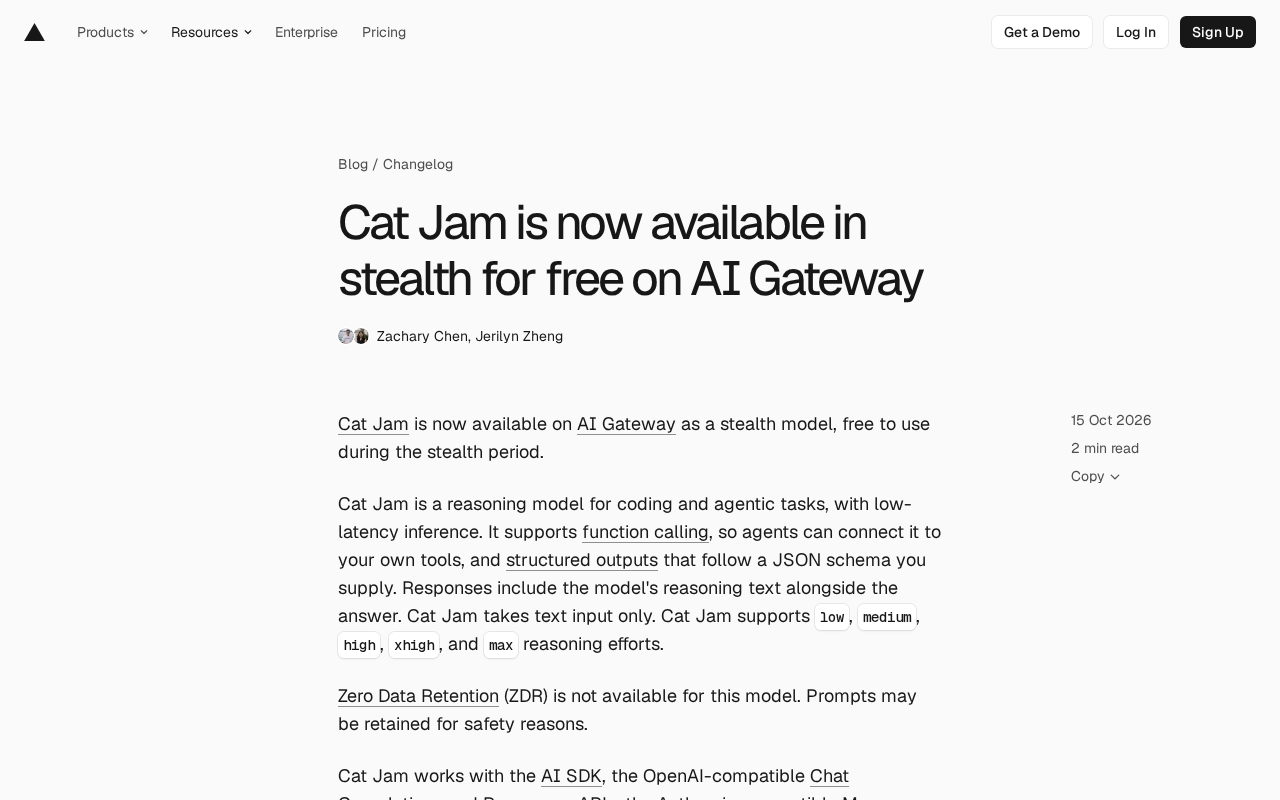
AI Gateway has recently launched a stealth model called Cat Jam, available free to all users during the stealth period. It's a reasoning model built for coding and agentic tasks, focused on low-latency inference. According to the official description, it supports function calling and structured output, and returns both the model's reasoning text and its final answer.
Core Capabilities: A Reasoning Model Built for Agent Workflows
Cat Jam's positioning is clear—it's not a general-purpose chat model, but a reasoning model designed for coding and agentic tasks. It supports function calling, meaning agents can connect it to their own toolchains; it also supports structured output, returning results that conform to a user-provided JSON schema. Responses include the model's reasoning text alongside the answer.
For reasoning effort, Cat Jam offers five levels: low, medium, high, xhigh, and max. Users can trade off speed against reasoning depth based on task complexity. This design mirrors the current mainstream approach for reasoning models: handing control over "how much to think" to the caller rather than fixing a default level.
One thing to note: Cat Jam only accepts text input and does not support multimodal input such as images.
Function calling refers to a model outputting a structured call instruction that conforms to a predefined schema during generation, rather than directly returning a natural-language answer. The caller (e.g., an agent framework) executes that function, feeds the return value back to the model, and reasoning continues. It's a foundational mechanism for building agents: the model thereby gains external capabilities like querying databases, calling search engines, and operating file systems. Structured output is typically implemented by imposing constraints during the decoding stage—for example, OpenAI's JSON Schema mode or grammar-constrained decoding—ensuring output strictly matches the provided JSON schema and preventing downstream parsing failures. Combined, the two allow the model to be reliably embedded in automation pipelines rather than used only for human-machine dialogue.
Data Retention Policy: ZDR Not Available
Cat Jam does not offer Zero Data Retention (ZDR). The official documentation notes that prompts may be retained for safety reasons.
For teams handling sensitive code or user data, this needs to be carefully evaluated before adopting. The price of being free and low-latency is a concession on data retention policy. In agent scenarios, the model often comes into contact with codebases, internal tool return values, and even credential information, so the absence of ZDR could directly trigger compliance reviews.
Zero Data Retention (ZDR) is a common compliance requirement in enterprise AI procurement. It means the provider does not save any prompt or response content after request processing is complete—including logs, caching, and training use. The alternative is limited retention (e.g., retained for 30 days then deleted) or full retention. ZDR typically requires enterprise customers to sign a separate agreement with the provider (such as OpenAI's ZDR addendum or Anthropic's enterprise data policy), and is not enabled by default. It's important to distinguish: not using data for training and not retaining it are two different things—many providers promise data won't be used for model training, but still retain it on the server for a period to support abuse monitoring, content moderation, or legal compliance. Cat Jam explicitly states that ZDR is unavailable and that prompts may be retained for safety reasons, putting it in the latter category.
How to Connect: One Command to Switch Across Multiple Tools
Cat Jam has broad compatibility. The official list of integration paths includes AI SDK, OpenAI-compatible Chat Completions and Responses APIs, Anthropic-compatible Messages API, and various coding agents connected to AI Gateway. Use the model name stealth/cat-jam when calling.
With AI SDK, for example, the call is quite straightforward:
import { streamText } from 'ai';

const result = streamText({
  model: 'stealth/cat-jam',
  prompt: 'Write a TypeScript function that retries fetch with exponential backoff.',
});
To use it in tools like Claude Code, Codex, or Cursor, first install the latest version of Vercel CLI and run setup:
npx vercel ai-gateway setup
Then select stealth/cat-jam in your agent. You can also try it directly in the model playground.
The design intent behind this integration path is clear: minimize migration costs. Users don't need to modify code specifically for Cat Jam—just swapping the model name is enough to get it running, making it nearly zero-cost for teams already using AI Gateway.
AI Gateway's Positioning: A Unified API Layer
To understand the significance of Cat Jam's launch, it helps to first look at AI Gateway itself. It provides a unified API for calling models, tracking usage and costs, and configuring retries, failover, and performance optimizations to achieve higher availability than a single provider. It also includes custom reporting, API key budgets, routing rules, and other features.
On pricing, AI Gateway passes through provider prices as-is with no markup and no platform fee on inference. BYOK (Bring Your Own Key) requests follow the same rule.
This means AI Gateway's business model isn't about marking up inference, but building value through a unified access layer, observability, and routing capabilities. Cat Jam being free during this period effectively showcases the value of this infrastructure layer to developers—get them using it first, then talk about retention.
Stealth models are a form of gray release in AI model distribution: providers temporarily launch new models under an anonymous name or codename to collect latency, accuracy, and error rate data under real workloads before officially announcing naming and pricing, while avoiding premature disclosure of the product roadmap. For developers, the typical characteristics of a stealth period are free or low-cost access, potential shutdown at any time, and no SLA guarantees. Performance data from the stealth phase is sometimes used to fine-tune final pricing tiers or adjust default reasoning effort. Building production dependencies on such models is therefore risky—they're better suited as candidates for evaluation: run a round of benchmarks on real tasks and decide whether to adopt after official release.
A Signal Worth Watching
There are typically two ways to read a stealth model launch: first, it's a pre-release gray test to collect real-world performance data; second, the vendor is trading a free period for developer feedback. Cat Jam's low-latency reasoning positioning, combined with support for multiple reasoning levels and agent workflows, points to high-frequency coding assistant scenarios rather than low-frequency deep Q&A.
Whether Cat Jam will become paid after the free period ends, and at what pricing, is not currently specified by the official announcement. For interested teams, running a round of latency and accuracy tests on real tasks during the stealth period is the lowest-cost way to evaluate it.
One-line Summary
AI Gateway launches free stealth reasoning model Cat Jam, focused on low-latency coding and agent tasks, but without ZDR support.
Paragraph Summary
AI Gateway has launched the stealth reasoning model Cat Jam, free during the stealth period, targeting coding and agentic tasks with a low-latency focus. It supports function calling and JSON schema structured output, returns both reasoning text and the final answer, offers five reasoning effort levels (low, medium, high, xhigh, max), and accepts text input only. Notably, Cat Jam does not offer Zero Data Retention (ZDR), and prompts may be retained for safety reasons, so teams handling sensitive code should evaluate carefully. Integration paths cover AI SDK, OpenAI-compatible Chat Completions/Responses APIs, Anthropic-compatible Messages API, and coding agents like Claude Code, Codex, and Cursor, with the model name stealth/cat-jam. AI Gateway itself passes through provider pricing with no markup and no inference platform fee, and the same applies to BYOK.
Related articles

JobRunner MCP Server: AI Agents Can Now Fix Failed Java Jobs
JobRunner launches an open-source MCP server enabling AI agents to view cluster status, diagnose failures, and recover Java jobs—incident response from any cloud coding environment or existing agent.

MLAI Digital Launches 9 Security Agents: MCP Server Safeguards the Full Lifecycle of Agentic AI
MLAI Digital launches Security MCP Server with nine built-in specialized security agents covering vulnerability discovery, attack simulation, prompt injection detection, API and infrastructure assessment, and accelerated remediation—embedding security validation across the full Agentic AI lifecycle from development to production.

Running Isaac Lab on H100 GPUs: Exploring Better Approaches
Exploring optimization methods for running Isaac Lab on NVIDIA H100 GPUs, including MIG configuration, mixed precision, TensorRT acceleration, and community experience to improve robotics simulation and reinforcement learning efficiency.