CAT ME: The AI App That Turns Your Face Into a Custom Cat Portrait
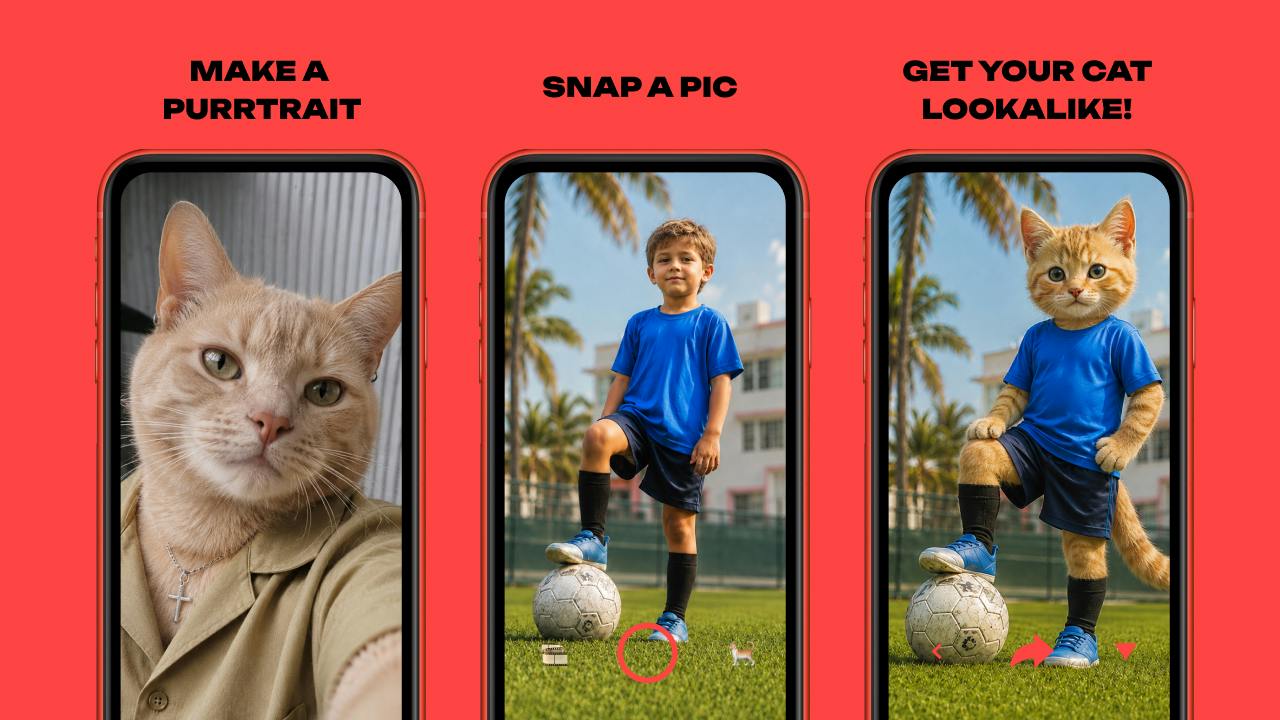
CAT ME uses AI to map your photo onto a personalized cat portrait in three simple steps.
CAT ME is an AI entertainment app that ranked sixth on Product Hunt, turning a person's photo into a matching cat portrait called a "Purrtrait." The process is distilled into three steps — snap, generate, share — with AI mapping facial features, expressions, hairstyles, and accessories onto the cat rather than using a fixed template. Designed for social sharing, it builds virality directly into its core flow. Its ceiling depends on generation consistency and how surprising the results feel. Users should review the app's privacy policy before uploading facial photos.
When AI Meets Cat Lovers
An app called CAT ME recently made it onto the Product Hunt leaderboard, landing in sixth place with 90 upvotes. Its premise is refreshingly simple — upload a photo of a person, and it generates a matching cat character. The development team coined a clever name for the result: a Purrtrait, blending "purr" (the sound cats make) with "portrait" — a detail that screams cat person energy.
For users living in the social media era, this kind of lightweight, highly shareable AI experience isn't new. From anime avatar generators and old photo restoration to now "becoming a cat," AI image generation technology keeps finding fresh ways to merge with mainstream entertainment. CAT ME taps into a universal curiosity: What would I look like as a cat? — a question that's both fun and has zero barrier to entry.
Three Steps to Your Custom Cat Portrait
According to the official description, CAT ME's workflow is stripped down to three simple steps:
- Take a photo — snap a picture of yourself or a friend;
- Generate — the AI creates a cat that matches the person's appearance and personality;
- Share — send your new feline identity to your social circle.
The magic happens in step two. The team emphasizes that every Purrtrait is AI-generated from the original photo, translating human facial features, expressions, hairstyles, and even accessories onto a cat — resulting in a truly one-of-a-kind feline portrait.
In other words, it's not just slapping a generic cat face filter on your photo. It attempts to establish a visual correspondence between human and cat — someone wearing glasses might get a cat wearing glasses; someone with curly hair might be matched with a fluffy, bushy-furred cat. This "feature mapping" is the heart of the product's appeal, and what sets it apart from ordinary filters.
A technical note: This kind of feature mapping typically relies on Style Transfer or conditional generation via Diffusion Models. The former works by extracting and recombining content and style features from images; the latter introduces conditioning signals like facial keypoints and semantic segmentation during the denoising process, guiding the model to stylize output as a cat while preserving the subject's original characteristics. Compared to early fixed filters, diffusion model approaches handle diverse inputs — different face angles, glasses, hairstyles — with much greater flexibility, though they remain sensitive to input photo quality and frontal alignment. This also explains the consistency issues mentioned later in the article.
The Product Logic Behind a Simple App
CAT ME's category tags are telling: Cats, Photography, Artificial Intelligence. These three words essentially summarize its entire value proposition — using AI technology, in a photography context, serving a massive community of cat lovers.
The success of apps like this rarely depends on technical complexity. It hinges on whether the product hits the right nerve for social virality. "Becoming a cat" naturally checks several viral boxes: results are surprising, screenshots are share-worthy, and it's perfect fodder for friendly banter. The fact that the team baked "share with friends" directly into the core flow shows they know exactly where their growth engine lives.
By the numbers, 90 upvotes and 3 comments is a solid but not spectacular debut — no breakout moment yet. But for an entertainment app with a clear use case and near-zero learning curve, its ceiling will largely depend on how consistently satisfying and surprising the generated results feel.
A Few Things Worth Knowing Before You Try It
For users curious to give it a go, a few considerations are worth keeping in mind. First, privacy — the app requires uploading photos of real people, which means facial data is being processed. Users should review its data storage and usage policy before diving in. Second, consistency of results — AI image generation can perform unevenly across different angles, lighting conditions, and facial features, which directly affects how well your Purrtrait actually resembles you.
Overall, CAT ME is a textbook example of a "small but delightful" AI entertainment product. It doesn't aim to solve serious problems. Instead, it packages a mature AI image technology into a breezy experience that anyone can play with and want to share. In an era where AI applications are becoming increasingly niche, products that focus on a single playful scenario may actually find their audiences more easily.
On facial data and privacy regulations: Facial data is subject to specific legislation across multiple jurisdictions. For example, the EU's General Data Protection Regulation (GDPR) classifies facial recognition data as a "special category of personal data," requiring explicit consent for collection. Illinois' Biometric Information Privacy Act (BIPA) imposes strict written authorization and retention requirements on companies that collect and store biometric identifiers. For apps that require selfie uploads, users should pay close attention to: whether photos are used solely for the current generation, whether they are deleted immediately after processing, whether they may be used for model training, and whether data is transferred across borders. Without a clear privacy policy, uploading a high-resolution frontal photo carries real, non-trivial risks.
Related articles

AI Agent Fundamentals: The Three Core Components — Brain, Memory, and Tools
A beginner's guide to AI Agents: covering the three core components (brain, memory, tools), four stages of LLM deployment, and why Agents matter for real business use cases.

Boycotting Software That Doesn't Support Linux: One Developer's Philosophy of Choice
A Linux-only developer shares his philosophy of boycotting non-Linux software — without sacrificing productivity — and explains how coding agents like Claude Code are closing the gap with commercial tools.
Why Do All AI-Generated Projects Look the Same? The Aesthetic Homogenization Problem in Vibe Coding
Why do vibe coding projects all use purple gradients and dark glassmorphism? We break down the technical roots of AI aesthetic homogenization and how to escape it.