Causo: Using AI Research and MCP to Break Through Database Filtering for Lead Discovery

Causo describes target customers in natural language, AI investigates public sources with evidence, and supports MCP integration.
Causo is a B2B sales lead tool newly launched on Product Hunt. Targeting the pain point that traditional database filtering struggles to capture ideal customers, it lets users describe their target customer profile in natural language, and AI investigates public sources such as news, official websites, and social media to find matching companies, providing a matching rationale and source link for each result to avoid black-box recommendations. It also supports the MCP protocol, allowing the same research to be reused in ChatGPT and Claude, lowering switching costs. Its features cover everything from lead discovery to decision-maker identification, email verification, and research-based outreach writing. The article argues it's suited for exploratory scenarios like entering new markets and finding customers in emerging niches, serving as a supplement rather than a replacement for traditional databases, though its data coverage and accuracy await user verification.
Why Isn't Traditional Lead Filtering Enough?
In B2B sales, we're used to finding prospects through database filters—setting criteria like industry, size, and geography, then picking from the results. But the reality is that the most ideal customers often don't appear according to database fields. They might be in some emerging niche, or have unique business pain points that are hard to capture with a few filter conditions. Causo, newly launched on Product Hunt, targets exactly this pain point: it lets you describe your target customer in natural language, then AI investigates public sources to find companies worth pursuing and provides evidence for each match.
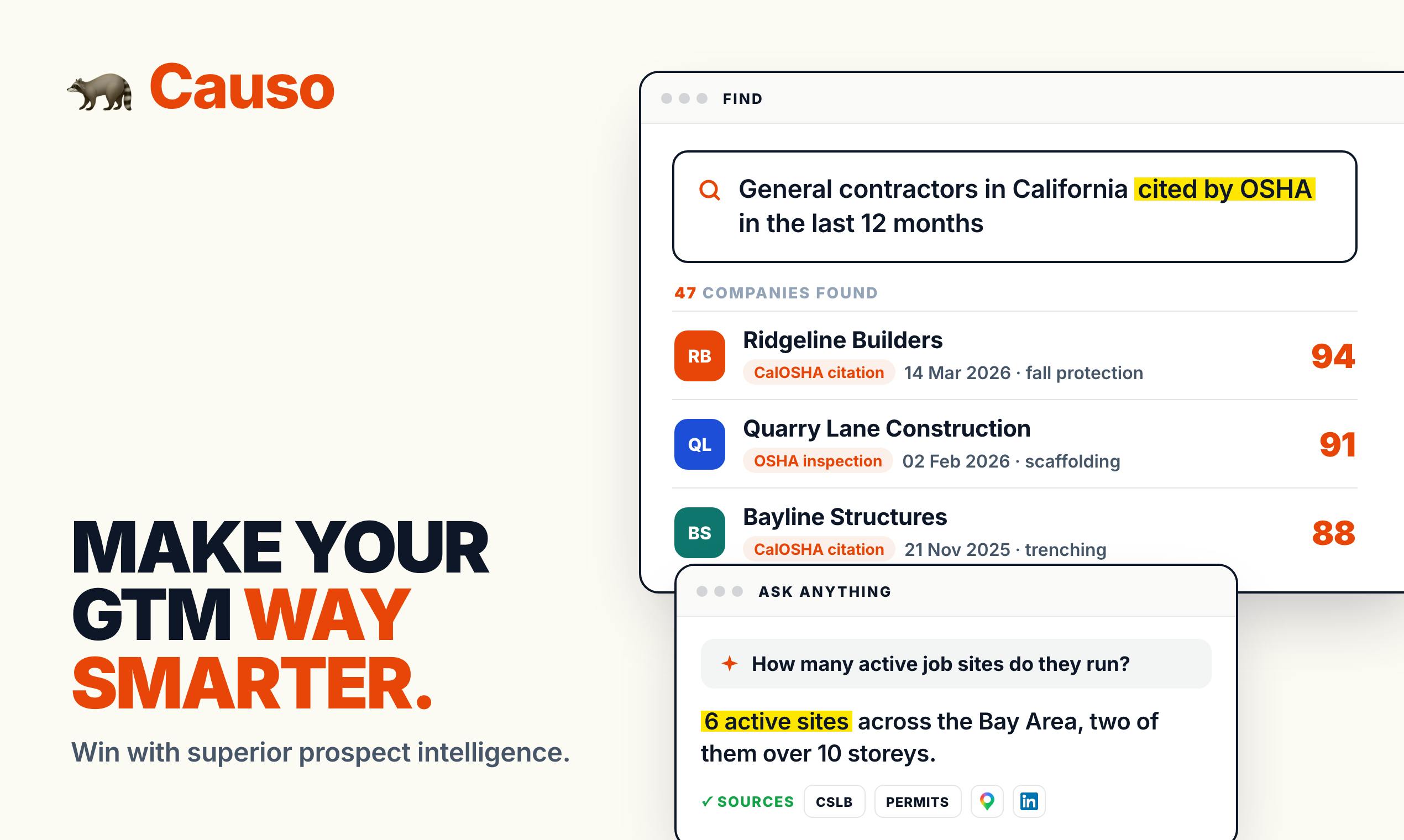
According to its Product Hunt page, Causo's core logic is that "your ideal customer doesn't always fit database filters." You simply describe what you're looking for in plain English, and Causo digs through public information rather than relying on preset tags.
How Causo Works: From Natural Language to Evidence Chain
Causo's workflow breaks down into three steps: describe the need, AI investigates, evidence is presented. You enter something like "find SaaS companies that recently raised funding and are expanding into the European market," and Causo searches public sources (news, official websites, social media, etc.) to find qualifying businesses, attaching a matching rationale and source link to each result. This solves the "black-box recommendation" problem of traditional lead tools—you not only know who matches, but also why they match.
This evidence-based approach gives sales teams a more solid context before contacting customers, rather than blindly mass-emailing. In Causo's own words, it's "better GTM intelligence, less spam."
"Black-box recommendation" is a long-criticized problem with lead generation tools: the system gives a match score or recommendation list without explaining the basis, so sales can't judge why a lead is worth pursuing, nor write a targeted opening based on it. The black-box nature of traditional tools stems from their reliance on preset tags and scoring models, with matching logic hardcoded inside the algorithm. The evidence-chain approach based on large language models is different—when retrieving public information, the model retains its reasoning path, breaking down "why this company fits the description" into verifiable factual points (such as funding news, job postings, official website announcements) and attaching source links. This explainability not only boosts sales' trust in leads but also makes the research results themselves raw material for outreach: sales can directly cite specific events from the evidence to personalize communication rather than speaking in generalities.
MCP Integration: Reusing Research in ChatGPT and Claude
Another highlight of Causo is its support for MCP (Model Context Protocol). This means you can explore in depth within Causo's chat interface, or run the same research directly in ChatGPT and Claude. For teams already used to working in AI assistants, this lowers switching costs and makes lead research fit more naturally into existing workflows.
MCP is an open protocol introduced by Anthropic, designed to let AI assistants connect to external tools and data sources. Through MCP, Causo turns itself into a "research tool" that AI assistants can invoke, which to some extent represents a new trend in sales tech: tools are no longer isolated but embedded in the AI ecosystem.
Model Context Protocol (MCP) is an open standard introduced by Anthropic in late 2024, designed to establish a unified connection method between AI assistants and external tools and data sources. You can think of it as the "USB-C interface" of the AI world: previously, each AI assistant connecting to an external service (such as a database, search engine, or CRM) required a separate integration to be built; with MCP, a tool only needs to implement the protocol once to be invoked by any MCP-supporting AI client. MCP uses a client-server architecture, where servers expose three types of capabilities—"tools," "resources," and "prompts"—and clients (such as Claude Desktop, Cursor, etc.) discover and invoke them as needed. For Causo, implementing an MCP server means its lead research capability is no longer a closed feature within the product, but a "skill" that general assistants like ChatGPT and Claude can directly invoke; users can initiate research without leaving the chat interface, which is also the technical foundation of the "tools embedded in the AI ecosystem" trend.
From Finding Leads to Reaching Decision-Makers
Finding matching companies is only the beginning. Causo also offers follow-up features: locating decision-makers, verifying emails, and writing research-based outreach messages. This means it attempts to cover the entire front-end process from lead discovery to initial outreach.
However, how well these features actually work remains to be verified by users. The 84 votes and 15 comments on Product Hunt show some level of attention, but as a new product, its data coverage and accuracy still need time to be tested.
Decision-maker identification and email verification are key steps in the B2B sales lead process. After finding a target company, sales need to identify the people who actually have purchasing authority—usually a combination of specific seniority (such as VP, Director) and function (such as marketing, IT, procurement)—a process that often relies on professional social data like LinkedIn. Email verification uses techniques such as SMTP handshakes, syntax and domain checks, and disposable email detection to determine whether an email address is genuinely reachable, reducing bounce rates and protecting the sender domain's reputation. These two steps directly determine outreach deliverability and reply rates. Causo packages these two capabilities with upstream lead discovery, aiming to reduce the friction of sales switching between multiple tools, but the depth of its data coverage and verification accuracy remain key variables determining its practicality.
Who Is Causo For?
Causo is primarily aimed at sales and marketing teams, especially those needing exploratory lead mining scenarios—such as entering new markets, finding customers in emerging fields, or niche industries where traditional databases fall short. For teams used to working with AI assistants, the MCP integration is a big plus.
But note that Causo is not a replacement for traditional databases, but a supplement. It's better suited as a "research assistant" to help sales quickly find direction under vague requirements, rather than for large-scale, standardized lead pulling.
Multi-Source Perspectives and Limitations
Currently, public information about Causo mainly comes from its Product Hunt launch page, with few independent reviews. Judging from the product description, its philosophy aligns with the current trend in AI sales tools: using large models to understand unstructured needs and public data to supplement structured databases. However, actual results depend on the breadth of its data sources and the accuracy of AI judgment, which still need real-world use to evaluate.
For interested teams, you can look into the trial opportunities offered on its official website and start validating with small-scope scenarios.
One-line Summary
Causo describes target customers in natural language, AI investigates public sources with evidence, and supports MCP integration.
Paragraph Summary
Causo is a B2B sales lead tool newly launched on Product Hunt. Targeting the pain point that traditional database filtering struggles to capture ideal customers, it lets users describe their target customer profile in natural language, and AI investigates public sources such as news, official websites, and social media to find matching companies, providing a matching rationale and source link for each result to avoid black-box recommendations. It also supports the MCP protocol, allowing the same research to be reused in ChatGPT and Claude, lowering switching costs. Its features cover everything from lead discovery to decision-maker identification, email verification, and research-based outreach writing. The article argues it's suited for exploratory scenarios like entering new markets and finding customers in emerging niches, serving as a supplement rather than a replacement for traditional databases, though its data coverage and accuracy await user verification.
Related articles

AgentCore in Practice: Connecting Custom Tools and MCP Servers to Agents
DebuggerCafe tutorial shows how to connect custom tools and MCP servers to Amazon Bedrock AgentCore agents, covering tool contract design, MCP reuse, and production concerns.

816B Parameters Scores Only 39? The Real Cost-Effectiveness of the Open-Source LLM Parameter Race
Meta's 816B Muse Spark Open scores just 39 on Artificial Analysis, while 180B Qwen3.8-Flash-Next scores 40. This article analyzes 11 open-weight models' parameters vs. scores, exploring the real impact of activated parameters, quantized size, and deployment cost.

Aerial Manipulators: The Next Step for Drones from 'Seeing' to 'Changing'
Starting from a Reddit discussion, this article analyzes the technical challenges, potential applications, and deployment bottlenecks of aerial manipulators, exploring the key challenges for drones moving from environmental perception to physical manipulation.