CCPS Sampling: Preserving Reasoning Diversity to Boost LLM Performance Without Fine-Tuning
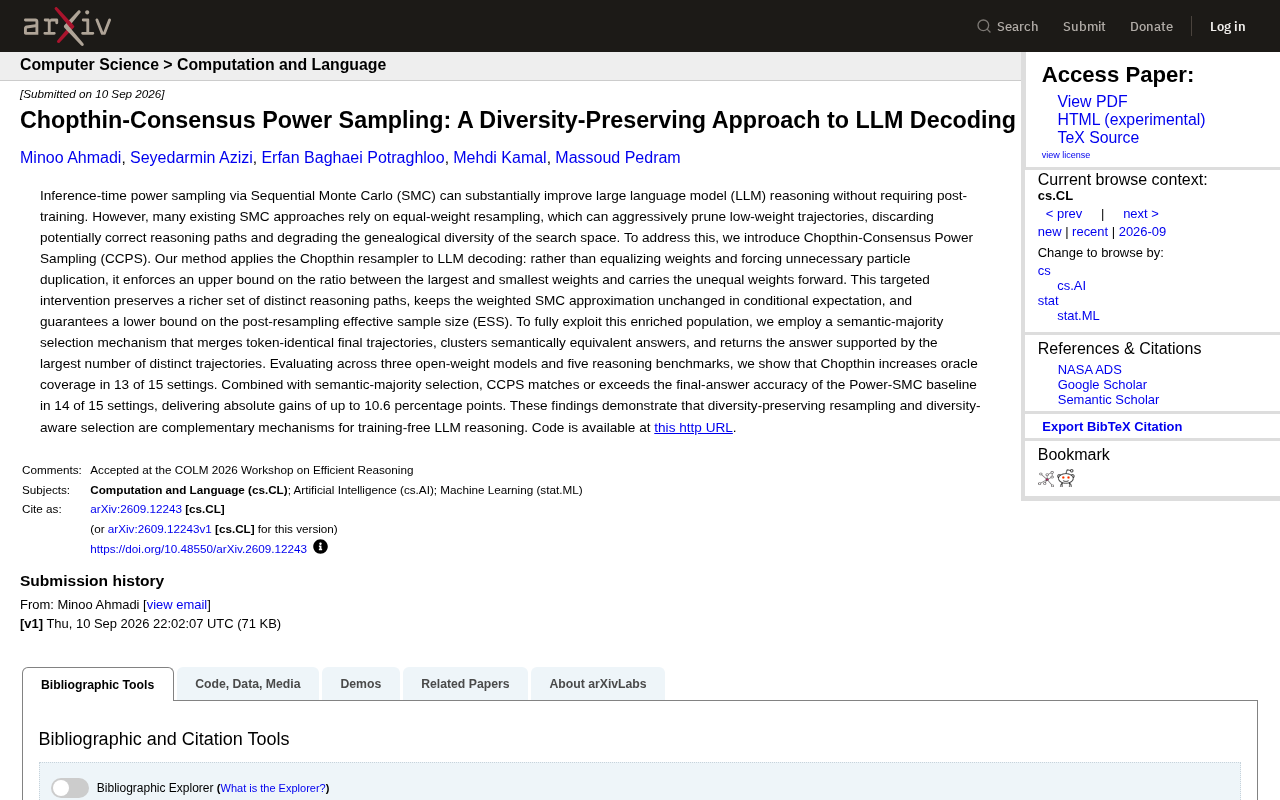
CCPS boosts LLM reasoning accuracy training-free via Chopthin resampling and semantic majority selection.
This paper addresses a long-overlooked flaw in SMC-based LLM inference: traditional equal-weight resampling aggressively prunes low-weight reasoning trajectories, collapsing genealogical diversity and causing correct answer paths to be discarded. The proposed CCPS method tackles this from two angles — a Chopthin resampler that caps the max-to-min weight ratio instead of flattening weights, preserving diverse paths while guaranteeing an ESS lower bound; and a semantic majority selection mechanism that deduplicates, clusters semantically equivalent answers, and votes by independent path count. Evaluated on three open-weight models across five benchmarks, CCPS matches or exceeds the Power-SMC baseline in 14 of 15 settings, with a peak absolute gain of 10.6 percentage points — all without any model fine-tuning.
The Overlooked Problem: How Resampling Kills Correct Answers
The performance of large language models on reasoning tasks depends heavily on the sampling strategy used at inference time. In recent years, power sampling at inference time based on Sequential Monte Carlo (SMC) has become a popular direction — it can significantly improve LLM reasoning without any post-training.
But these methods have a long-overlooked flaw. Many existing SMC approaches rely on equal-weight resampling, which flattens the weights of all retained trajectories during the sampling process. This seems clean and simple, but it aggressively prunes low-weight trajectories. The problem is that a reasoning path with a currently low weight isn't necessarily wrong — it may be the critical branch leading to the correct answer. Equal-weight resampling discards these potentially correct reasoning paths outright, causing the genealogical diversity of the search space to collapse sharply.
In other words, the model may "bet" too early on a handful of high-weight paths during inference, missing opportunities to arrive at correct answers that were well within reach.
The Core Idea Behind CCPS: Cap, Don't Flatten
A new paper on arXiv proposes Chopthin-Consensus Power Sampling (CCPS), which tackles diversity loss from two angles simultaneously.
The Chopthin Resampler: Carry Weights Forward with Their Differences Intact
CCPS's first innovation is introducing the Chopthin resampler into the LLM decoding process. The key difference from traditional equal-weight resampling lies in how weights are handled:
- Traditional approach: Equalizes all weights and forces particle duplication — a process that is itself a source of information loss.
- Chopthin approach: Instead of flattening, it sets an upper bound on the ratio between the maximum and minimum weights, while propagating those unequal weights forward.
This targeted intervention delivers three benefits: it preserves a richer set of distinct reasoning paths; it keeps the weighted SMC approximation unbiased in conditional expectation (no mathematical bias is introduced); and it guarantees a lower bound on the effective sample size (ESS) after resampling, preventing particle degeneracy.
To put it simply, Chopthin only "trims" extreme weight imbalances — it doesn't clear-cut the entire forest to a uniform stump height.
Semantic Majority Selection: Let the Most-Supported Paths Vote on the Answer
Preserving diverse reasoning paths is only half the battle. Equally important is how to select the final answer from this richer "population" of paths.
CCPS introduces a semantic majority selection mechanism that works in three steps:
- Merge final trajectories with identical tokens — eliminate literal duplicates;
- Cluster semantically equivalent answers — group responses that differ in wording but agree in meaning;
- Return the answer supported by the most distinct trajectories — let the count of independent reasoning paths serve as a vote.
This mechanism is complementary to Chopthin resampling: the resampler preserves diversity during generation, while semantic majority selection exploits that diversity during selection. The paper frames this as a synergy between "diversity-preserving resampling" and "diversity-aware selection."
Experimental Results: Matches or Beats Baseline in 14 out of 15 Settings
The research team evaluated CCPS on three open-weight models across five reasoning benchmarks, yielding solid results:
- Chopthin resampling alone improved oracle coverage (the proportion of the search space containing correct answers) in 13 out of 15 settings;
- The full CCPS — combining Chopthin with semantic majority selection — matched or exceeded the Power-SMC baseline in final answer accuracy across 14 out of 15 settings;
- The largest absolute improvement reached 10.6 percentage points.
These numbers make clear that diversity is not merely a cosmetic metric — it translates directly into higher accuracy. The widespread improvement in oracle coverage confirms that correct paths are genuinely being preserved better, while the accuracy gains show that semantic majority selection successfully converts those paths into correct final answers.
Why This Work Deserves Attention
What makes CCPS most compelling is that it is training-free. It requires no fine-tuning or post-training of the model whatsoever — it intervenes purely at inference time to extract more of the reasoning capability the model already possesses. This is especially valuable in resource-constrained settings or when model weights are inaccessible for training.
From a methodological standpoint, this paper offers a crisp insight: over-convergence has a cost in LLM reasoning. Equal-weight resampling sacrifices search-space diversity for computational tidiness — but diversity is precisely the resource needed to find correct answers. CCPS recovers that loss through the relatively mild intervention of capping the weight ratio, while preserving the theoretical guarantees of SMC.
For researchers and engineers focused on enhancing LLM reasoning, this approach offers directly reusable ideas. The paper's code is open-sourced on GitHub (github.com/MinooAhmadii/chopthin-consensus-power-sampling) for those who want to explore the implementation.
Summary
CCPS puts diversity preservation at the center of LLM reasoning improvement. The Chopthin resampler avoids aggressive pruning during generation, while semantic majority selection fully leverages diverse reasoning paths at decision time. Together, they deliver meaningful accuracy gains without any training. This is a reminder that sampling strategies at inference time still have substantial room for optimization — and that "how diversity is managed" may be one of the most underappreciated variables in that space.
Related articles

MIT Spinout Transforms Plastic Waste into High-Resilience Building Materials
MIT spinout Atlas Building Composites converts plastic waste into resilient structural components for buildings and infrastructure, pioneering a high-value recycling pathway.
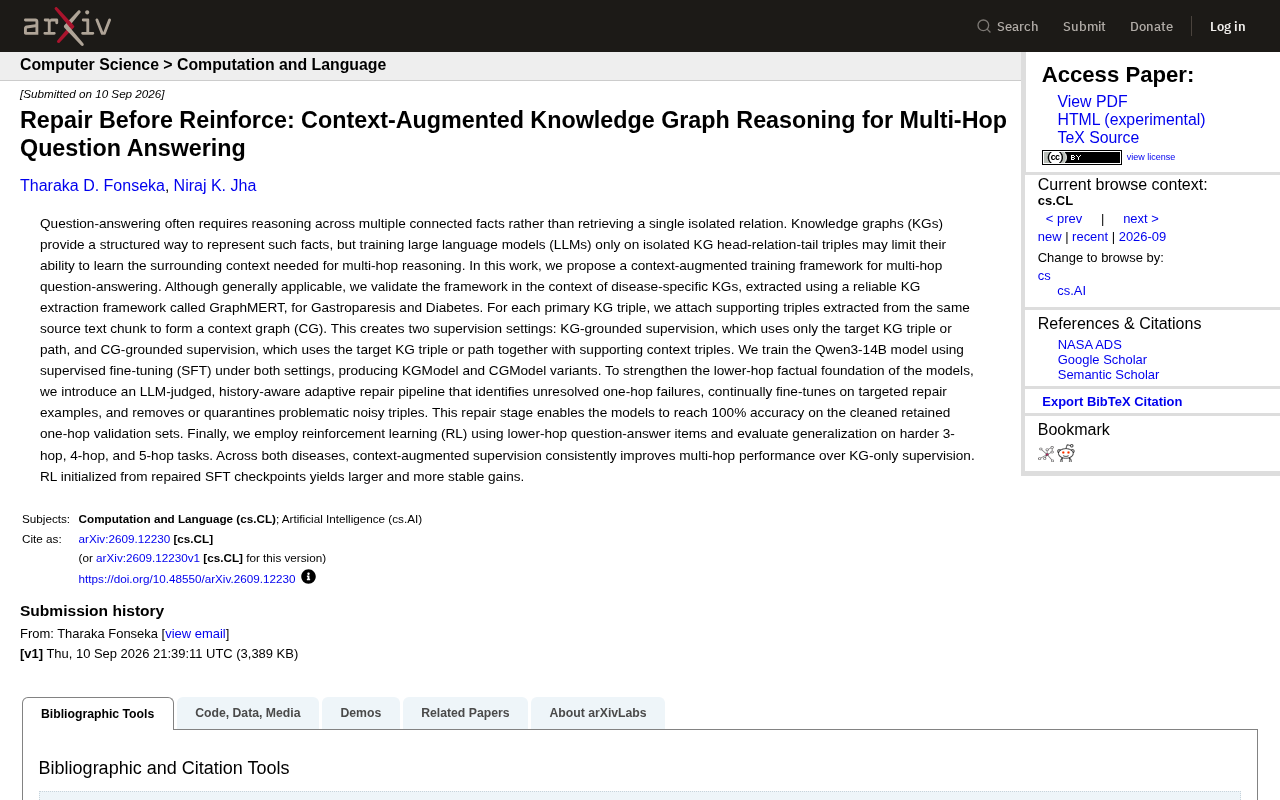
Repair Before Reinforce: Context-Augmented Knowledge Graph Reasoning Tackles Multi-Hop QA
New arXiv paper proposes a context-augmented KG reasoning framework using a "Repair Before Reinforce" strategy to improve LLM multi-hop QA. Validated on Gastroparesis and Diabetes KGs with Qwen3-14B, achieving 100% single-hop accuracy after repair.

HardFlow Algorithm: Enabling Generative AI to Meet Hard Constraints in Safety-Critical Scenarios
HardFlow is a new algorithm designed to make generative AI strictly comply with hard constraints in safety-critical scenarios while maintaining high-quality outputs.