Cepheid: Decoupling Scale from Structure for a New Paradigm in Cross-Family Motion Completion

Cepheid decouples residual structure from physical scale, learns a dimensionless prior, and enables a unified model to outperform harmonic extension across geometry families.
Cepheid tackles cross-family generalization in recovering dense mesh motion from sparse vertex displacements by decoupling residual structure from physical scale. Traditional residual priors often underperform parameter-free harmonic extension outside the training distribution, and cross-family training suffers from a Scaling Barrier where scale differences are large and collapse as observations become denser. Cepheid learns a dimensionless prior to capture cross-family shared residual patterns, estimates amplitude from sparse test-time observations, and adjusts with a lightweight correction fitted only on the training source. Experiments show the same unified model surpasses harmonic extension on all evaluated geometry families, including unseen cloth and legged bodies, and transfers zero-shot to animal point tracking and soft robot grasping without skeletons, registration, or cross-mesh correspondences.
Title
Cepheid: Decoupling Scale from Structure for a New Paradigm in Cross-Family Motion Completion
Meta Description
Cepheid proposes a cross-family motion completion method that decouples scale from structure, learning a dimensionless residual prior, estimating amplitude from sparse observations, and outperforming harmonic extension on unseen cloth and legged bodies without skeletons or registration.
Article Content
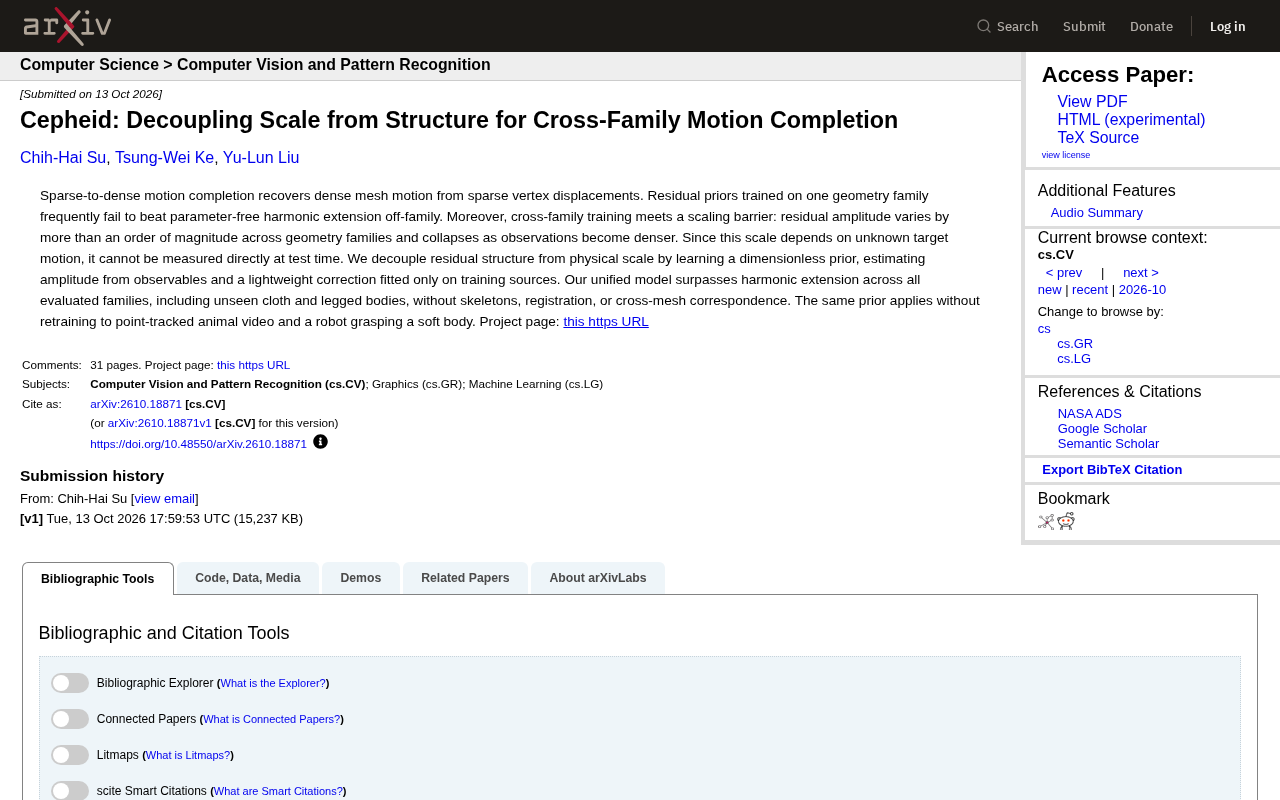
Recovering dense mesh motion from sparse vertex displacements is a classic challenge in computer graphics and vision. Traditional methods typically rely on residual priors trained on specific geometry families, but once they step outside the training distribution, these priors often fail to even match parameter-free harmonic extension. More troubling still, cross-family training suffers from a Scaling Barrier: residual amplitudes can differ by more than an order of magnitude between geometry families, and they collapse sharply as observations become denser. Since this scale depends on the unknown target motion, it cannot be directly measured at test time.
Recently, a study named Cepheid proposed an elegant solution—decoupling residual structure from physical scale, learning a dimensionless prior, then estimating amplitude from observable quantities and adjusting it with a lightweight correction fitted only on the training source. Ultimately, a unified model outperforms harmonic extension on all evaluated geometry families, including never-before-seen cloth and legged bodies, and does not require skeletons, registration, or cross-mesh correspondences.
The Core Challenge of Cross-Family Motion Completion
The goal of motion completion is to recover dense motion for an entire mesh from a small number of sparse vertex displacement observations. This is critical in scenarios such as animation production, virtual try-on, and robotic manipulation simulation. However, motion patterns differ dramatically across geometry families (e.g., human bodies, animals, cloth, soft robots), so a residual prior trained on human bodies may perform worse when transferred directly to cloth than the classic harmonic extension.
Harmonic extension is a parameter-free method that assumes motion propagates smoothly across the mesh surface and does not rely on any learning. But under complex motion, it cannot capture high-frequency details and local deformations. Residual priors are meant to fill this gap, but the problem is that residual amplitudes vary drastically across families—some families have very small residuals, others very large. Even more problematic, as observation points become denser, residual amplitude decreases significantly, meaning the scale information learned during training may be completely wrong at test time.
Harmonic Extension is a classic interpolation method in mesh signal processing. Its core idea is to treat known vertex displacements as boundary conditions defined on the mesh surface and fill in the displacements of unobserved vertices by solving the Laplace equation Δf = 0. On a discrete mesh, this is equivalent to setting each unknown vertex's displacement to a weighted average of its neighboring vertices' displacements, with weights typically taken as cotangent weights or uniform weights. The advantages of harmonic extension are that it requires no training, is computationally efficient, and produces smooth results, so it is commonly used as a baseline in motion completion. But its fundamental limitation is that the solution to the Laplace equation is naturally the "lowest-frequency" one and cannot express high-frequency motion details such as local bending, wrinkles, or volume changes. When the true motion contains significant non-smooth components, harmonic extension produces overly smoothed results, which is exactly the gap that learned residual priors attempt to fill.
Residual Prior refers to learning a network on top of a baseline prediction (such as harmonic extension) to predict the difference between "true motion minus baseline." Since residuals are usually smaller in magnitude and more concentrated in distribution than the original motion, learning residuals is easier than directly regressing dense motion. But the statistical properties of residuals depend heavily on the geometry family and observation density—for example, residual amplitudes caused by cloth wrinkles are far larger than those from human joint motion, and the more observation points there are, the more accurate the baseline itself is and the smaller the residual amplitude. This condition-dependent scale is precisely the core reason cross-family transfer is difficult.
Cepheid's Core Idea: Decoupling Scale from Structure
The key insight of Cepheid is that the structure of the residual (i.e., its spatial distribution pattern) and its physical scale (i.e., amplitude magnitude) can be handled separately. Structure is shared across families, while scale is family-specific and depends on the unknown target motion.
Thus, the research team designed a two-stage approach:
- Learn a dimensionless prior: Have the model focus only on the direction and shape of the residual, ignoring its absolute magnitude. This way, the prior is not dominated by the scale of any one family.
- Estimate amplitude from observable quantities: Use the sparse observations visible at test time to infer the residual scale of the current family. This step does not require true dense motion as supervision.
- Lightweight correction: Fit a simple correction module on the training source to further adjust the amplitude estimate.
This decoupling allows the same prior to be reused across families without retraining for each new family.
Dimensionless Prior originates from the idea of dimensional analysis in physics: many regularities shared across systems are reflected only in proportional relationships between variables, independent of absolute units. In Cepheid, this means the network does not directly predict the absolute displacement vector of the residual, but rather predicts its normalized direction field or shape pattern—for example, dividing the residual by its own root-mean-square magnitude so that the output falls near unit scale. This way, regardless of whether the target family is a human body or cloth, the spatial distribution pattern of the residual falls within the same numerical range, and the network parameters are not dominated by any large-scale family. At test time, an independent amplitude estimation module rescales the dimensionless structure back to physical scale. This decoupling is similar to separating hue from brightness in image processing, or separating waveform from gain in signal processing, and is a general strategy for improving cross-domain generalization.
Experimental Results: Outperforming Harmonic Extension Across the Board
The paper evaluated on multiple geometry families, including families seen during training and unseen ones. The results show that Cepheid's unified model surpasses harmonic extension on all evaluated families, including cloth and legged bodies that never appeared in the training set. Even more impressive, the same prior can be applied directly without retraining to animal videos for point tracking and to scenes of robotic grasping of soft objects.
This means Cepheid not only solves the cross-family generalization problem but also demonstrates strong zero-shot transfer ability. It does not rely on skeletons, registration, or cross-mesh correspondences, which are typically required preprocessing steps in traditional methods and are both time-consuming and error-prone.
Technical Details and Implementation Highlights
Cepheid's implementation has several notable design choices. First, it does not assume meshes have the same topology, so it can handle meshes with different resolutions and connectivity. Second, the amplitude estimation module uses only the observed sparse displacements and regresses the scale factor through a lightweight network. Finally, the correction module is very small, containing only a few parameters, which avoids overfitting.
This design makes the model very efficient at test time: the prior is fixed, and both amplitude estimation and correction are forward computations that do not require iterative optimization. This is valuable for scenarios requiring real-time or interactive applications, such as animation preview and robot control.
Zero-shot Transfer refers to a model performing inference directly on an unseen data distribution without using any target-domain annotations or fine-tuning. In motion completion, this requires that the prior, amplitude estimator, and correction module all avoid depending on the target family's true dense motion. Cepheid can achieve this because: the dimensionless prior has already learned cross-family shared residual structure on the training source; the amplitude estimator consumes only the sparse displacements observable at test time; and the correction module is fitted only on the training source and is generic to all target families. Unlike traditional transfer learning, zero-shot transfer does not assume a small amount of target-domain annotation, nor does it require retraining on new families. Its cost is that the performance ceiling is limited by the coverage of the source-domain prior—if the target family's structural patterns differ too greatly from the training source, the dimensionless prior may also fail, which explains why Cepheid still emphasizes the qualifier "evaluated geometry families."
Industry Impact and Future Directions
Cepheid offers a new way of thinking about cross-family motion completion: rather than forcing one model to adapt to all scales, explicitly decouple scale. This may inspire more research on "invariance" and "equivariance"—which properties should be shared across families, and which should adapt based on the input.
At the application level, this method promises to reduce the cost of motion capture and animation production. For example, using a small number of markers to drive cloth or soft bodies of different characters would no longer require training a separate model for each character. In robotics, deformation estimation during grasping of soft objects could also benefit.
Of course, Cepheid is currently limited to offline evaluation, and future work needs to verify its robustness in real video streams and dynamic scenes. In addition, the accuracy of amplitude estimation depends on observation quality and may degrade when sparse noise is significant. These are directions worth further exploration.
Project page: https://su-terry.github.io/cepheid-website/
One-line Summary
Cepheid decouples residual structure from physical scale, learns a dimensionless prior, and enables a unified model to outperform harmonic extension across geometry families.
Paragraph Summary
Cepheid addresses the cross-family generalization challenge in recovering dense mesh motion from sparse vertex displacements by decoupling residual structure from physical scale. Traditional residual priors often underperform parameter-free harmonic extension outside the training distribution, and cross-family training suffers from a Scaling Barrier where scale differences are large and collapse as observations become denser. Cepheid first learns a dimensionless prior to capture cross-family shared residual spatial patterns, then estimates amplitude from sparse observations visible at test time, and adjusts with a lightweight correction fitted only on the training source. Experiments show that the same unified model surpasses harmonic extension on all evaluated geometry families, including unseen cloth and legged bodies, and can transfer zero-shot to animal point tracking and soft robot grasping scenarios without skeletons, registration, or cross-mesh correspondences.
Related articles

DeepCell: One-Click AI Generation of Documents, Spreadsheets, and Slides
DeepCell tops Product Hunt with one-click generation of documents, spreadsheets, and slides, using the .deepcell format for linked updates, designed for System 2 tasks like modeling and sales reviews.

Doneas: 15-Minute Daily Accountability Calls That Keep Indie Developers From Procrastinating
Doneas is a daily accountability tool for indie developers: plan tasks on Monday, join a 15-minute call with five builders each day, and log deliveries on a public progress page. This article analyzes its core mechanics, effectiveness, and potential issues around retention and matching.

Fastlane 2.0: Fully Automated AI Ad Campaigns, From Creative to Optimization
Fastlane 2.0 is an AI ad automation tool: enter your website and it learns your brand, generates video and image ads, and runs and optimizes them on Meta, TikTok, Instagram, and YouTube.