Cercle: An Intimate Social App That Fights Loneliness with Emotional Signals

Cercle uses mood signals and home-screen widgets to help close friends stay emotionally connected.
Cercle is an intimate social app that combats modern loneliness by making emotions visible. Users check in with their mood, which displays on close friends' home-screen widgets in real time. Built by Sheeta Verma after witnessing friends struggle in silence, it shifts the burden of reaching out from help-seekers to carers, lowering barriers to support while navigating the delicate balance between emotional transparency and privacy.
A Social App Built for Intimate Relationships
In an age where social media permeates every aspect of life, a paradox grows ever more apparent: our "friend" counts are at historic highs, yet genuine loneliness is spreading. This paradox has been confirmed by multiple studies—in 2023, U.S. Surgeon General Vivek Murthy issued a public health advisory on the "loneliness epidemic," noting that even though social media connects billions of people, roughly half of American adults report experiencing loneliness. Research shows that shallow interactions on social media (like likes and scrolling through feeds) cannot substitute for deep emotional connection, and may even worsen psychological distress through social comparison effects.
Cercle is a product that targets this modern dilemma. It ranked 12th on Product Hunt with 125 upvotes and 25 comments, positioning itself at the intersection of Health & Fitness, Messaging, and Social Media. Product Hunt is the world's most prominent platform for discovering new products, founded by Ryan Hoover in 2013, where community members express interest in new products through upvotes and comments. Daily rankings are determined by multiple factors including vote count, comment quality, and voter weight—a 12th-place finish indicates that Cercle earned meaningful recognition from the early adopter community.
Cercle's tagline is highly evocative—"The bat signal for your closest friends." This metaphor borrows from Batman's distress signal, hinting at the product's core logic: when you need your friends, or when they need you, both sides sense it immediately—rather than waiting until someone has silently spiraled into a low point.
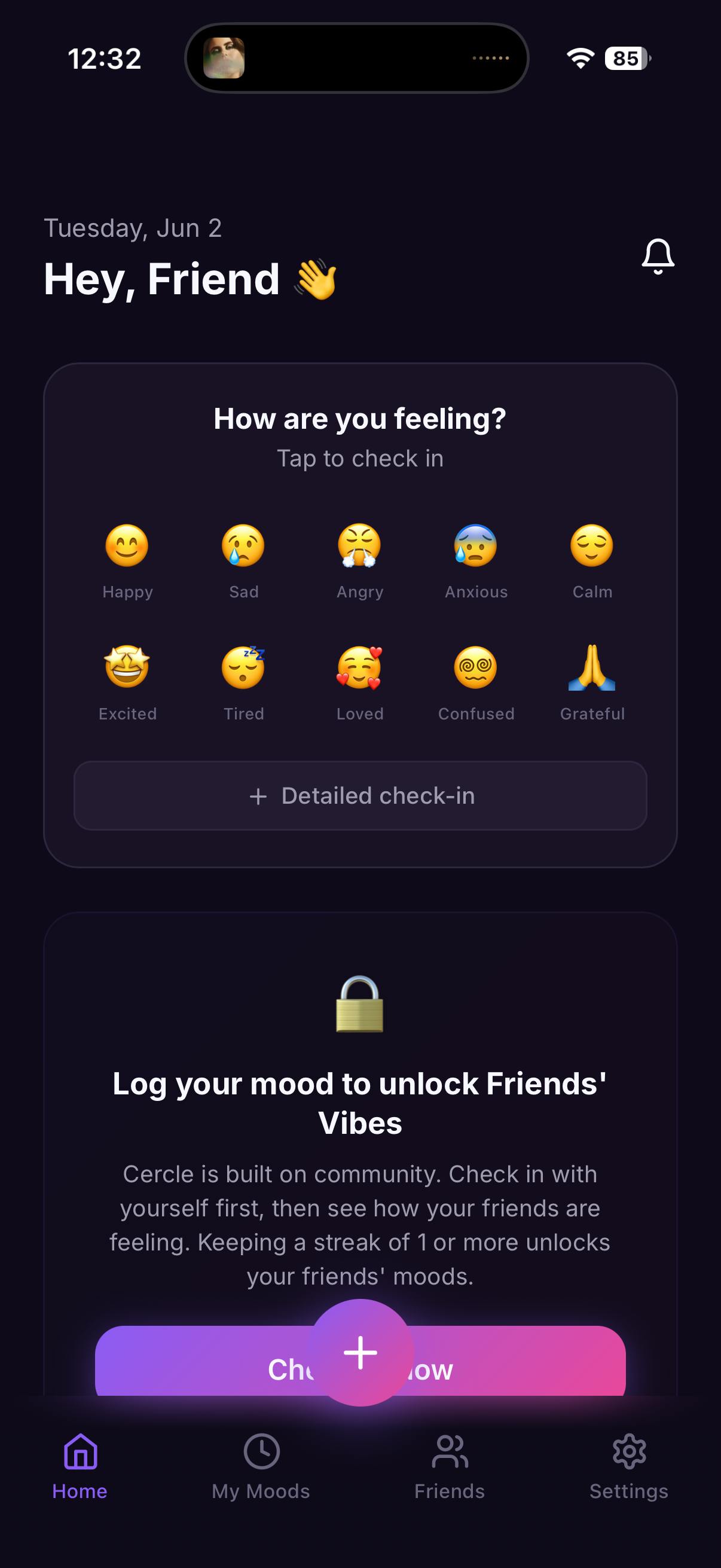
Cercle's Core Mechanism: Making Emotions Visible Signals
Mood Check-ins and Sharing
Cercle's product design revolves around the dimension of "emotion." Users can perform self check-ins to record and share their current mood, choosing to make it visible only to their closest few friends or to their entire Cercle circle. This design cleverly transforms "how am I doing right now"—information that typically requires someone to actively ask—into a passively perceptible status.
The mood check-in feature is rooted in the psychological theory of "affect labeling"—research shows that simply naming your emotions can reduce amygdala activation, thereby lessening the intensity of negative feelings. This feature also resonates with the rising "Quantified Self" movement, which advocates using data tracking of physical and mental states to enhance self-awareness. At the application level, mood journaling apps like Daylio and Pixels have already accumulated millions of users, proving demand for emotion tracking. Cercle's innovation lies in socializing what was previously a private emotion-tracking behavior, expanding from "self-awareness" to "relationship maintenance."
Home-Screen Widget for Real-Time Mood Alerts
The product's most differentiating feature is its home-screen widget. Friends' mood updates display in real time on your phone's home screen, meaning you don't need to open the app or actively inquire—you can gauge someone's state before making a call or sending a message.
A home-screen widget is a UI component provided by mobile operating systems that displays real-time information without opening an app. Apple significantly improved its Widget system in iOS 14 (2020) through the WidgetKit framework, allowing developers to create information cards that remain fixed on the home screen. The core advantage of widgets is "zero interaction cost"—users receive information simply by unlocking their phone, with no additional taps or loading required. Previously, apps like Locket (a real-time photo-sharing widget) had already validated this interaction paradigm in intimate social scenarios. Cercle extends this model from photos to emotional states.
In the company's own words, this "takes the guesswork out of your friendships." When you see a close friend's mood signal drop, you know to reach out before they ask for help—this is the "bat signal" metaphor brought to life.
The Story Behind Cercle
Cercle was built by founder Sheeta Verma, and its inspiration is quite heavy: she witnessed a succession of close friends struggling in silence, bearing their difficulties alone. This state of "living and struggling in silence" reflects the reality of many modern people—even while embedded in social networks, it's hard to receive attention when you truly need it.
From a product philosophy perspective, Cercle isn't trying to solve "how to meet more people" but rather "how to deepen existing intimate relationships." It takes a contrarian approach by deliberately shrinking the social radius, placing the focus on the few people who truly matter. This runs directly counter to the logic of mainstream social platforms that chase scale and connection quantity.
Notably, the "intimate social" track that Cercle occupies is not an empty market. Several products have previously attempted similar directions: Path (a social network limited to 150 people, now shut down), Locket (home-screen widget photo sharing), BeReal (one authentic photo per day), and Pair/Between (couple-focused social apps). The common challenge for these products is that intimate social user bases are inherently small, network effects are weak, and monetization is difficult. However, Gen Z's growing fatigue with large social platforms is accelerating a "social downgrading" trend—users actively shrinking their social circles and seeking more authentic online interactions—which provides a timely window for products like Cercle.
Noteworthy Product Design Approaches
Proactive Care vs. Passive Waiting
Cercle's value proposition is built on one insight: the people who truly need help are often the least willing to ask for it. Traditional instant messaging tools require the help-seeker to send a signal first, but Cercle's continuous mood visualization transfers the trigger for care from the "help-seeker" to the "carer." This design lowers the psychological barrier to seeking help and makes it easier for goodwill to be activated.
This design philosophy has a solid psychological foundation. Social psychology research shows that people are least likely to speak up precisely when they most need help, for reasons including: fear of burdening others, fear of judgment, self-esteem maintenance needs, and the social withdrawal caused by depression itself. This phenomenon is known as the "help-seeking paradox." Traditional social tools are designed on the assumption that "people who need help will initiate a conversation," but this assumption ignores psychological barriers. The "behavioral activation" strategy in cognitive behavioral therapy emphasizes the importance of external triggers—when the outside world proactively extends a hand, people in distress find it easier to accept help. Cercle's design essentially productizes this therapeutic concept.
Balancing Privacy and Boundaries in Emotional Sharing
It's worth considering that emotional sharing is a double-edged sword. Continuously exposing your mood state can create social pressure, and real-time monitoring of friends' emotions may evolve into an invisible burden. Cercle attempts to strike a balance between openness and privacy through layered visibility (close friends vs. the entire circle), but whether this mechanism can truly protect users' sense of boundaries in actual use remains to be verified.
The challenges of emotional transparency span multiple dimensions. First is the "emotional labor" problem—when emotions become visible, users may feel compelled to "perform" a positive state, creating display pressure similar to that on social media. Second is the "surveillance" problem—being continuously observed for emotional state can feel uncomfortable, even when observers mean well. Third is the "compassion fatigue" problem—prolonged exposure to others' negative emotional signals can drain caregivers' psychological energy. Academic discussion around the ethics of "Affective Computing" is intensifying, with the core question being: to what extent should technology intervene in the human emotional domain? Cercle's layered visibility design is an initial response to these issues, but far from an exhaustive solution.
Conclusion: A Gentle Social Experiment Against Loneliness
At a time when the "loneliness epidemic" has become a public health issue, Cercle represents an emerging direction in social product exploration—one that no longer competes on breadth of connection, but returns to depth of connection.
For users tired of broad social networking who crave authentic connections with a few important people, Cercle offers a new approach. Whether it can gain a foothold in the fiercely competitive social space depends on whether users are willing to accept the premise of "emotional transparency" and whether the product can continuously maintain that precious sense of trust. Regardless of the outcome, social experiments like this one—rooted in mental health—deserve the industry's attention.
Related articles

Getting Started in Machine Learning Research: Essential Paper Reading List and Research Internship Application Path
A complete path from zero to research internship for ML beginners, covering essential classic papers (AlexNet, ResNet, Transformer), paper reading methods, reproduction tips, and practical advice for research internship applications.

Claude Code Hands-On Tutorial: Complete Guide from Installation to Automated Development
Complete guide to Claude Code covering environment setup, permission configuration, Go Goals autonomous loops, Skills system, MCP protocol integration, and version control for automated development.

Gemini 3.7 Flash Release and GPT-5.6 Ultra-Fast Mode: AI Open Source Enters the Ecosystem Era
Google releases Gemini 3.7 Flash for coding and Agent optimization while OpenAI launches GPT-5.6 Ultra-Fast mode with 14x speed gains. AI open source shifts from open models to open ecosystems.