Cerebras Runs Qwen3 at 1,500 Tokens/Sec: Why Inference Speed Matters
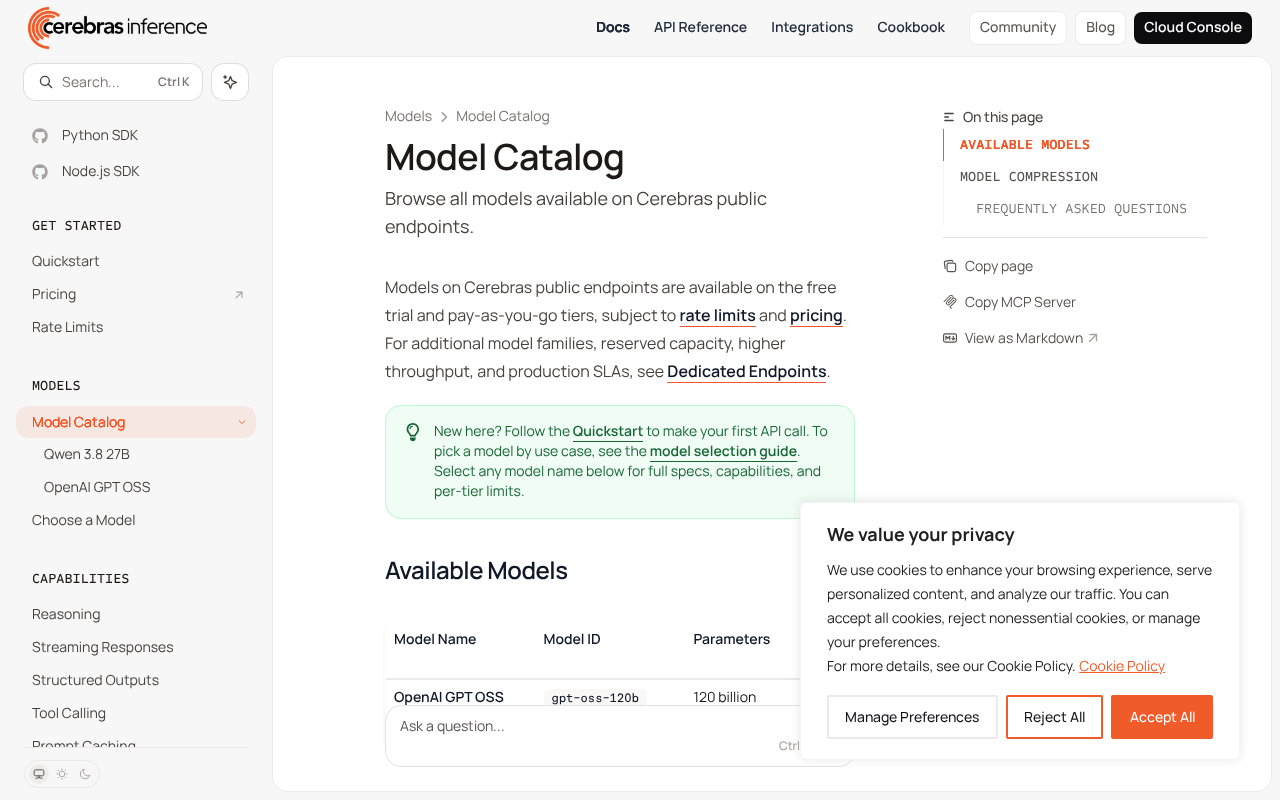
Cerebras achieves 1,500 tokens/sec inference with Qwen3-27B, redefining LLM speed expectations.
Cerebras demonstrated 1,500 tokens/sec inference throughput running Alibaba's Qwen3-27B model on its Wafer-Scale Engine, an order of magnitude faster than typical GPU solutions. The speed gain comes from storing model weights in massive on-chip SRAM, eliminating memory bandwidth bottlenecks. While the community is impressed, key questions remain around cost, high-concurrency throughput, and CUDA ecosystem lock-in.
When Inference Speed Breaks the 1,500 Token/Sec Barrier
A recent Hacker News discussion has sparked widespread attention in the tech community: AI chip company Cerebras announced that running Alibaba's Qwen 3 series 27B-parameter model on its Wafer-Scale Engine (WSE) achieved an inference throughput of up to 1,500 tokens/sec. The post quickly racked up nearly 400 upvotes and hundreds of comments, becoming a hot topic in the community.
For developers who have been following LLM inference performance closely, 1,500 tokens/sec is far from an abstract number. By comparison, mainstream GPU inference solutions (such as deployments based on NVIDIA H100) typically achieve only tens to a couple hundred tokens per second on models of comparable size. Cerebras has boosted inference speed by a full order of magnitude—driven by the unique advantages of its hardware architecture and redefining our expectations for interactive experiences with large models.
Why Cerebras Can Run This Fast
The Architectural Advantage of the Wafer-Scale Engine
Cerebras's core competitive edge lies in its unique Wafer-Scale Engine (WSE). Unlike traditional GPUs, which combine multiple discrete chips through high-speed interconnects, Cerebras fabricates an entire silicon wafer into a single massive processor, integrating hundreds of thousands of compute cores and a vast amount of on-chip SRAM.
The bottleneck in LLM inference often isn't compute power—it's memory bandwidth. During autoregressive generation, the model must repeatedly read weight parameters, placing extremely high demands on memory bandwidth. GPUs are constrained by HBM bandwidth, whereas Cerebras stores model weights directly in on-chip SRAM, avoiding frequent off-chip memory accesses. This yields a massive advantage in per-token generation latency.
A Tipping Point for Conversational AI
What does 1,500 tokens/sec actually mean? Taking Chinese text as an example, this roughly translates to generating hundreds of Chinese characters per second—far exceeding human reading speed. The generation process is essentially instantaneous.
This speed improvement is more than just an incremental gain. When model responses go from "wait a few seconds" to "appear instantly," the entire interaction paradigm shifts fundamentally. In scenarios requiring multi-step reasoning (Chain-of-Thought) or agent workflows, models often need to generate large volumes of intermediate thinking steps. Inference speed directly determines whether these complex tasks are practical.
The Significance of the Qwen3 Model Itself
The model featured in this demonstration is Alibaba's Qwen 3 series. Qwen (Tongyi Qianwen) has been a standout performer in the open-source LLM space in recent years, with models at various sizes ranking highly across evaluation benchmarks—particularly recognized for Chinese language capabilities and code generation.
The 27B parameter scale hits a practical "sweet spot"—it offers significantly stronger reasoning and knowledge capabilities than 7B-class models, while being much easier to deploy and accelerate than flagship models with hundreds of billions or even a trillion parameters. Cerebras's choice of Qwen3 as its showcase model speaks to both the maturity of the open-source model ecosystem and the solid support for mainstream open-source models on non-NVIDIA hardware platforms.
Community Discussion and Reflections
In the Hacker News comments section, developers brought a balanced perspective to the conversation. Beyond the sheer amazement at the speed, many raised critical questions:
- Cost Considerations: Manufacturing and procuring wafer-scale chips is extremely expensive, and Cerebras primarily offers its services through cloud APIs. Whether individual developers and small-to-medium businesses can access this speed at a reasonable price is key to determining its practical viability.
- Batch Processing vs. Single-Request Trade-offs: Exceptionally high single-request speed is impressive, but in real production environments, service providers care more about overall throughput (users served per second). Single-stream 1,500 tokens/sec and overall efficiency under high concurrency are two very different metrics.
- Ecosystem Compatibility: NVIDIA's CUDA ecosystem remains the de facto industry standard. Challengers like Cerebras need sustained investment in software toolchains and framework support to truly disrupt the existing landscape.
The Inference Speed Race Enters a New Phase
Cerebras's achievement is a snapshot of the intensifying competition in AI inference hardware. Beyond Cerebras, dedicated inference chip companies like Groq are also using "ultra-high speed" as their selling point, continuously breaking records. This arms race around inference speed is pushing the entire industry to rethink the "inference-as-a-service" business model.
For end users and application developers, this is undoubtedly good news. Faster inference speed means:
- Smoother real-time conversational experiences, especially in latency-sensitive scenarios like voice assistants;
- More complex agent systems become feasible, as multi-step reasoning and tool calling are no longer bottlenecked by long wait times;
- Costs for inference-intensive applications are likely to drop, since speed improvements often come with optimized per-token costs.
Conclusion
Qwen3 running at 1,500 tokens/sec is both a showcase of Cerebras's hardware prowess and a successful example of combining open-source models with innovative hardware. When inference speed is no longer a bottleneck, we may see an entirely new wave of AI applications emerge. Real-world challenges like hardware costs and ecosystem compatibility still need time to resolve, but the "speed ceiling" for LLM inference is being shattered again and again—and this is only the beginning.
Related articles

Workbuddy for Absolute Beginners: How a Desktop AI Agent Fits Into Real Workflows
A beginner's guide to the Workbuddy desktop AI agent: installation, claiming credits, file management, and building automated workflows—compared with CodeX for fit and cost, helping professionals shift from AI question-askers to AI managers.

OpenAI's New Agent Stack: Computer Use, Decisions API, and Ultra-Fast Workflows
OpenAI Dev Day unveiled a new agent stack: Computer Use outperforms humans, Decisions API delivers ultra-low-latency classification via Luna, Agents API opens the same Computer Use capabilities, and GPT-6.1 Sol costs only one-seventh of Astra. Core updates, benchmark data, and developer insights.

Liang Wenfeng Open-Sources DeepInfo Inference Framework, Takes On U.S. Ban
DeepSeek open-sources its DeepInfo inference framework after its models, featuring GPU/CPU cross-pipelining, small-model prediction with large-model verification, and full Huawei Ascend and NVIDIA chip support—facing the U.S. federal ban head-on. This article analyzes its significance for AI deployment and open-source strategy.