Charter Space Raises $5M to Bring Insurance Solutions to the Space Industry

Charter Space raises $5M to offer specialized insurance coverage that traditional insurers can't provide to commercial space companies.
The rapid growth of commercial spaceflight has created a chronically undersupplied market: space insurance. Traditional insurers lack the domain expertise to properly underwrite satellite launches and on-orbit operations, leaving many space companies without viable coverage options. Startup Charter Space has raised $5 million to address this structural gap, offering tailored risk assessment and underwriting solutions built on genuine industry knowledge. For commercial space companies, insurance is not just a risk management tool — it's a prerequisite for securing funding, signing contracts, and passing regulatory review. Charter Space's emergence is also seen as a sign that the space economy is maturing from technical exploration into full-scale commercial operation.
The Insurance Problem Facing the Space Industry
The space economy is expanding rapidly. From satellite launches to orbital infrastructure, more commercial companies are entering the sector than ever before. Yet a long-overlooked problem has come to the surface: these high-risk, technically complex space ventures often struggle to find insurers willing to cover them.
As Charter Space describes on its own website, space companies routinely face an awkward reality — traditional insurers "heard a bunch of scary science words and freaked out." That tongue-in-cheek line cuts right to the heart of the knowledge gap between the space industry and conventional insurance providers.
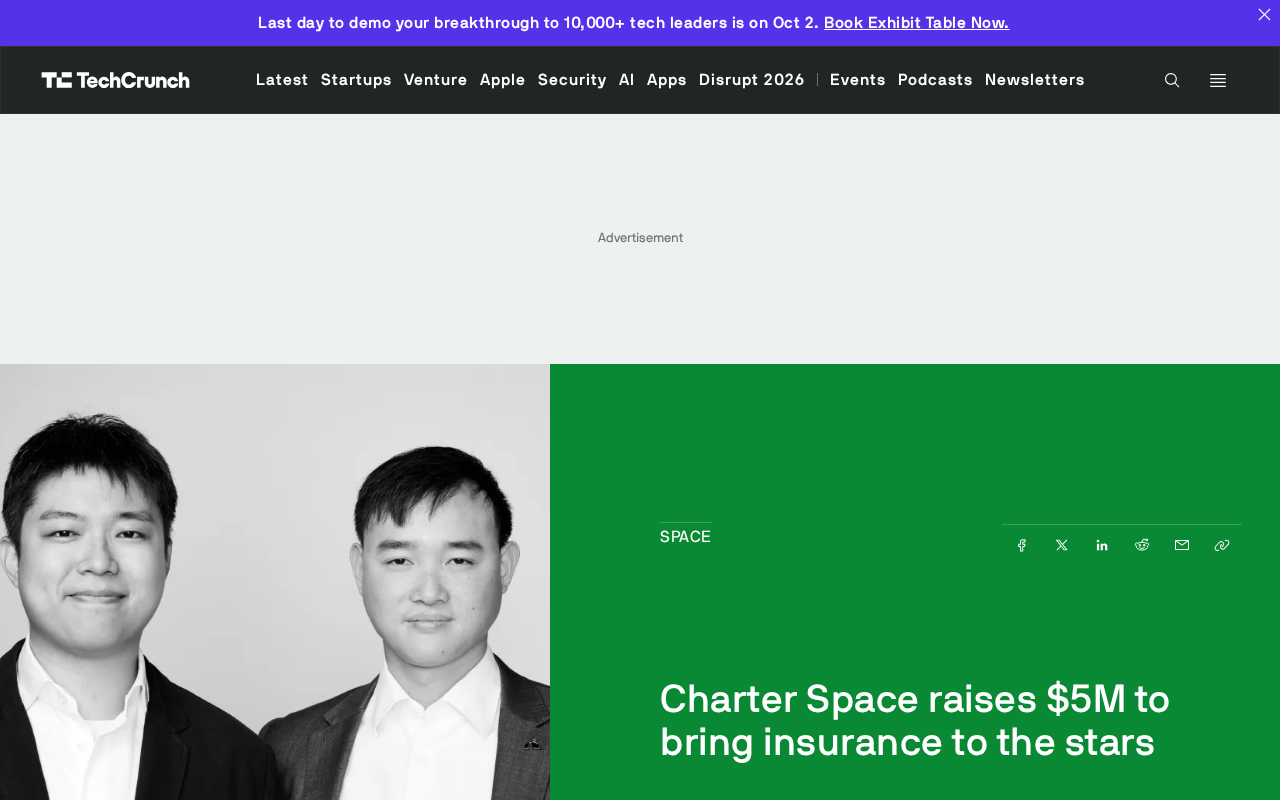
Charter Space's Positioning and Funding Round
Charter Space recently closed a $5 million funding round with a clear mission: bring proper insurance services to the space industry. While $5M is modest by tech startup standards, it's enough for an early-stage company in a focused vertical to validate its market thesis and build out its core product.
The company's entry point is well-defined: fill the gap left by traditional insurers who lack the domain expertise to underwrite space ventures. Space missions involve complex engineering risks, extreme environmental conditions, and extremely high asset values — all factors that make conventional actuarial models a poor fit. Charter Space aims to apply genuine industry knowledge to deliver tailored risk assessment and underwriting solutions for space companies.
Why Space Insurance Is a Real and Urgent Need
As the barriers to entry in commercial spaceflight continue to fall, the number of players launching into space has surged. Satellite constellations, launch services, and in-orbit manufacturing operations all involve massive capital outlays and substantial uncertainty. A failed launch or an on-orbit equipment failure can mean losses in the tens or even hundreds of millions of dollars.
For these companies, insurance isn't just a risk management tool — it's often a prerequisite for securing investment, signing contracts, and passing regulatory review. Without adequate coverage, projects can stall entirely. Charter Space is targeting exactly this kind of structural demand: not creating a new market, but solving a pain point that already exists and is chronically undersupplied.
Space insurance is not a new concept. Commercial satellite launch coverage dates back to around 1965, with Lloyd's of London among the earliest traditional underwriters in this space. However, early market participation was extremely limited, premiums were steep, and coverage was largely confined to the launch phase — leaving gaps for on-orbit failures, debris collisions, and other in-service risks.
With the rise of commercial launch providers like SpaceX, launch frequency has increased dramatically. While this has expanded the pool of risk events, the high technical variability between individual missions still makes actuarial modeling exceptionally difficult — a classic "small sample size, high heterogeneity" problem. The emergence of large satellite constellations like Starlink and OneWeb has introduced yet another layer of complexity: systemic risk scenarios involving hundreds of simultaneous on-orbit assets, where a single software failure or cascading debris event could trigger chain losses at a scale traditional insurance models were never designed to handle.
Industry Observations
From a broader perspective, the rise of space insurance is a marker of the space economy's maturation. When an emerging industry begins to require specialized financial and risk management services, it signals a transition from pure technical exploration toward full-scale commercial operation.
Charter Space's emergence reflects growing capital market confidence in the supporting services layer of the space infrastructure stack. As more specialized service providers enter the sector, the commercial ecosystem around the space industry is likely to deepen. That said, the central challenge remains: how to accurately price risks that are genuinely unprecedented, with little historical data to lean on. That will be the defining technical problem for companies like Charter Space to solve over the long term.
The core technical challenge in space insurance pricing is the tension between scarce historical data and highly customized risk profiles. Traditional actuarial methods rely on large pools of historical loss data from comparable events to estimate probability distributions — but space missions are often one-of-a-kind, with unique technical configurations that resist direct statistical comparison. Approaches currently being explored by the industry include physics-based engineering simulation models as an alternative to pure statistical modeling, digital twin technology for real-time on-orbit satellite monitoring to enable dynamic rate adjustments, and catastrophe modeling frameworks borrowed from the reinsurance market to address systemic risk scenarios. If emerging specialized insurers like Charter Space can establish a defensible edge in pricing methodology, they will build a competitive moat that traditional carriers will find very difficult to replicate.
Related articles

Cursor Can Now Control Your Computer: AI Agents Can Drive Desktop Apps for Testing
Cursor adds desktop control: AI agents can drive desktop apps like the iOS Simulator to test their own features. We analyze the impact on dev workflows, possible technical approaches, and reliability concerns.

Vibecoding a Custom Inference Engine: High Hopes, Harsh Reality
A Reddit developer shares the real experience of vibecoding a custom inference engine: running GGUF Q4 models in the browser with WebGL2 and GLSL, only to fall into tokenizer debugging hell. This article analyzes the engineering challenges of browser-side LLM inference and why cloning llama.cpp is the more rational choice.

How High Are Anthropic's Early Investor Paper Returns Ahead of IPO?
Anthropic's early investor paper returns draw attention ahead of IPO. This article analyzes sources of book gains, capital structure, pre-IPO games and risks, and implications for the AI startup ecosystem.