Chat with Your AI Agent on WhatsApp: A Deep Dive into the Open-Source Tool agent-bridge

agent-bridge is an open-source TypeScript npm package that turns WhatsApp self chat into an AI Agent control interface.
agent-bridge is an open-source TypeScript project that repurposes WhatsApp's "self chat" feature as an interaction interface for AI Agent frameworks, letting users send commands and receive responses in a familiar chat window — no terminal or dedicated app required. Published as an npm package for easy Node.js integration, its value lies in reducing Agent usage friction by embedding access into everyday IM tools for cross-device, anytime reach. However, the solution relies on unofficial WhatsApp automation libraries, carrying account ban risks, and as a personal open-source project, its stability and security auditing still await broader community scrutiny.
An Open-Source Experiment Bringing AI Agents into WhatsApp
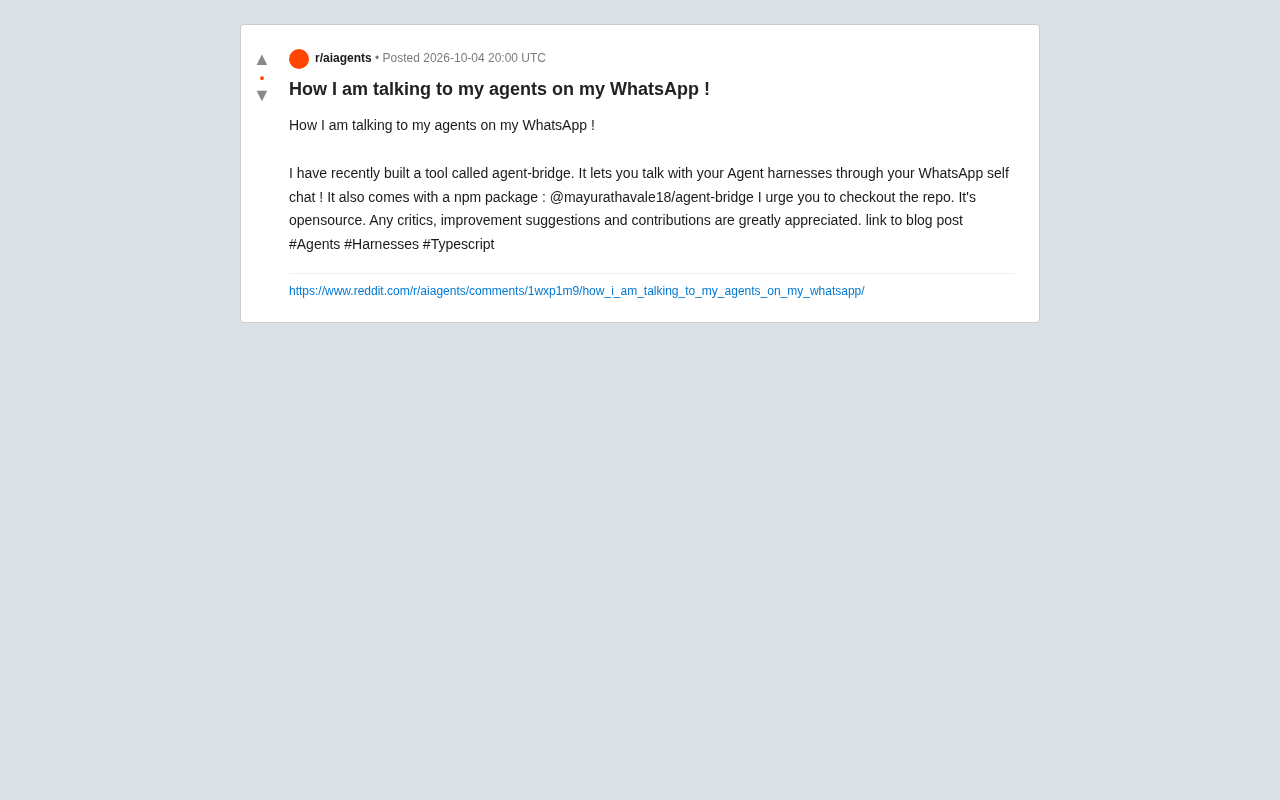
As AI Agent tools continue to proliferate, developers are exploring new ways to interact with intelligent systems. A developer recently shared their open-source project agent-bridge on Reddit, with a straightforward core idea: use WhatsApp's "self chat" feature to communicate directly with your Agent framework.
What makes this approach clever is that it turns an instant messaging interface people already use every day into a control panel for AI Agents. No need to open a terminal or switch to a dedicated app — just send a message in a familiar chat window and let the backend Agent handle the task.
What Exactly Is agent-bridge?
According to the author, agent-bridge is a bridge connecting WhatsApp to an Agent harness — the underlying framework that hosts and orchestrates Agent execution, managing lifecycle, tool calls, and context. agent-bridge's role is to forward WhatsApp messages to these harnesses and relay the Agent's responses back to the chat window.
The project is written in TypeScript and published as the npm package @mayurathavale18/agent-bridge, meaning any Node.js developer can integrate it into their project with a single install command. The author emphasizes that this is a fully open-source project and welcomes community criticism, improvement suggestions, and code contributions.
Why WhatsApp's "Self Chat"?
WhatsApp's self chat (messaging yourself) is an often-overlooked feature, typically used for note-taking or temporarily storing information. agent-bridge repurposes this private, self-only channel as a human-machine interaction interface, offering several practical benefits:
- Zero learning curve: The chat interface is an interaction paradigm everyone already knows
- Cross-device sync: WhatsApp natively supports multi-device access across phones and desktops
- Access from anywhere: You can issue commands to your Agent whether or not you're at a computer
From a technical implementation perspective, agent-bridge likely relies on unofficial WhatsApp Web reverse-engineering libraries (such as whatsapp-web.js or baileys) to send and receive messages. These libraries simulate the WebSocket protocol of the WhatsApp Web client to communicate with WhatsApp servers, enabling message automation without the official Business API. By contrast, WhatsApp's official Cloud API requires business verification and charges per message volume — a higher barrier to entry. The advantage of unofficial libraries is zero cost and flexibility, but the trade-off is a persistent risk of account bans — WhatsApp detects automated accounts through behavioral pattern analysis and may restrict them. Understanding this underlying dependency helps developers assess their own risk tolerance before trying it out.
What Pain Points Does This Type of Tool Address?
The practical value of AI Agents depends heavily on "accessibility." Many powerful Agent frameworks are hindered by the requirement to run in a specific environment, forcing users to stay at their computers and interact through a command line or dedicated interface. Moving the entry point to an IM platform is fundamentally about reducing the friction of using Agents.
This type of thinking is not uncommon in the industry — invoking backend services via Telegram Bot, Slack, WeCom, and similar channels has long been standard practice. What differentiates agent-bridge is its specific adaptation for Agent harnesses, its focus on WhatsApp as a platform with a massive global user base, and its developer-friendly approach through open source and the npm ecosystem.
Practical Considerations to Keep in Mind
Despite its elegant concept, there are real trade-offs to weigh when deploying this type of project. WhatsApp has strict policies around unofficial automated access, and connecting via unofficial means carries account risk. Message bridging also raises privacy and data security concerns — your commands and Agent responses both pass through an intermediary layer.
Furthermore, as a personal open-source project, its stability, maintenance commitment, and level of security auditing remain to be tested by the community. The author has openly invited external scrutiny, which is precisely how open-source projects grow healthily: iterating and improving through real-world use and community feedback.
WhatsApp's Terms of Service explicitly prohibit unauthorized automated access, and violating accounts may face temporary bans or even permanent suspension. For individual developers' experimental projects, the actual probability of being banned varies by usage intensity and behavioral patterns — low-frequency use carries relatively lower risk. If you need similar functionality running reliably in a production environment, more stable alternatives include: WhatsApp Business Cloud API (officially supported but paid), Telegram Bot API (fully open and free), or the Matrix protocol (decentralized and open-source friendly). On the privacy front, when messages are processed by a locally running bridge service, data doesn't leave your own server — but if the bridge is deployed in the cloud, you'll need to additionally evaluate data retention and transmission encryption policies.
Conclusion
agent-bridge represents a direction worth watching — embedding the interaction entry point for AI Agents into tools people use in their daily lives. For developers who want to dispatch their Agents on the go, this is a lightweight, open-source, and quick-to-get-started experiment. If you're a TypeScript developer, take a look at the GitHub repository for implementation details and give the npm package a try yourself.
Of course, given the limited original information available, a complete assessment of its specific architecture, supported Agent framework types, and performance characteristics will require further review of the project documentation and hands-on experience.
Related articles

JobRunner MCP Server: AI Agents Can Now Fix Failed Java Jobs
JobRunner launches an open-source MCP server enabling AI agents to view cluster status, diagnose failures, and recover Java jobs—incident response from any cloud coding environment or existing agent.

MLAI Digital Launches 9 Security Agents: MCP Server Safeguards the Full Lifecycle of Agentic AI
MLAI Digital launches Security MCP Server with nine built-in specialized security agents covering vulnerability discovery, attack simulation, prompt injection detection, API and infrastructure assessment, and accelerated remediation—embedding security validation across the full Agentic AI lifecycle from development to production.

Running Isaac Lab on H100 GPUs: Exploring Better Approaches
Exploring optimization methods for running Isaac Lab on NVIDIA H100 GPUs, including MIG configuration, mixed precision, TensorRT acceleration, and community experience to improve robotics simulation and reinforcement learning efficiency.