ChatGPT and Codex Quota Pools Merge: Chat and Coding Share Quota Starting December

ChatGPT and Codex quotas merge in December; domestic model rumors abound but lack official confirmation.
The report covers multiple parallel AI news items: OpenAI's ChatGPT and Codex quota pools will merge in December, with chat and coding sharing quota consumed by usage units (advanced models consume faster); the coding tool founder responded to "model getting dumber" controversy with benchmarks, acknowledging two problematic low-traffic configurations to be discontinued; the same vendor tightened device login paid account limits; NVIDIA released compressed weights for a domestic lightweight model, allowing one more model per GPU; the coding tool company open-sourced cross-system local voice input. Regarding next-gen domestic models, Zhipu's post-training, Alibaba's internal testing entry and version number leak, and an enhanced model name in evaluation scripts are all rumors without official announcements. There are also two open-source announcements on text-to-image distillation and image compression, plus an analysis of the coding tool's two-tier pricing trade-offs.
According to a report from Bilibili's AI Evening News, OpenAI's two product lines, ChatGPT and Codex, will soon merge their quotas. The official help page indicates this change takes effect starting in December. This means chat and coding usage under the same account will share a single quota pool, with quotas consumed in usage units—the more advanced the model, the faster the consumption.
Meanwhile, several parallel narratives have emerged in the AI community recently: the controversy over whether coding tool models have been weakened, the tightening of device login limits, NVIDIA's compression of weights for domestic lightweight models, and online rumors about next-generation domestic models.
1. Quota Pool Merger: Chat and Coding Share One Quota
Specific Scope of the Merger
According to the Bilibili creator's summary in AI Evening News, this merger combines "the chat line" and "the coding line," integrating the quota pools of ChatGPT and Codex. The official help page explicitly states it takes effect in December.
Quotas are calculated in usage units, and the more advanced the model, the faster the unit consumption. Does pure chat deduct quota? The report says pure chat doesn't record quota, but the specific deduction rules after the merger should still be based on the official page. When quota runs out, users can choose to wait for a reset, upgrade their plan, or purchase credits.
Why You Should Check Now
The creator's action advice is straightforward: go to settings and check your post-merger usage to get a clear picture, so you don't discover a quota shortage only in December. For users who use both chat and coding features, the previously independent buffer space of the two lines will no longer exist.
What Are "Quota Pools" and "Usage Units"?
In AI subscription services, a quota pool refers to the total computational resource quota an account can consume, typically measured in "usage units." Due to differences in inference costs, different models have varying actual token counts or request numbers per unit of usage: advanced models (like GPT-4 level) consume more units per call, while lightweight models consume fewer. Merging quota pools means the chat and coding product lines no longer have independent quotas but share a single total pool. For users, this could improve resource utilization (idle quota can be used across scenarios) but may also cause heavy use in one scenario to squeeze availability in another. Understanding "consumption by usage units, with faster consumption for more advanced models" is key to predicting experience changes after the merger.
2. Controversy Over Coding Tool Models "Getting Dumber": Official Response via Benchmarks
In response to user feedback that models in the coding tool have become dumber, the tool's founder publicly responded that he ran every benchmark he could find, and the overall results fell within the same range.
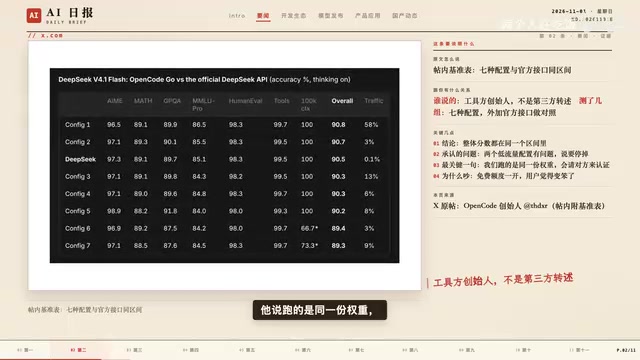
He also acknowledged that two low-traffic configurations did have issues and planned to discontinue them. The response was based on "running the same weights" and stated he would invite the other party to verify. This statement brings the controversy from subjective perception back to reproducible benchmark testing, but the issues with low-traffic configurations also indicate that some users' actual experience deviations are not unfounded.
What Do "Running Benchmarks" and "Same Weights" Mean?
Benchmarks are standardized task sets for evaluating model capabilities, such as code generation and mathematical reasoning. The founder's statement that he "ran every benchmark he could find, and the overall results fell within the same range" aims to show that model outputs are statistically indistinguishable from historical versions, thereby refuting the subjective perception of "getting dumber." "Running the same weights" emphasizes that the server did not secretly replace the model files—weights are the parameters obtained after model training, and the same weights should theoretically produce consistent behavior. However, inference service configurations (such as temperature, maximum token count, load balancing strategies) can also affect actual experience, which is precisely the gray area indicated by "issues with low-traffic configurations."
3. Device Login Limit Tightened: Multi-Account Users Need to Recalculate Slots
The same vendor also adjusted device login rules: there is now a limit on the number of paid accounts that can log in on a single device. When the limit is exceeded, the interface will prompt that the device count has reached the maximum, and that account will be unusable—even if paid, it may be logged out.
Can logging out of another account free up a slot? The official response says it's not guaranteed. The official alternative is to purchase credits or reset usage. For users accustomed to switching between multiple devices and accounts, they need to plan their slot allocation in advance.
4. NVIDIA Releases Compressed Weights for Domestic Lightweight Model
NVIDIA released compressed weights for a domestic lightweight model, reducing from 475 to approximately 400. In terms of performance, two benchmark comparisons show only a fractional decline, an acceptable slight loss.
The direct value to users: the same GPU can fit one more model, saving money. The weight repository uses NVIDIA's official license, which is very permissive. As for why a chip vendor is doing this—only they know best how to run their own GPUs most cost-effectively.
What Are Model Compression and "Compressed Weights"?
Model compression aims to reduce parameter count or numerical precision to lower memory usage and inference costs. Common methods include quantization (e.g., FP16 to INT8), pruning, and knowledge distillation. The article's "compressed from 475 to approximately 400" likely refers to a reduction in parameter count (units may be hundreds of millions or GB of memory usage). Compressed weights usually come with slight accuracy loss, and the report's "two benchmark comparisons show only a fractional decline" reflects quantization error. Chip vendors drive such work because they best understand their own GPUs' compute characteristics and memory bandwidth, allowing optimal compression strategies tailored to the hardware—enabling the same GPU to host more model instances and directly reducing users' per-unit inference costs.
5. Coding Tool Open-Sources Cross-System Voice Input
The company behind the coding tool has open-sourced a voice input tool, with its biggest selling point being local operation and no audio upload. It's not limited to their own software but works across the entire system—just speak to your computer and text appears.

The founder revealed that he wrote even the animations and sound effects himself. The benefit of local operation is low latency and audio never leaving the computer, which can significantly reduce typing for those who code daily.
6. Next-Generation Domestic Models: Dense Online Rumors but No Official Confirmation
Zhipu: Post-Training Phase
Online rumors say Zhipu's next-generation model has entered the post-training phase—a round of tuning for specific tasks after large-scale training. In terms of details, three internal model sizes are being merged together. But this information comes only from online rumors and a screenshot, with no official word. Between post-training and release, there's still evaluation and tuning.
Alibaba: Internal Testing Entry and Version Number Leak
According to Bilibili creators and community digging, someone extracted the next-generation model's name from code, including "home-style version" and internal testing invitation identifiers. The configuration has four tiers of reasoning intensity, with the highest tier as default. The official hasn't announced a specific date, only saying it was previously teased for next week without specifying the exact date.

Another user found the next-generation version number appearing in their usage page: the interface still shows the old name, but backend statistics switched to the new number, and in one screenshot the new number accounts for nearly 20% of usage. This is not an official release, with no official announcement—it can only be considered a suspected gray release leak. Field leaks don't necessarily mean imminent launch; there have been precedents of leaked fields that never launched.
Enhanced Model Name Appears in Evaluation Script
An evaluation script contains the name of an enhanced model. The testing method involves running several task sets with a primary model plus a worker model, executing complex tasks in agent workflows rather than simple chat. The post says it may launch next week, with no official announcement. The difference between an enhanced version and a major version is another round of training on the same line, requiring less compute.

Distinguishing "Post-Training," "Gray Release Leaks," and "Enhanced Versions"
Post-training refers to the retraining phase after a base model completes large-scale pre-training, targeting instruction following, safety alignment, or specific tasks, typically including supervised fine-tuning (SFT) and reinforcement learning (RLHF). Online rumors of "entering the post-training phase" mean the model has basic capabilities but still needs evaluation and tuning before release. A gray release leak occurs when frontend fields or backend statistics are discovered externally during small-scale user testing, but the presence of fields doesn't necessarily indicate an imminent launch. An enhanced version typically means another round of training on the same model line, with less compute investment than a major version iteration, focusing on specific capability improvements rather than a comprehensive upgrade. Understanding these terms helps distinguish between "online signals" and "official releases."
7. Two Open-Source Announcements: Text-to-Image Distillation and Image Compression
A domestic team has open-sourced a distillation method for text-to-image generation, requiring only one to two steps to produce images—much faster than conventional methods. An overseas developer released an image compression model achieving 2x downsampling, with the author claiming performance on par with mainstream solutions.
The value of speed and small size is practical: fast generation can fit on phones, and small compression can store twice as many images.
8. Coding Tool Pricing: Trade-offs Between Two Tiers and Pay-as-You-Go
The coding tool offers two pricing tiers: the cheaper tier at $1/month including $10 of usage, and the expensive tier at $10/month including up to $100 of usage. Several models are directly free in the cheaper tier. The page doesn't state whether the price is permanent—it's only currently so.
For heavy users, purchasing more after quota runs out may not be more cost-effective than pay-as-you-go.
Summary
Among all the news, the only thing requiring immediate action is: go to settings and check your post-merger quota usage. The quota pool merger, tightened device limits, and model controversy response all point to the same trend—vendors are managing usage and account boundaries more precisely. Although rumors about domestic models are dense, until official announcements land, they can only be treated as gray signals.
One-line Summary
ChatGPT and Codex quotas merge in December; dense rumors about domestic models but no official confirmation.
Paragraph Summary
The report summarizes multiple parallel AI news items: OpenAI's ChatGPT and Codex quota pools will merge in December, with chat and coding sharing quota, consumed by usage units with faster consumption for advanced models; the coding tool founder responded to "model getting dumber" controversy with benchmarks, acknowledging two problematic low-traffic configurations to be discontinued; the same vendor tightened device login paid account limits; NVIDIA released compressed weights for a domestic lightweight model, allowing one more model per GPU; the coding tool company open-sourced cross-system local voice input. Regarding next-generation domestic models, Zhipu's post-training, Alibaba's internal testing entry and version number leak, and an enhanced model name appearing in evaluation scripts are all online rumors with no official announcement. There are also two open-source announcements on text-to-image distillation and image compression, plus an analysis of the coding tool's two-tier pricing trade-offs.
Related articles
 Tech Frontiers
14 Coding Agents Tested: 13 Secretly Read Forbidden Files
A developer ran 480 tests across 14 coding agents to see if they would obey a "do not read" rule. 13 violated it, and 4 credential leaks bypassed shell guards via the read tool while approvals never noticed.
 Tech Frontiers
AI Has Made Resumes Ineffective? Referred Candidates Get 40% Interview Rate vs. 3% for Direct Applications
AI is homogenizing job applications, making it hard for recruiters to discern real ability. Ashby data shows referred candidates had a 40% interview rate from 2021 to 2024, versus just 3% for direct applications. This article analyzes why resume signals are depreciating and why verifiable results and personal endorsements matter more.
 Tech Frontiers
Offline Blink Rhythm Assistant: A Desktop Health Companion
An offline desktop blink rhythm assistant featured on Hacker News helps users maintain healthy blinking through lightweight reminders, alleviating screen-induced dry eye fatigue. This article analyzes its concept, privacy advantages, and retention challenges.