ChatGPT and Codex Share Usage Quota: The Key Details OpenAI Hasn't Disclosed
ChatGPT and Codex will share a usage pool; instant chat is exempt, but per-plan token quotas are undisclosed.
OpenAI's Help Center confirms that starting December 2026, ChatGPT's regular conversations and Codex coding will share a single usage pool, affecting Plus, Pro, and Business users, with instant-style quick chats exempt. Usage is measured in tokens, and consumption speed depends on the model and task complexity; heavier models handling large codebases drain budgets much faster. After hitting the limit, there are only three options: wait for a reset, upgrade your plan, or buy credits. OpenAI hasn't disclosed the exact change date or per-plan token quotas—any precise numbers are guesses. The article also cross-verifies Meituan's LongCat 2.5 full release, noting disputed parameter claims, company-reported benchmarks, and open-source weights not yet live.
OpenAI is quietly changing the usage rules for paying users. Starting December 2026, ChatGPT's everyday conversations and Codex's coding sessions will share a single usage pool, affecting Plus, Pro, and Business users alike. But the most critical detail—exactly how many tokens each plan includes—was not disclosed in OpenAI's Help Center update.
What Does a Shared Usage Pool Mean?
According to OpenAI's Help Center article "Understanding ChatGPT and Codex Usage Limits," updated October 31, 2026, ChatGPT's regular conversations and Codex coding previously had separate quota pools. You could exhaust your chat quota without affecting your coding quota, and vice versa. Codex and ChatGPT's internal work tools already shared a pool, and the December change will pull regular conversations into that same pool.
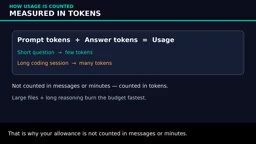
In other words, the quota wall between chatting and coding will be torn down. OpenAI explicitly states that usage is measured in tokens—the smallest unit of text a model reads and writes. Every prompt you send and every answer you receive consumes tokens. This is why quotas are measured in tokens rather than message counts or minutes.
Different tasks consume tokens at wildly different rates. A short question uses very little, while a coding session processing large files with long reasoning consumes a great deal. How fast your budget drains depends on two factors: the model you choose and the task you give it. A heavier model performing deep reasoning or handling a large codebase will consume far more tokens than a lightweight model answering a simple question.
Tokens and Context Windows
A token is the smallest unit of text a language model processes; roughly one English word corresponds to about one token, while Chinese uses about 1.5–2 characters per token. Every inference requires the model to split input text into tokens and then generate output tokens one by one, which is why billing and quotas are generally based on tokens. Closely related to tokens is the context window—the maximum number of tokens a model can "remember" in a single session, including both input and output. A larger context window lets the model handle longer documents and larger codebases at once, but each request consumes correspondingly more tokens. Understanding the difference between tokens and context windows helps explain why long agent tasks (multi-step agents) consume more budget than single-turn Q&A: an agent repeatedly reads and writes intermediate results, stacking token costs at every step.
An Important Exception: Instant Chat Doesn't Count Against the Quota
OpenAI states that instant-style quick chats do not draw from the shared pool. If you just need a quick answer and use instant chat, it shouldn't consume the budget you need for long conversations or Codex coding sessions. This exception is worth remembering—after December, it may become your go-to way to handle small questions.
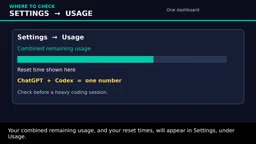
OpenAI also states that you'll see your full remaining usage and reset times on the "Usage" page in Settings. This matters because once chatting and coding share a single pool, you need one unified dashboard rather than two guesses. Before December, get in the habit of checking the usage screen to understand how much shared quota remains and when it resets, so you can plan heavy coding work around it.
The Role of Instant Chat
Instant chat generally refers to ChatGPT's lightweight mode for quick Q&A, characterized by low latency and short answers, often powered by smaller or distilled models rather than full reasoning models. In contrast, deep reasoning modes (such as the o-series or models with a "thinking" button) generate internal reasoning tokens before answering, taking longer and consuming more. By excluding instant chat from the shared pool, OpenAI is effectively encouraging users to route simple queries to a low-cost channel, reserving shared budget for long conversations and Codex coding sessions. This design also means users must actively judge task complexity: factual queries and short rewrites suit instant chat, while multi-turn debugging and code generation are better suited to heavier models that consume the shared quota.
Three Options After Hitting the Limit
According to OpenAI, once you hit the limit you have three options: wait for the reset, upgrade your plan, or purchase credits for eligible features. There is no fourth option in the Help Center's wording. If you rely on Codex for daily work, don't let large coding tasks land at the end of a usage cycle without a backup plan, because waiting for a reset could pause your work.
OpenAI's own statement is that it expects most users will need to wait no more often than they do now. This is OpenAI's expectation, not a guarantee, and not a promise about your account. If you're a light user, this expectation may hold; if you're a heavy Codex user or run long agent sessions daily, you should watch the usage screen closely in December and judge based on your own data.
The Gaps OpenAI Left
This is the most critical part: OpenAI has not announced a specific start date for the December change, nor the quota size for each plan under the new shared pool. We don't know how many tokens Plus, Pro, or Business each receive. Until OpenAI publishes these numbers, any video claiming to know the exact December token counts is guessing.
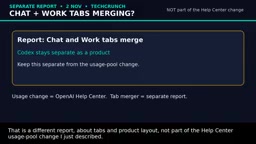
Another report worth distinguishing: a separate TechCrunch report on November 2 said OpenAI is merging ChatGPT's Chat and Work tabs, while Codex remains independent as a product. That's a different report about tabs and product layout, not part of the Help Center usage pool change. The usage change is confirmed by OpenAI's Help Center; the tab merge is a separate November report—don't conflate the two.
Cross-Verification Across Sources: Meituan's LongCat 2.5 Release
In a separate event, Meituan fully released the LongCat 2.5 model on November 1–2, 2026. According to multiple sources, LongCat 2.5 is not an entirely new model—it existed as an API preview as early as September 25. What's new is the full release. Meituan describes it as a native multimodal model for long-horizon agent tasks, where agents can run continuously across multiple steps, tools, and checks rather than answering a short question.
Meituan lists 1.6 trillion total parameters with about 48 billion activated per token. But caution is warranted: an October 29 report noted these figures were carried over from LongCat 2.0's model card, so the parameter claims are disputed and not yet settled. Clearer is the context window: 1 million tokens of context, with up to 128,000 output tokens.
Meituan also says LongCat 2.5 was trained on longer agent action sequences, including sequences containing failures, so the agent learns to recover and continue rather than only following perfect paths. The model is optimized for Chinese domestic chips, pointing to a model designed to run well on hardware within China.
LongCat 2.5 is currently available via the LongCat Chat website (longcat.chat) and the LongCat API. Meituan says the API is compatible with Claude Code, Codex, and Hermes tools, explicitly targeting developers already using coding agents. Open-source weight release is described as "coming soon" and is not yet live. If you see posts claiming open-source weights are already on GitHub, that's ahead of the facts.
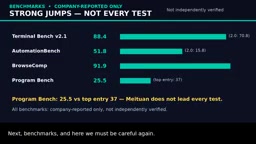
On benchmarks, all figures are company-reported and have not been independently verified. Meituan reports Terminal Bench 2.1 at 88.4, up from 70.8 in 2.0; Automation Bench at 51.8, up from 15.8; and BrowseComp at 91.9. If these numbers hold, they're strong jumps. But Meituan doesn't lead on every test—on Program Bench, LongCat 2.5 scores 25.5, while the top entry is 37.
On pricing, Meituan lists limited-time API pricing: 30 cents per million input tokens, 0.6 cents per million cached input tokens, and $1.20 per million output tokens. This is a limited-time price and should be treated as open beta rather than a permanent rate. When comparing agent model costs, remember that long agent tasks consume large numbers of tokens, so both the per-million price and total tokens per task matter—not just the sticker price.
Mixture-of-Experts (MoE) Architecture and "Total/Activated Parameters"
LongCat 2.5's published "1.6 trillion total parameters, about 48 billion activated per token" is a typical Mixture-of-Experts (MoE) architecture description. An MoE model consists of multiple expert subnetworks and a routing mechanism; each forward pass activates only some experts, so total parameter count can be far larger than the parameters actually used in a single computation. Total parameters determine the model's capacity ceiling, while activated parameters more directly affect inference compute and cost. This also explains why parameter claims easily spark controversy: different sources may confuse total and activated parameters, or carry over old model cards. When evaluating MoE models, consider total parameters, activated parameters, training data, and context window together—not just a single number.
Things to Watch That Haven't Happened Yet
Qwen 4 has still not been released. Some reports mention a November 2–8 window, but that's only report-stage talk with no official confirmation—don't treat Qwen 4 as released. Kimi K3.1 Pro open-source weights are scheduled for November 4, but there's no repository yet. When the date arrives, check the actual repository before trusting any download link.
What You Should Do
If you use both ChatGPT and Codex, start watching the usage screen now and think about which work suits instant chat, which suits lightweight models, and which heavy coding tasks are worth consuming the full shared budget. If you're following agent models, observe LongCat 2.5 with the same discipline: test the live chat and API, wait for independent benchmark verification, and wait for a real GitHub release before calling it open source.
Starting in December, ChatGPT and Codex share one budget, instant chat stays exempt, and the exact size of that budget remains undisclosed. LongCat 2.5 is fully released with a large context, mixed benchmark performance, and an open-source release still to come.
Credits and the Usage Reset Mechanism
OpenAI's mention of "purchasing credits for eligible features" refers to buying additional usage beyond your plan's quota on demand, typically priced per token or per request and tied to specific features (such as Codex coding sessions). Credits differ from the usage included in your plan: plan quotas reset per cycle and typically don't roll over, while credits are paid increments whose validity period and scope are governed by official terms. The three options after hitting the limit—waiting for a reset, upgrading your plan, and buying credits—correspond to time cost, subscription cost, and usage-based cost, respectively. For heavy users who depend on Codex, estimating token consumption per coding session in advance and scheduling heavy tasks early in the cycle is more controllable than passively waiting for a reset at the end.
One-line Summary
ChatGPT and Codex will share a usage pool, with instant chat exempt, but per-plan token quotas remain undisclosed.
Paragraph Summary
OpenAI's Help Center confirms that starting December 2026, ChatGPT's regular conversations and Codex coding will share a single usage pool, affecting Plus, Pro, and Business users, while instant-style quick chats don't draw from it. Usage is measured in tokens, with consumption speed depending on the model and task complexity; heavy models handling large codebases drain budgets significantly faster. After hitting the limit, there are only three options: wait for a reset, upgrade your plan, or buy credits. OpenAI hasn't announced the exact change date or per-plan token quotas—any precise figures are guesses. The article also cross-verifies Meituan's LongCat 2.5 full release, noting its disputed parameter claims, company-reported benchmarks, and open-source weights that aren't yet live.
Related articles
 Tech Frontiers
Gemini Omni 1.2 Flash: AI Video Moves Toward Draft-Style Editing
Google's Gemini Omni 1.2 Flash update enables conversational, draft-style editing of the same video—swap scenes while keeping products, adjust lighting while keeping characters. Clips up to 15s, 720p costs 30% less than the previous Flash—ideal for e-commerce ads, previs, and short-asset production.

Codex Tutorial: One-Command Install and Run Your First Task
Codex tutorial: one-command install and run your first task. Covers the four Codex forms, sandbox and approval guardrails, AGENTS.md and MCP configs, cloud network policy, and the iron rule of human review—everything you need to get started with this autonomous coding agent.
 Tech Frontiers
Localix: An Open-Source Agentic Development Environment with Multi-Model and Local AI Integration
Localix is an MIT open-source Agentic Development Environment (ADE) supporting seamless Claude Code plugin loading, multi-model cloud and local execution, Mini Apps extensions, and agent context management—an open AI collaboration workbench for developers.