ChatGPT and Codex Usage Limits Merged: OpenAI Moves to Unify Coding and Conversation

OpenAI merges ChatGPT and Codex usage limits, signaling Codex's shift from standalone product to platform capability module.
Starting from a low-traffic Hacker News post, this article discusses OpenAI's product adjustment of merging ChatGPT and Codex usage limits. The author notes that the essence of the merge is changing quota allocation from 'per product' to 'per account,' driven by reducing user cognitive burden and promoting coding capability as added value of ChatGPT subscriptions. High-frequency coding users are most affected, as agentic coding tasks and conversation tasks will compete for the same quota; team management becomes easier, while light users notice little change. The article views this as reflecting Codex's shift from independent exploration toward platform integration, beneficial for subscription tier design and account value measurement, but transparency remains the real test, with specific quota rules still awaiting official clarification.
A Seemingly Lightweight Product Adjustment
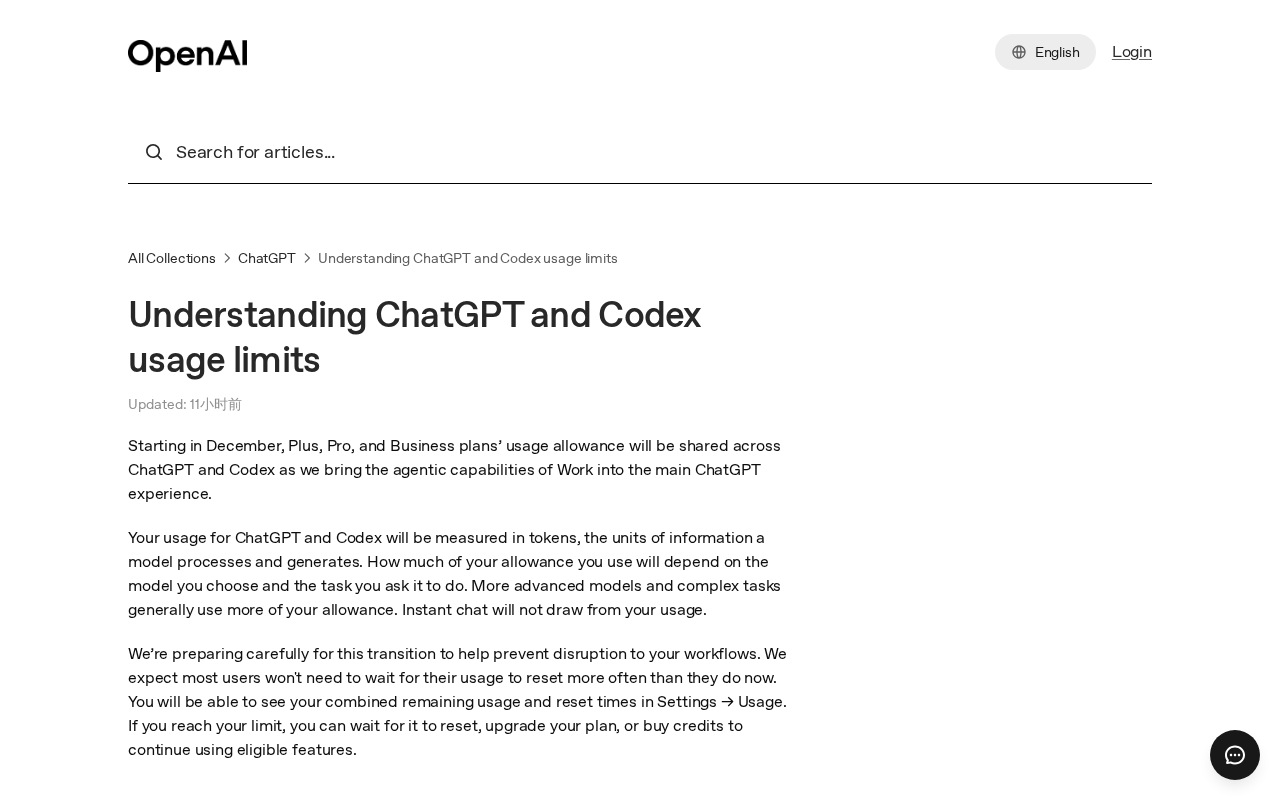
A post on Hacker News with just 14 upvotes, titled "ChatGPT and Codex usage limits merging," carries very little information — yet it points in a direction worth pondering: OpenAI is merging the usage limits for ChatGPT and Codex. This means users may no longer need to distinguish between "conversation quota" and "coding quota" in the future, but instead share a single quota pool.
For ordinary users, this looks like a minor interface-level change; for heavy developers, it could directly change how they invoke AI in their daily work. To understand its significance, one first needs to grasp where these two products sit within OpenAI's ecosystem.
Two Products, Two Billing Logics
ChatGPT targets general-purpose conversation scenarios, covering writing, Q&A, analysis, and similar tasks; Codex is built around code generation, completion, and agentic coding. Previously, each maintained its own usage cap, so when users switched between the two, they were effectively dealing with two independent quota accounting systems.
Merging the usage limits essentially changes "splitting by product" into "splitting by account." There may be two motivations behind this: first, reducing the cognitive burden on users; second, making it easier for OpenAI to promote coding capabilities as an added value of ChatGPT. If Codex no longer has an independent quota, it becomes more like a capability module within ChatGPT's premium subscription.
The evolution of Codex: Codex was originally a code generation model released by OpenAI in 2021, widely known as the underlying engine for GitHub Copilot, and was deprecated in March 2023. In the current context, "Codex" refers to the agentic coding tool that OpenAI relaunched in 2025. It is not a single model but a coding agent product that integrates code generation, completion, refactoring, test running, and other capabilities, usable via CLI or IDE plugins. It shares the same underlying model family as ChatGPT but differs in product positioning and interaction form, which is why it previously maintained an independent usage quota. Understanding this evolution helps clarify that merging the limits is not a simple stacking of two parallel products, but rather OpenAI's strategic retreat of "coding" from an independent tool back into a platform capability.
Who Is Most Affected by the Merged Limits
The most directly affected are high-frequency coding users. If, after the merge, ChatGPT's general conversation and Codex's coding calls share the same quota, then a long agentic coding task could squeeze subsequent conversation usage space, and vice versa. For developers who use AI to write code every day while also using ChatGPT to handle documents and communication, quota planning will require more trade-offs.
Another affected group is teams and light users. For team procurement, a merged quota is easier to manage uniformly; light users may not notice any change at all, or may even find it "more cost-effective" because the quotas are now connected.
According to the limited feedback in the Hacker News discussion thread, concerns center on quota consumption speed and transparency, but with only 4 comments, it is insufficient to form a representative user opinion.
What are the consumption characteristics of "agentic coding tasks": The key difference between agentic coding and traditional code completion is that it lets the model autonomously execute multi-step tasks — reading files, running commands, iterating on modifications, and self-verifying. Each step may trigger a new model call, so the token consumption of a single task is far higher than that of a single conversational Q&A, and the consumption amount is hard to estimate in advance. This is precisely where the risk is most concentrated after quota merging: a complex agentic task could consume a large amount of quota without the user being aware, thereby squeezing the conversation quota under the same account. For developers, understanding the order-of-magnitude difference between "task-level consumption" and "conversation-level consumption" is a prerequisite for assessing the impact of the merge.
The Product Signal Behind Unified Quotas
The merging of usage limits often occurs when a product line moves from "independent exploration" to "platform integration." Codex's early existence as an independent product was conducive to validating coding scenarios separately; once coding capability was proven to be a core use case of ChatGPT, incorporating it into a unified quota reduces the fragmentation users feel between the two entry points.
This also has direct significance for OpenAI's commercialization: a unified quota system makes it easier to design subscription tiers and to measure the overall value of a single account, rather than separately tracking the usage of two products.
The typical path of platform integration: When tech products move from independent exploration to platform integration, they usually follow a three-stage pattern of "independent validation → capability proof → absorption and integration." Early independent products facilitate separate pricing, separate measurement, and rapid experimentation; once a capability is proven by data to be a core use case, companies tend to absorb it into the main product's subscription system to reduce user switching costs across multiple entry points while increasing the main platform's ARPU (average revenue per account). Salesforce's gradual absorption of Slack and Microsoft's of GitHub into unified account systems follow similar logic. The quota merger of ChatGPT and Codex is a reenactment of this path in AI products, and its signal value outweighs its functional value.
What Developers Should Watch For
Before official details are announced, developers should focus on three things: whether the merged quota is uniformly converted by token, whether agentic coding task consumption is still priced separately, and what the degradation strategy is after exceeding the limit. These three items determine whether the merge is an "experience optimization" or a "hidden reduction."
The source material does not provide specific quota figures, effective dates, or official announcements, so for now it can only be treated as a directional signal rather than a fully implemented plan. For teams that rely on Codex for daily development, it is advisable to adjust workflows and budget allocation after official documentation is released.
Summary
The merging of ChatGPT and Codex usage limits is not an isolated feature update, but an action by OpenAI to fold coding capability into a unified account system. It reduces the cognitive cost of switching between products and makes quota management more centralized. The real test lies in transparency: whether users can clearly know how much quota a coding task consumed. The HN post itself contains limited information, but the questions it points to are specific enough to warrant continued tracking of official follow-up statements.
Related articles

Baidu's ERNIE 5.5 Flash Base Goes Open Source, Images 2.6 Dual Versions Hit the API
Baidu releases ERNIE 5.5 Flash Base sparse MoE model with 280B total parameters and million-token context; OpenAI Images 2.6 Flare and Sunburst hit the API; Ascend adapts Kimi K31 Pro on day one; Google Cloud briefly shows GPT-6 and other model names.

Baidu ERNIE 5.5 Flash Base Open-Sourced: 280B Parameters with Only 14B Active, Million-Token Context
Baidu ERNIE 5.5 Flash Base is now open-sourced: 280B total parameters with only 14B active, million-token context, MLA and HCA hybrid attention. We analyze its specs, Base model positioning, comparison with DeepSeek V4.1 Flash, and hands-on experience with Baidu's free AI workbench.

How BookTok Became the Antidote to Reading in the Digital Age
The Vergecast talks with BookTok creator Morgan Book about the BookTok community ecosystem, why romance novels are thriving, whether audiobooks count as reading, and the trade-offs behind Kindle's premium feel and price hikes.