Baidu's ERNIE 5.5 Flash Base Goes Open Source, Images 2.6 Dual Versions Hit the API

Baidu releases untrained ERNIE 5.5 Flash Base base weights, Ascend adapts Kimi K31 Pro on day one, Images 2.6 dual versions enter the API.
This article rounds up four AI developments. Baidu releases the sparse MoE model ERNIE 5.5 Flash Base with 280 billion total parameters, 14 billion activated per token, pretrained on 33.5 trillion tokens, and supporting a million-token context, but only provides base weights without mid- or post-training; official comparison data shows it leading DeepSeek V4 FlashBase on MMLU Pro and HumanEvo Plus, though the results are one-sided. Ascend completed day-one inference adaptation on the day Kimi K31 Pro's weights were published, covering multiple super-node products, while Kimi also advances a cloud-hosted agent service. OpenAI Images 2.6 enters the API, split into speed-oriented Flare and quality-oriented Sunburst endpoints. In addition, Google Cloud was reported to have briefly shown model names such as GPT-6, and speculation about a link between OpenAI's acquisition of Pierre still lacks official basis.
Baidu Releases ERNIE 5.5 Flash Base: A 280-Billion-Parameter "Work in Progress"
Baidu has released ERNIE 5.5 Flash Base, a sparse mixture-of-experts model. It has 280 billion total parameters with 14 billion activated per token, was pretrained on 33.5 trillion tokens, and supports context windows of up to one million tokens.
What's interesting is how Baidu is positioning this release—the company explicitly states that these are base model weights that have not yet undergone mid-training or post-training. In other words, developers are getting an unpolished "foundation" that they can continue training on their own terms from the same starting point. This strategy isn't common in the open-source community, but for research teams that want deep customization, it's actually more appealing than a finished product.
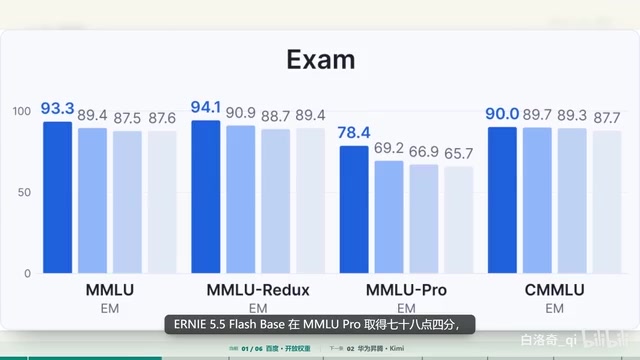
Baidu published comparison data for the base model: on MMLU Pro, ERNIE 5.5 Flash Base scored 78.4 versus DeepSeekAd V4 FlashBase's 69.2; on the HumanEvo Plus coding test, Baidu's model scored 82.3 versus the comparison model's 69.5. Note that while the chart uses the same evaluation process, the results come from Baidu itself—until third parties reproduce them, these numbers should be treated as one-sided disclosure.
Sparse mixture-of-experts (MoE) is an architecture in which the model activates only a subset of parameters during inference: the model consists of multiple "expert" subnetworks plus a routing network, and each token is routed to a small number of experts for computation. So "total parameters" reflects the model's capacity, while "activated parameters" determines the compute cost of a single inference pass. Of ERNIE 5.5 Flash Base's 280 billion total parameters, only 14 billion are activated per token—this sparsity keeps inference costs low while maintaining large capacity. The trade-off is that memory usage is still based on total parameters, and routing load balancing plus expert-parallel communication add engineering complexity.
Mid-training and post-training are two stages in the current large-model training pipeline: mid-training typically refers to continued pretraining on high-quality corpora or context-length extension after pretraining; post-training includes supervised fine-tuning, RLHF/preference alignment, and so on, which give the model instruction-following and safe behavior. Releasing only pretrained weights means the model is not yet aligned, and direct conversation quality may be poor—but for teams that need to build their own domain alignment pipelines, the starting point is cleaner and offers more room for customization.
Ascend Adapts Kimi K31 Pro on Day One, Cloud Agent Service Also in Progress
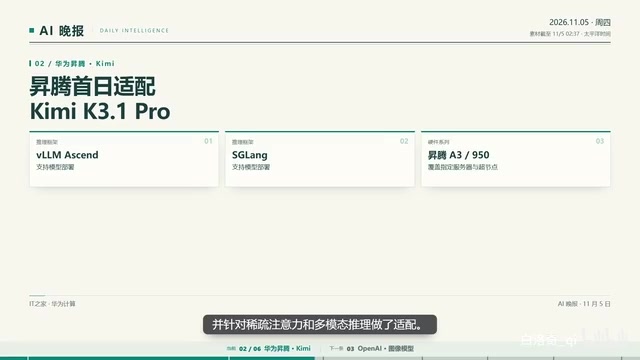
According to IT Home citing Huawei Computing, on the day Kimi K31 Pro's full weights were published, Ascend completed day-one inference adaptation based on VLLM Ascend and SGLang, supporting deployment on Atlas 800 A3, Atlas 900 III SuperPod, and the Ascend 950 super-node series, with dedicated adaptation for sparse attention and multimodal inference.
The significance of day-one adaptation lies in ecosystem responsiveness. The time gap between publishing model weights and getting inference running on hardware directly determines whether developers can validate the model on domestic compute at the earliest opportunity.
Kimi is also advancing Hosted Agents—providing agent runtime environments as a cloud service, supporting long-running tasks and multi-agent collaboration, and saving enterprises the work of building their own sandboxes and infrastructure. This service was previously introduced to enterprises and is now being further implemented.
VLLM Ascend and SGLang are two mainstream large-model inference serving approaches: vLLM is known for PagedAttention and continuous batching, and the Ascend version is its hardware backend port for Ascend NPUs; SGLang stands out for RadixAttention prefix caching and structured generation. "Day-one adaptation" means getting a new model's weights, operators, and parallel sharding strategies running on an inference framework and specific hardware at usable performance—which usually involves handling missing operators, precision alignment, and communication topology, so the time gap is a direct indicator of hardware ecosystem maturity.
Hosted Agents (managed agent services) refers to vendors providing agent runtime environments as a cloud service: developers only define tools and tasks, while the platform handles sandboxes, session state, long-task scheduling, and multi-agent coordination. It solves the problem of duplicated infrastructure construction when deploying agents, but it also hands the execution environment, data boundaries, and billing to the cloud vendor.
OpenAI Images 2.6 Enters the API: Two Paths, Flare and Sunburst
The OpenAI Images 2.6 mentioned in the morning briefing is now available in the API, with two versions offered—Flare and Sunburst—with distinctly different positioning:
- Flare: focused on speed, generating an image in as fast as 6 seconds at low quality.
- Sunburst: aimed at higher detail and multimodal scenarios, emphasizing consistency across multi-turn edits.
Developers can also use image annotation, editing, SVG export, and a new complexity parameter. Splitting speed-oriented and quality-oriented into two endpoints effectively lets callers make an explicit choice between latency and detail, rather than passively accepting a compromise. For batch image-generation pipelines versus creative scenarios requiring fine editing, the adaptation logic is completely different.
Splitting image generation into two endpoints—Flare (speed-oriented) and Sunburst (quality-oriented)—essentially exposes the latency-quality trade-off explicitly to callers. For batch image-generation pipelines, per-image time directly determines throughput and cost; fast low-quality generation can be used for draft screening, thumbnails, or A/B assets. For scenarios requiring fine editing, consistency across multi-turn edits (keeping the same subject, style, and composition stable across multiple revisions) is more critical than single-image quality, and this usually depends on stronger instruction following and image-conditioning control. Explicit endpoints also allow pricing, rate limiting, and retry strategies to be designed separately by scenario.
Google Cloud Briefly Shows Mysterious Model Names, OpenAI Acquisition Stirs Again
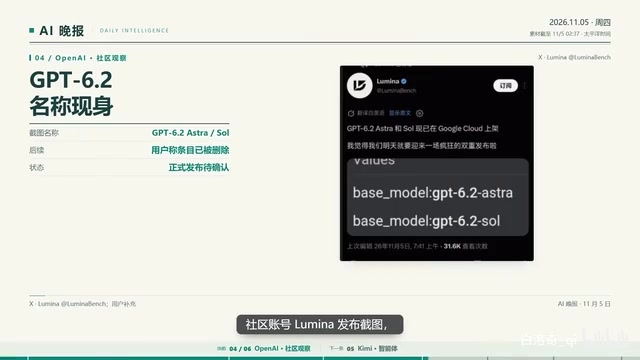
Community account Lumina posted a screenshot claiming that model names GPT-6, True, Astra, and Sol appeared on Google Cloud. Some users added that these entries were subsequently removed.
Whether these names represent official releases remains to be confirmed. The brief appearance of model names could come from an internal configuration leak or from test entries being mistakenly listed; without official explanation, any interpretation is just speculation.
Another lead comes from OpenAI: the company previously announced the acquisition of developer tools company Pierre, a deal still subject to closing conditions. Regarding the GPT-like phrasing that had circulated in the community, some users noticed that a Pierre co-founder's account name happens to echo it, and speculated that the two are related. It must be emphasized that this is only community interpretation with no official basis.
A Few Observations
Baidu's choice to release base weights without post-training, handing the initiative for "alignment" and "fine-tuning" to the community, is a posture more worthy of attention than simply chasing benchmark rankings—provided third parties can reproduce those evaluation scores. Ascend completing adaptation on the same day Kimi's new weights were published shows that the domestic hardware ecosystem's follow-up pace is accelerating. And the dual-version design of Images 2.6 reflects that image-generation APIs are moving from "one model for everything" toward scenario-layered product thinking. As for Google Cloud's mysterious naming and the OpenAI acquisition gossip, until officially confirmed, they're just fodder for casual conversation.
One-line Summary
Baidu releases the untrained-post-training base weights of ERNIE 5.5 Flash Base, Ascend adapts Kimi K31 Pro on day one, and Images 2.6 dual versions enter the API.
Paragraph Summary
This article rounds up four AI developments. Baidu releases the sparse MoE model ERNIE 5.5 Flash Base with 280 billion total parameters, 14 billion activated per token, pretrained on 33.5 trillion tokens, and supporting a one-million-token context—but it only provides base weights without mid-training or post-training; official comparison data shows it leading DeepSeek V4 FlashBase on MMLU Pro and HumanEvo Plus, though the results are one-sided disclosure. Ascend completed day-one inference adaptation on the day Kimi K31 Pro's weights were published, covering multiple super-node products, while Kimi also advances a cloud-hosted agent service. OpenAI Images 2.6 enters the API, split into the speed-oriented Flare and quality-oriented Sunburst endpoints. In addition, Google Cloud was reported to have briefly shown model names such as GPT-6, and speculation about a link between OpenAI's acquisition of Pierre still lacks official basis.
Related articles

9 AI Subscription Plans Compared: The Real Cost Per 100M Tokens Revealed
Bilibili creator tests 9 AI subscription plans from Volcano, Alibaba, Tencent, Baidu, Zhipu, Xiaomi, MiniMax and more, converting them all to real cost per 100M tokens, breaking down fixed-quota vs. three-tier coefficient billing and how caching, time-of-day discounts, and window limits affect actual quota.

Vibe Coding for Beginners: Expressing Intent Instead of Handwriting Code
What is Vibe Coding? A 137-episode Bilibili course defines it: the core is expressing intent, not writing code. This article analyzes Vibe Coding's productivity logic, target audience, and entry expectations to help beginners decide if it's worth learning.

LangChain Beginner's Guide: An Agent Development Roadmap from LangGraph to Deep Agents
Clarify the encapsulation relationship among LangChain, LangGraph, and Deep Agents, and master the learning path and selection logic for agent development frameworks—suitable for beginners in large model development.