ChatGPT DOT Hits Usage Limits: Even Pro Subscriptions Can't Escape Task Caps

A ChatGPT Pro user hit a temporary rate limit while using DOT for bulk email cleanup, restored after three hours.
A ChatGPT Pro user attempted to use the DOT feature to bulk-clean multiple email accounts, triggering a system usage limit that forced the task to stop. Service was automatically restored about three hours later, confirming it was a temporary rate limit rather than a ban. The case highlights a key tension in current AI assistants: bulk email cleanup requires the AI to independently read, analyze, and act on each message, generating API requests and token consumption far beyond normal chat — even paid Pro accounts aren't immune. The article recommends batching large tasks, understanding the real boundaries of paid subscriptions, and notes that how providers balance openness with resource protection will be critical to AI assistant maturity.
An Email Cleanup That Triggered a Usage Limit
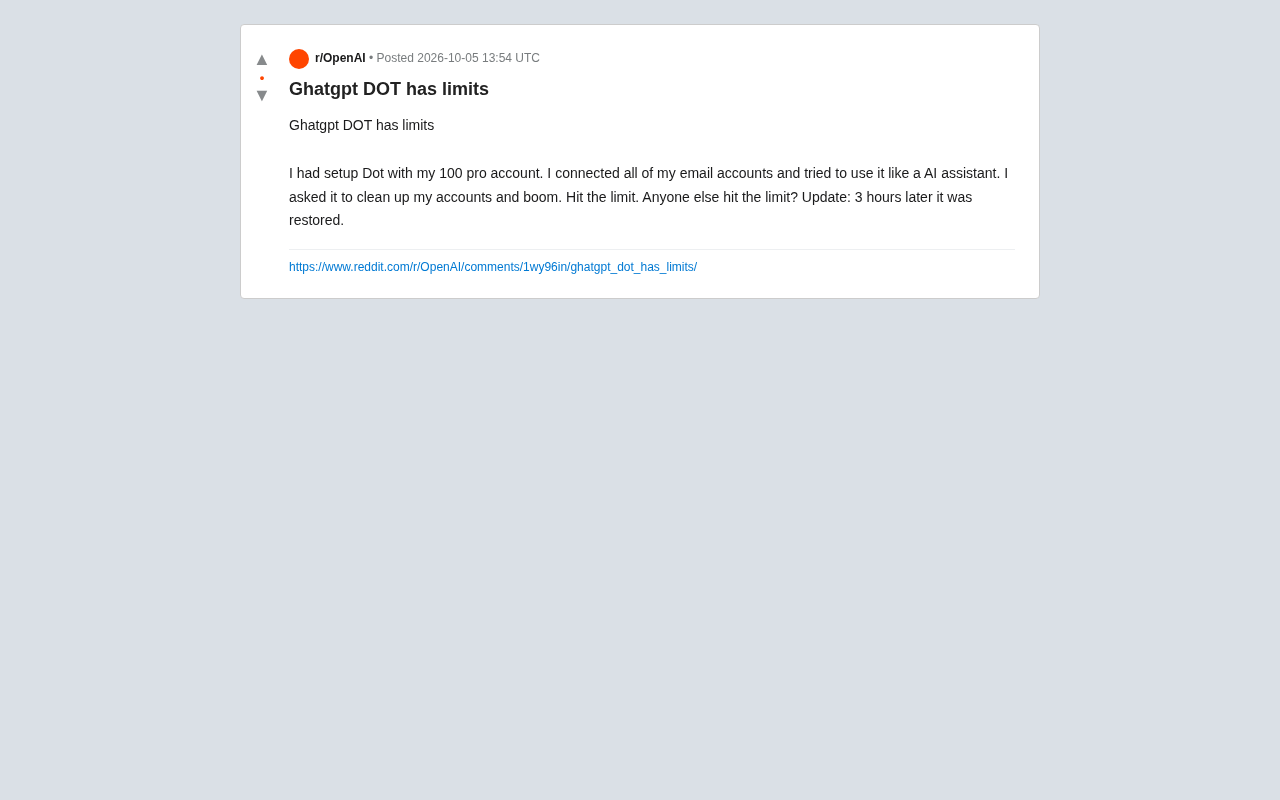
A Reddit user recently shared their experience using ChatGPT's DOT feature. They had configured DOT on their ChatGPT Pro account, connected all their email accounts, and were trying to use it as an all-purpose AI assistant. When they asked DOT to help "clean up" those email accounts, the system immediately hit a usage limit and the task came to an abrupt stop.
What makes this notable is that the user was on a paid Pro account — one that's generally assumed to come with higher usage allowances. Even so, attempting a bulk email operation across multiple accounts was enough to get the system to pump the brakes. This makes it clear that no matter how high your subscription tier, AI assistants still have hard limits when it comes to large-scale, high-frequency real-world tasks.
ChatGPT's DOT (sometimes referred to as a task execution agent or, in some contexts, an Operator-style task agent introduced by OpenAI) represents an important direction in AI assistant development. It allows users to authorize ChatGPT to connect to external accounts — such as Gmail or Outlook — and perform actual operations on the user's behalf, rather than simply offering suggestions. This is fundamentally different from traditional question-and-answer AI: in DOT mode, the AI actively calls external APIs, reads real data, and triggers write operations (like deleting, moving, or flagging emails). The entire workflow is closer to RPA (Robotic Process Automation) than a simple conversation. As a result, the system load and number of API calls generated per task far exceeds that of ordinary chat sessions.
The Limit Isn't Permanent — Service Restored After Three Hours
The user followed up on their post with an update: roughly three hours later, the functionality was automatically restored and the account was back to normal. This indicates that what DOT encountered was not an account ban or a permanent restriction, but rather a temporary rate limit or quota cooldown mechanism.
This kind of mechanism is quite common in large language model services. When a single account makes a large number of requests in a short period — say, processing an entire mailbox cleanup in one go — the system determines that it has exceeded a reasonable usage rate and temporarily suspends the relevant capabilities, restoring them after a cooldown period. For users who genuinely rely on AI assistants to handle everyday tasks, this kind of interruption can noticeably disrupt workflow continuity.
Rate limiting is a standard technique used by internet services to prevent resource abuse. The core logic is to cap the number of requests from a single account or IP within a fixed time window. LLM services layer an additional "token quota" mechanism on top of this — every model call consumes a certain number of tokens (a unit measuring the volume of input and output text). Pro accounts have higher daily and monthly token limits than free accounts, but those limits still exist. In a bulk email cleanup task, the AI must process, understand, and make classification decisions for each individual email, meaning token consumption can grow exponentially in a short period, quickly exhausting the quota. Once the cooldown ends and the quota resets, functionality is restored — a design consistent with standard rate-limiting practices used by major cloud services like the OpenAI API and Google Cloud.
Why Even an "All-Purpose Assistant" Still Hits a Ceiling
Connecting AI to real data sources like email and calendars — and letting it execute actions on your behalf — is a major frontier in AI assistant development. But this case shows that the dream of "hand it to the AI and it handles everything with one command" still has some way to go before it's truly mature.
Bulk email cleanup means the AI must read, analyze, judge, and execute a large number of independent operations, with each step potentially corresponding to one or more model calls and API requests. The computational cost and request density of these tasks far exceeds that of ordinary conversation, making it much easier to hit the usage caps set by the service provider. In other words, the closer a task gets to "real-world heavy lifting," the more likely it is to expose the conservative approach that current AI services take toward quota design.
Practical Takeaways for Users
For users who want to use tools like ChatGPT as an everyday assistant, this case offers some useful guidance:
- Break large tasks into batches: Rather than asking the AI to clean up all accounts at once, split the work into multiple smaller batches to reduce the likelihood of hitting a limit.
- Understand that limits are temporary: Don't panic when you hit a restriction. In most cases, a few hours of cooldown is all it takes to restore functionality — it's not a sign that something is wrong with your account.
- Paid doesn't mean unlimited: Even high-tier subscriptions like Pro still have usage boundaries. Paying primarily raises your quota ceiling — it doesn't remove limits entirely.
While this is just one user's experience and represents a limited sample size, it reflects the real-world constraints that AI assistants must confront as they move toward practical, everyday use. As features that "connect to real data and execute actions" become increasingly common, how service providers strike the balance between capability and resource protection will directly determine the upper bound of the user experience.
Related articles

Chain of Thought Isn't Just for AI: How Humans Can Use CoT to Improve Thinking Quality
Chain of Thought isn't just a prompt trick for large models. Starting from a Hacker News discussion, this article analyzes why CoT works for human thinking too, breaks down actionable ways to transfer it, and highlights the key differences between human CoT and machine CoT.
Cloudflare Teams Up with OpenAI: Closi…
Cloudflare Teams Up with OpenAI: Closing the Loop from Vulnerability Discovery to Defense with AI
Cloudflare uses OpenAI Daybreak to investigate security vulnerabilities and generate reviewable remediation plans, while developers use Codex to boost coding efficiency and quality.

Orca Multi-Agent Orchestration in Practice: A Guide to Parallel Collaboration with Claude and Codex
Orca is Stable AI's free open-source agent workbench supporting 34 agents like Claude Code and Codex in parallel. Learn its Git worktree isolation, multi-model orchestration, and mobile management.