ChatGPT Ends Unlimited Chat: How Should Users Respond?
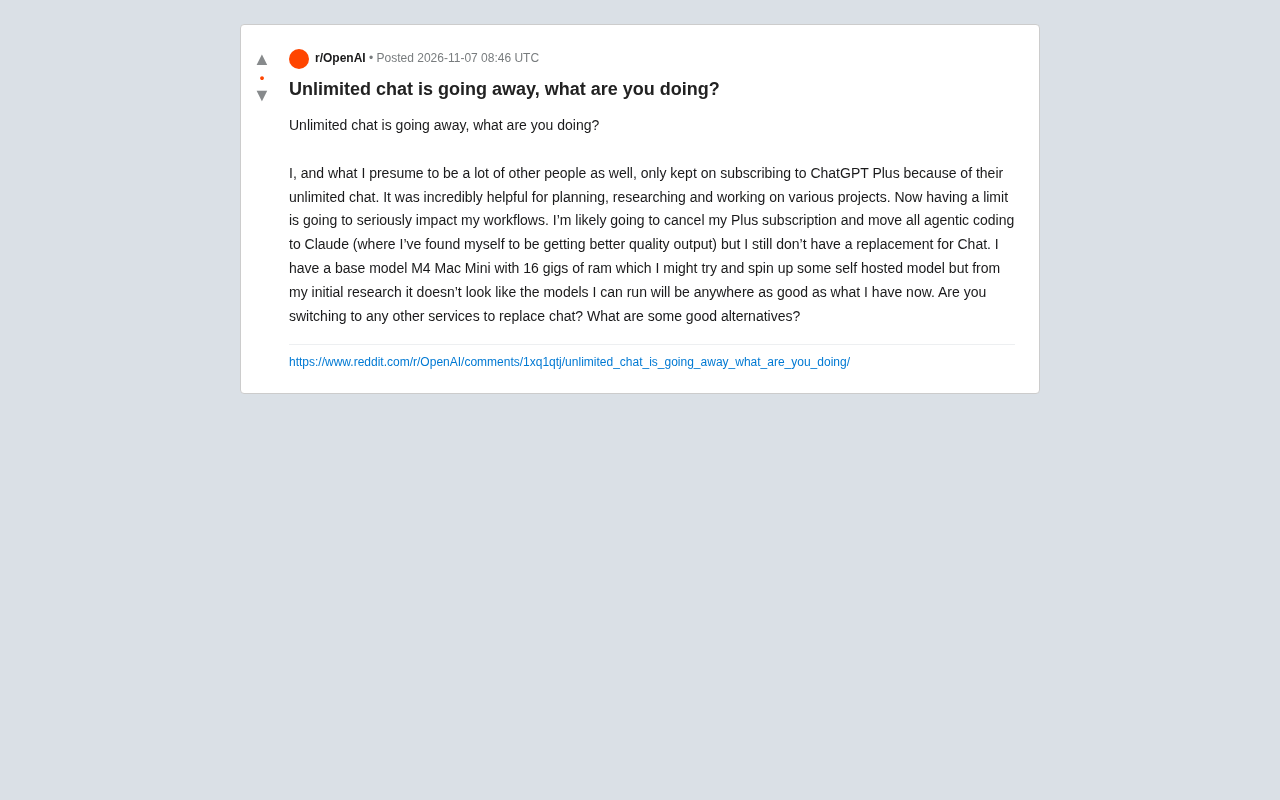
OpenAI's cancellation of ChatGPT Plus unlimited chat sparks user backlash, with users turning to Claude, self-hosted models, and other alternatives.
The article centers on community discussion sparked by OpenAI's upcoming cancellation of ChatGPT Plus unlimited chat. Reddit users generally see unlimited chat as the core value of the subscription and will reassess it after removal. The poster plans to migrate agentic coding tasks to Claude but lacks an ideal replacement for everyday chat; local self-hosted models are limited by hardware performance. The community also recommends Llama 3, Mistral, Perplexity AI, and Character.AI, but each has limitations. The article notes that this move may prompt other AI companies to follow with limits to control costs, while creating opportunities for competitors and open-source tools, and reflects that AI service business models are still being explored, with users needing to adapt to more refined pricing strategies.
Introduction
Recently, a post on Reddit sparked widespread discussion: OpenAI is about to cancel the unlimited chat feature of ChatGPT Plus and introduce usage limits instead. Many users say that unlimited chat was their main motivation for subscribing to Plus, and this change will seriously affect their workflows. The poster admits that he may cancel his subscription and shift agentic coding tasks to Claude, but for everyday chat, he still cannot find a suitable alternative.
Why Does Unlimited Chat Matter?
For many professional users, unlimited chat is not just "casual chatting"—it is a productivity tool. The poster mentions that unlimited chat has been enormously helpful for planning, research, and various project work. Without limits, they can hold multi-turn conversations with AI at any time and delve deeply into problems without worrying about running out of quota. This seamless experience is one of the core attractions of ChatGPT Plus.
However, OpenAI may be doing this to relieve server pressure or to push commercialization. Although the company has not explicitly stated the reason, users generally feel disappointed. One user commented: "I understand the company needs to make a profit, but canceling unlimited chat will make me reconsider whether the subscription is worth it."
OpenAI has historically adopted different rate-limiting strategies for free and Plus users of ChatGPT. Free users are usually limited to a certain number of messages every few hours, while one of the core selling points of the Plus subscription ($20 per month) is a usage allowance far higher than the free tier, approaching "unlimited" in earlier versions. This "unlimited" was never technically truly unlimited; it meant that under normal usage intensity, limits were almost never triggered. With the introduction of multimodality, reasoning models (such as the o series), and agent features, the compute consumption per conversation has risen significantly, making the "unlimited" model unsustainable in terms of cost. Therefore, shifting to explicit usage quotas or pay-as-you-go billing is a common signal that generative AI services are moving from a user-acquisition phase into a phase of refined operations.
User Coping Strategies
Faced with this change, users have begun exploring alternatives. The poster says he plans to migrate agentic coding tasks to Claude, where he gets higher-quality output. This reflects a trend: users choose different AI tools based on task type. Claude excels at code generation, while ChatGPT may still have an advantage in general chat.
But for everyday chat, the poster still has no alternative. He mentions that he has a base-model M4 Mac Mini (16GB memory) and is considering running a self-hosted model, but preliminary research shows that the quality of models that can run locally is far below that of the cloud models he currently uses. This highlights the limitations of local deployment: high hardware requirements and limited model performance.
Self-hosted large language models refer to users running model weights on their own hardware (such as a personal computer, workstation, or private server) rather than calling a cloud API. Common tools include Ollama, LM Studio, llama.cpp, and others, which support quantized execution of open-source models on consumer GPUs or even CPUs. However, local deployment is constrained by VRAM and compute: a 16GB unified-memory M4 Mac Mini can typically only run quantized models in the 7B to 14B parameter range smoothly, whereas flagship cloud models often have hundreds of billions of parameters and have undergone large-scale alignment training. Therefore, there is still a clear gap between local and cloud models in complex reasoning, long-context retention, and code generation quality. The advantages of local deployment are controllable privacy, no usage quotas, and offline availability, making it suitable for data-sensitive or lightweight tasks.
Other Alternatives in the Community
In the Reddit discussion, other users shared their alternatives. Some recommended open-source models such as Llama 3 and Mistral, used via API or local deployment. Others mentioned Perplexity AI for research and Character.AI for entertainment chat. However, these options each have pros and cons and are difficult to fully replace the unlimited chat experience of ChatGPT.
One detail: multiple sources indicate that users are not very loyal to AI services—they care more about practical utility. Once a service no longer meets their needs, the migration cost is not high.
Open-source models such as Meta's Llama series and Mistral AI's Mistral series are usually released as open weights, allowing users to download, fine-tune, or call them through third-party API services. Their performance has improved rapidly in recent years, and some small and medium-sized models are already close to early closed-source models on specific benchmarks, but they still lag behind top closed-source models such as GPT-4 and Claude in general conversation fluency, instruction following, and safety alignment. Perplexity AI positions itself as an "answer engine," combining large models with real-time web retrieval; it excels at research-oriented Q&A with source citations but is not suitable for long multi-turn creative chat. Character.AI focuses on role-playing and entertainment-oriented conversation, and its models are personalized and tuned, but they have limited capability in professional planning and coding tasks. These tools each have their own focus, and users often need to combine them to cover all the scenarios previously handled by unlimited chat.
Impact on the AI Industry
OpenAI's cancellation of unlimited chat may trigger a chain reaction. Other AI companies may follow suit and introduce usage limits to control costs. But at the same time, this also creates opportunities for competitors. For example, Anthropic's Claude and Google's Gemini may attract dissatisfied users. In addition, self-hosted models and open-source tools may receive more attention, although there is still a performance gap at present.
In the long run, the business model of AI services is still being explored. Unlimited chat, as a marketing tactic, may be difficult to sustain. Users need to adapt to more refined pricing strategies, while AI companies need to find a balance between user experience and profitability.
Conclusion
ChatGPT's cancellation of the unlimited chat feature has made many users uneasy, and they are actively looking for alternatives. Whether switching to Claude, trying self-hosted models, or exploring other AI tools, users' behavior reflects a strong emphasis on the practical utility of AI services. This change may also prompt the AI industry to rethink pricing models and drive more innovation. For ordinary users, diversifying their use of AI tools may be the best strategy for coping with change.
Related articles
 Tech Frontiers
MuJoCo: An Analysis of DeepMind's Open-Source General-Purpose Physics Simulator
An in-depth analysis of Google DeepMind's open-source physics simulator MuJoCo: high-performance C++ kernel, MJCF modeling format, contact solving principles, MJX GPU acceleration, and robot reinforcement learning use cases.
 Tech Frontiers
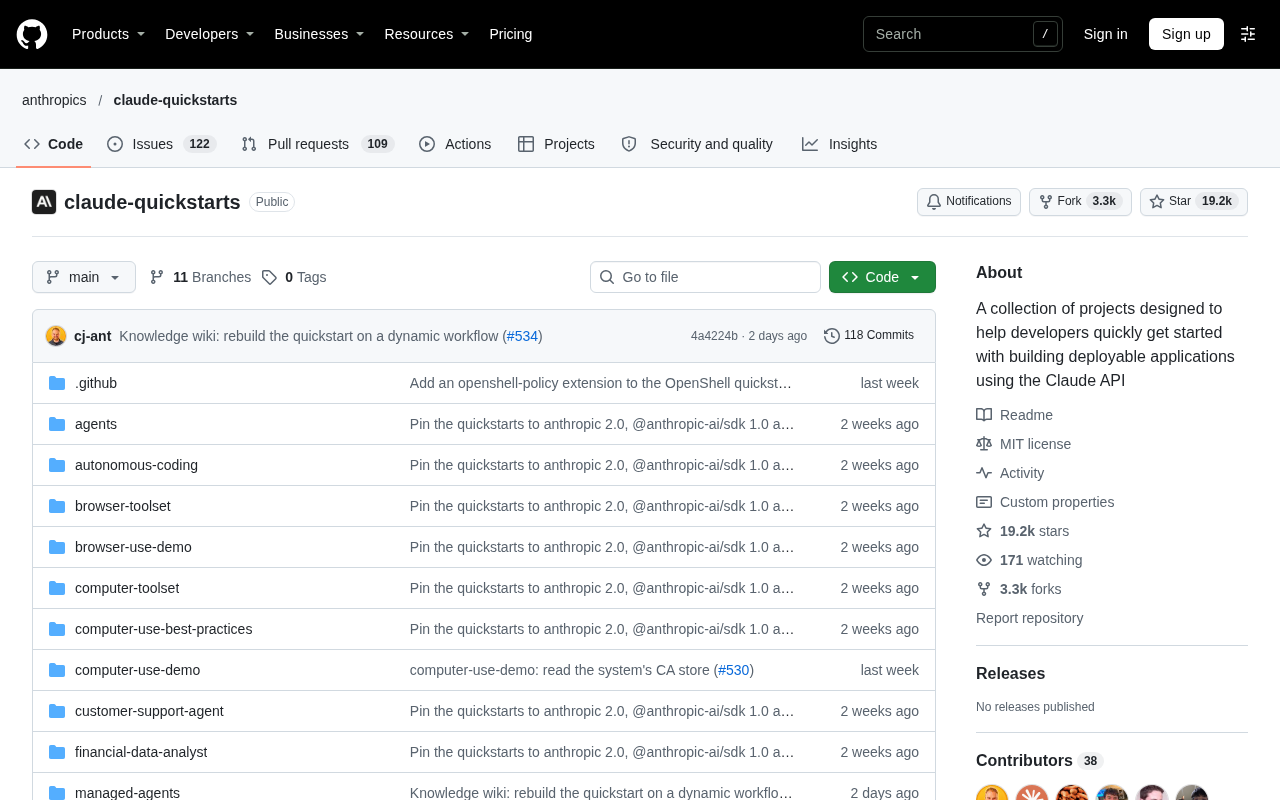
Claude API Quick Start: The Official Quickstarts Project Collection
Anthropic's official claude-quickstarts project collection helps developers quickly build deployable apps with the Claude API. Nearly 20k stars, Python-based, great for beginners and prototyping.
 Tech Frontiers
AI Agents Connecting Directly to APIs: Which Calls Can Be Safely Allowed?
AI agents can call any API, but the real challenge is deciding which calls can be safely allowed. This article analyzes allowance decisions from three dimensions—intent matching, least privilege, and controllable impact—and argues that the control layer should sit outside the agent, combined with audit traceability to build a trustworthy API call governance mechanism.