ChatGPT Images 2.0 for Brand Design: How Well Does AI-Generated Brand Kits Actually Work?

ChatGPT Images 2.0 is redefining the starting point and workflow of brand visual design
ChatGPT Images 2.0 leverages three core advantages—style consistency, text rendering, and conversational iteration—to enable users to rapidly generate conceptual Brand Kits through natural language, dramatically lowering the barrier to brand visual exploration. The tool is well-suited for early-stage startup branding, designer inspiration, and client proposal communication, but still has limitations in strategic depth and copyright ownership, making it currently more appropriate as a conceptual reference rather than a direct commercial solution.
AI Image Generation Officially Enters the Brand Design Arena
OpenAI's recently launched ChatGPT Images 2.0 is generating significant buzz in the creative design community. An increasing number of designers and entrepreneurs are using this AI image generation tool for conceptual brand visual system design—from logos to color palettes, from typography selection to complete Brand Kits. AI is redefining the starting point of creative work.
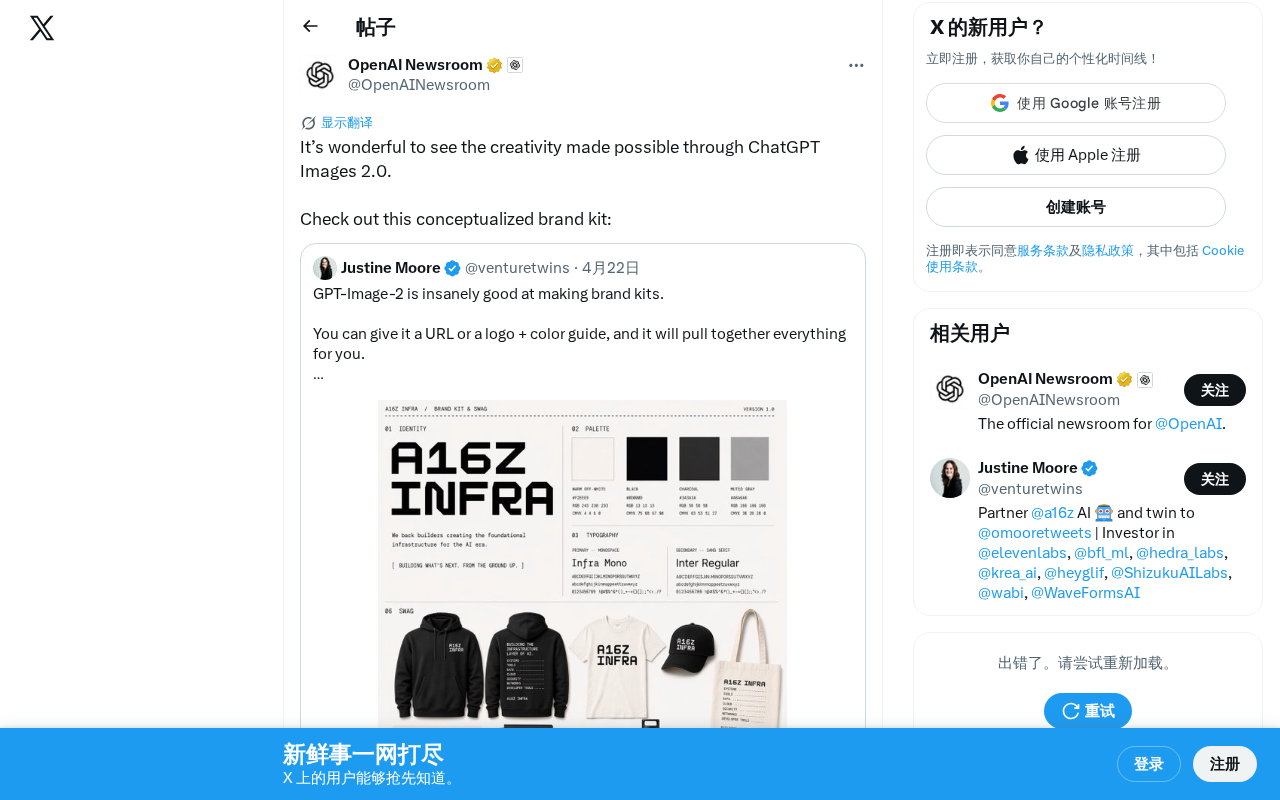
What Does an AI-Generated Brand Kit Actually Include?
A Brand Kit is the core deliverable of a Visual Identity System (VIS), with theoretical roots tracing back to the rise of Corporate Identity (CI) design systems in the 1960s. A complete Brand Kit goes beyond aesthetics—it's a rigorous visual language system, typically presented as Brand Guidelines. It covers logo safe zones, minimum sizes, prohibited usage, precise Pantone/CMYK/RGB/HEX color values, primary and secondary font licensing specifications, and application examples across different media such as business cards, packaging, and digital interfaces. Following the traditional workflow, completing a full Brand Kit requires professional designers to invest days or even weeks of effort.
ChatGPT Images 2.0 has changed this pace. Users only need to describe brand tonality and requirements through natural language, and within minutes they can receive a conceptual Brand Kit with unified visual style and impressive completeness. This not only dramatically lowers the barrier to brand visual exploration but also provides designers with a new path for rapidly validating creative directions.
Three Core Advantages of ChatGPT Images 2.0 for Brand Design
A Quantum Leap in Style Consistency
The technical approach behind ChatGPT Images 2.0 represents a significant leap in generative AI imagery. Early AI image generation tools (such as DALL-E 1 and early versions of Midjourney) were primarily based on GAN (Generative Adversarial Network) architecture, resulting in poor style consistency and virtually unusable text rendering. Around 2022, Diffusion Models represented by Stable Diffusion became mainstream, dramatically improving image quality, but contextual coherence across multi-turn conversations remained weak. ChatGPT Images 2.0 integrates multimodal large language models with improved image generation architecture, making it possible to maintain visual style consistency within the same conversation context—precisely the core requirement for brand design scenarios. Multiple design elements generated within the same conversation—color schemes, graphics, typography—can maintain a unified visual language, since visual coherence is the very foundation of brand recognition.
Text Rendering Finally Works Reliably
Logo design inevitably involves combining text with graphics, and text rendering has been a persistent pain point for AI image generation, with deep technical roots. Diffusion models and GANs treat images as pixel distributions during training rather than structured semantic units. For these models, text is merely a special visual texture rather than a symbol system with precise semantics. This leads to generated text frequently suffering from letter distortion, spelling errors, and stroke merging. Recent improvement approaches include: dramatically increasing the proportion of high-quality text images in training data, introducing dedicated text rendering modules, and using RLHF (Reinforcement Learning from Human Feedback) for targeted optimization of text clarity. ChatGPT Images 2.0's progress in this direction is clearly visible: brand name clarity and typographic aesthetics have significantly improved, and generating logos with text is no longer a matter of luck.
Conversational Iteration Reduces Revision Costs to Near Zero
Users can adjust design directions through ongoing conversation. For example, telling it "switch the primary color to a deeper blue," "make the logo style more minimalist," or "add a dark mode version"—this interaction model makes design exploration remarkably efficient, with just a few conversation rounds getting you close to the ideal result.
Which Scenarios Are Best Suited for Brand Design with ChatGPT Images 2.0?
Low-Cost Brand Exploration for Early-Stage Startups
For startup teams and solo entrepreneurs, this is likely the most cost-effective approach to brand visual exploration available today. Before formally hiring a designer, founders can use AI to generate multiple concept directions, figure out what style they actually want, and then communicate much more efficiently with designers afterward.
An Inspiration Catalyst for Professional Designers
For working designers, AI-generated Brand Kits serve more as a rapid sketching assistant. It helps you explore multiple visual directions in a short time, break habitual thinking patterns, and then you refine and polish the work professionally from that foundation.
A Communication Tool for Client Proposal Stages
Rapidly generating multiple visual concepts during the proposal stage helps design teams align with client needs more intuitively. Once clients see concrete visual proposals, their feedback becomes more precise, and the number of revision rounds decreases noticeably.
The Real-World Limitations of AI Brand Design Cannot Be Ignored
While ChatGPT Images 2.0 demonstrates exciting possibilities in the brand design space, a sober assessment shows it's currently better suited for concept exploration and inspiration reference—there's still a clear gap before it can be used directly for commercial purposes.
Professional brand design requires consideration of market positioning, target audience psychology, cultural context, cross-media scalability, and numerous other factors. This deeper strategic thinking remains the irreplaceable core value of human designers.
Additionally, copyright ownership and originality protection for AI-generated designs must be taken seriously in practical applications. Currently, across major global jurisdictions, copyright ownership of AI-generated content remains in a legal gray area. The U.S. Copyright Office (USCO) has explicitly stated that works purely generated by AI without human creative expression are not eligible for copyright protection. The EU's AI Act is also continuously discussing intellectual property frameworks for AI-generated content. For brand design, this means AI-generated logos may face originality scrutiny challenges when filing for trademark registration—trademark offices typically require applicants to have clear copyright ownership of the design. In practice, designers usually need to make substantial manual modifications and re-creation of AI-generated drafts to establish human authorship, thereby providing legal protection for subsequent trademark registration and commercial use.
Final Thoughts: AI Brings Empowerment, Not Replacement
The core value ChatGPT Images 2.0 brings to brand design isn't replacing designers—it's lowering the technical barrier to creative expression. It enables more people to quickly transform vague brand visions in their minds into visible visual proposals.
As AI image generation technology continues to iterate, the potential for human-AI collaboration in creative design is only beginning to be unlocked. For designers, learning to leverage these tools well may matter more than worrying about being replaced by them.
Key Takeaways
- ChatGPT Images 2.0 enables rapid generation of stylistically unified conceptual Brand Kits through natural language, dramatically lowering the barrier to brand visual exploration
- The new version shows significant improvements in style consistency, text rendering, and conversational iterative design, powered by deep integration of multimodal large language models and diffusion model architecture
- Applicable to multiple scenarios including early-stage startup brand exploration, designer inspiration generation, and client proposal communication
- AI-generated brand designs are currently better suited as conceptual references; strategic thinking in professional brand design still requires human designer leadership
- Copyright ownership and originality protection issues still require careful consideration in practical applications, especially in trademark registration scenarios where substantial human re-creation of AI drafts is essential
Related articles
 Product Reviews
The Programmer's Desk Setup Guide: Building a Workspace That Feels Like Home
Discover how programmers build productive, comfortable workspaces. From multi-monitor setups to ergonomic design, explore the desk philosophy that drives focus and flow.
 Product Reviews
Qoder vs Cursor Real-World Comparison: Which $20/Month AI IDE Is Better?
Hands-on comparison of Qoder vs Cursor AI IDEs: Agent autonomy, human interaction count, and architecture decisions. Qoder needed only 2 interactions vs Cursor's 8.
 Product Reviews
Cursor Cloud Agent Demo: Eliminating Bottlenecks Across the Entire Software Development Lifecycle
Deep analysis of Cursor's Cloud Agent demo showing how cloud VMs, automated test artifacts, and a full-chain control plane systematically eliminate human bottlenecks across the software development lifecycle.