ChatGPT Now Blocks Requests to Mimic Authors' Writing Styles: Causes and Implications

ChatGPT now refuses to mimic living authors' styles amid mounting copyright lawsuits and legal pressure.
OpenAI's ChatGPT has begun blocking user requests to write in the style of specific living authors. Driven by major copyright lawsuits from authors and publishers, this defensive measure targets explicit named-author mimicry while indirect style descriptions often still work. The change signals the generative AI industry's broader shift toward compliance and creator protection.
ChatGPT Blocking Author Style Mimicry: Event Overview
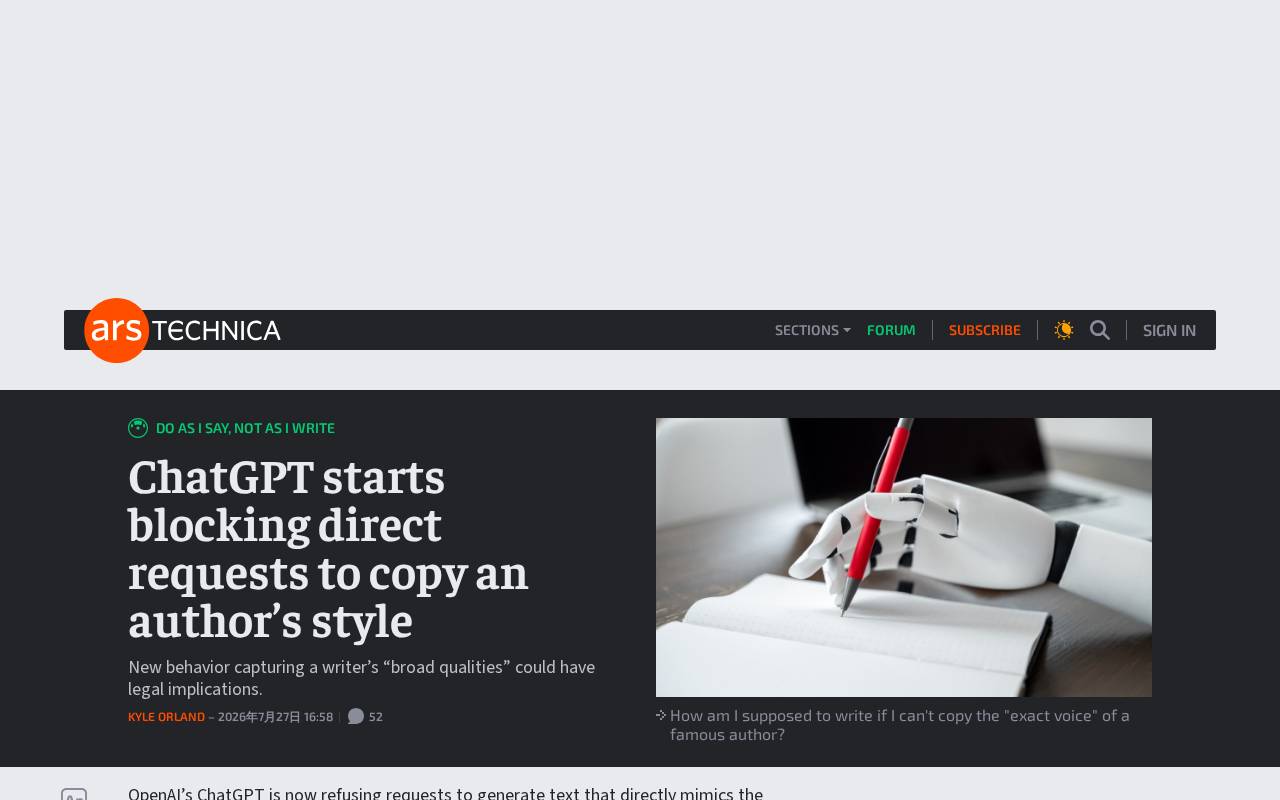
Recently, users have discovered that OpenAI's ChatGPT has begun blocking a specific type of request: when users explicitly ask the model to "write in the style of a living author," the system refuses to comply. While subtle, this change reflects the increasingly sharp tensions surrounding generative AI at the intersection of copyright, creative ethics, and commercialization pressures.
For users who have long relied on ChatGPT for text creation, "mimicking a specific author's writing style" was once a common and effective use case. Whether learning particular narrative techniques or quickly generating stylized marketing copy, naming a specific author often yielded satisfying results. Now, however, this pathway is being progressively tightened.
Why OpenAI Is Restricting Author Style Mimicry Requests
Copyright Lawsuits and Legal Pressure
Generative AI companies have faced ongoing lawsuits from authors, publishers, and media organizations in recent years. The core dispute centers on the fact that these models' training data contains vast amounts of copyrighted works, while model outputs can precisely reproduce specific authors' stylistic characteristics.
To understand the root of this controversy, one needs to understand how large language models are trained. GPT-series models rely on massive text corpora for training, typically including data sources such as Common Crawl (web crawler datasets), digitized book corpora, news articles, and academic papers. A significant proportion of this material is copyright-protected, and AI companies generally have not obtained explicit authorization from original authors when scraping and using this data. Whether this practice constitutes "Fair Use" under U.S. copyright law remains unresolved.
Since 2023, several landmark lawsuits have brought this conflict to the forefront: The New York Times v. OpenAI and Microsoft alleges unauthorized use of millions of news articles for model training; the Authors Guild, representing well-known authors such as John Grisham and George R.R. Martin, filed suit accusing OpenAI of illegally using their books for training; class-action lawsuits by authors like Sarah Silverman similarly target unauthorized data use. The core legal questions in these cases include: whether AI training constitutes transformative use, whether model outputs constitute derivative works, and whether large-scale use exceeds the bounds of fair use.
When users explicitly request "writing in the style of a living author," model outputs are more likely to be characterized as direct appropriation of that author's creative work. This kind of "named mimicry" occupies a legal gray zone and is most easily used as evidence in litigation. Therefore, blocking such instructions at the request level is a defensive strategy for OpenAI to reduce legal risk.
Notably, under current copyright law frameworks, "style" itself is typically not protected by copyright. Copyright protects specific expression, not ideas or methods. An author's preference for short sentences, metaphor habits, or narrative structure can hardly be classified as protected "expression." However, when an AI model can precisely reproduce the comprehensive stylistic characteristics of a specific author, the nature of this behavior becomes ambiguous—it is neither verbatim copying nor entirely independent creation. Some legal scholars argue this may involve "Right of Publicity" or "unfair competition" in other legal domains, especially when the precision of mimicry is sufficient to substitute for the original author's commercial value in the market. It is precisely this ambiguity in legal characterization that has prompted OpenAI to impose restrictions at the product level preemptively.
A Signal of Protecting Creator Rights
Beyond risk mitigation, this move can also be interpreted as OpenAI sending a goodwill signal to the content creator community. Over the past two years, the relationship between AI and creator communities has been strained at times. By restricting direct replication of living authors' styles, OpenAI is attempting to find a balance point between "technical capability" and "respect for creators."
The Actual Boundaries of ChatGPT's Style Blocking Mechanism
You may not have noticed, but this type of blocking is often not absolute. Based on user feedback, the system primarily targets requests that "directly and explicitly name a living author." If users adopt more indirect descriptions—such as describing a particular narrative rhythm, tonal characteristics, or structural preferences—the model can typically still generate content with a similar style.
From a technical perspective, ChatGPT's blocking mechanism is part of "Alignment" technology in the AI safety field. Its implementation typically involves multiple layers of protection: first, an input filtering layer that uses classifiers to detect whether user requests contain sensitive instructions (such as a combination of an explicit author name and mimicry intent); second, behavioral norms embedded during the RLHF (Reinforcement Learning from Human Feedback) stage that enable the model to autonomously judge whether it should refuse certain types of requests during inference; and finally, an output review layer that performs secondary checks on generated content. However, due to the flexibility of natural language, users can bypass detection through "Prompt Injection" and semantic rephrasing, making the actual blocking effect probabilistic rather than absolute.
This also reveals the inherent limitations of such content moderation:
- Rules are easily bypassed: Users can easily circumvent direct blocking by rephrasing their prompts.
- Style is difficult to define: "Writing style" itself lacks clear legal and technical boundaries, making precise filtering extremely difficult.
- Legitimate needs get caught in the crossfire: Legitimate uses such as literary research and writing instruction may also be restricted.
In other words, this is more like a guardrail that "reduces obvious risks" rather than a complete blockade of all stylized creative possibilities.
Practical Impact on Users and the AI Industry
Impact on Regular Users
For most users who rely on ChatGPT for everyday writing, the short-term impact is limited. Those truly affected are creators who habitually use "named mimicry." They will need to adjust their prompting strategies, turning instead to describing specific linguistic characteristics to achieve similar effects.
Implications for the AI Industry
This change is a microcosm of the entire generative AI industry's move toward compliance. As regulation tightens and lawsuits multiply, major model providers are re-examining their content generation boundaries. It's foreseeable that more similar "soft restrictions" will emerge in the future, covering areas such as celebrity likenesses, artists' visual styles, and musical styles.
From a global regulatory perspective, this trend already has clear institutional support. The EU's AI Act requires AI companies to disclose summaries of copyrighted content in their training data; the U.S. Copyright Office is conducting a series of public consultations on the copyrightability of AI-generated content; China's "Interim Measures for the Management of Generative AI Services" also imposes requirements on the legality of training data. Meanwhile, some AI companies are exploring "licensed training" models—such as OpenAI signing content licensing agreements with the Associated Press and Axel Springer, and Google reaching a paid data usage agreement with Reddit—attempting to establish legitimate data supply chains from the source. These initiatives collectively point in one direction: the AI industry is transitioning from a "use first, ask questions later" phase of unchecked growth to a normalized operational phase where data usage comes at a cost.
For the industry, the core challenge lies in striking a balance between "protecting creators" and "preserving tool utility." Excessive restrictions will diminish product value, while a hands-off approach will exacerbate legal and ethical risks.
Conclusion
ChatGPT blocking author style mimicry requests may appear to be a minor product adjustment, but it actually reflects generative AI's ongoing exploration of copyright governance. It neither completely prohibits stylized creation nor truly resolves the underlying copyright disputes—rather, it represents a pragmatic compromise under pressure.
As legal frameworks gradually become clearer, the three-way negotiation between AI providers, creators, and users will continue. For users, understanding these boundaries and learning to use tools efficiently within compliant parameters will become an increasingly important skill.
Related articles

JobRunner MCP Server: AI Agents Can Now Fix Failed Java Jobs
JobRunner launches an open-source MCP server enabling AI agents to view cluster status, diagnose failures, and recover Java jobs—incident response from any cloud coding environment or existing agent.

MLAI Digital Launches 9 Security Agents: MCP Server Safeguards the Full Lifecycle of Agentic AI
MLAI Digital launches Security MCP Server with nine built-in specialized security agents covering vulnerability discovery, attack simulation, prompt injection detection, API and infrastructure assessment, and accelerated remediation—embedding security validation across the full Agentic AI lifecycle from development to production.

Running Isaac Lab on H100 GPUs: Exploring Better Approaches
Exploring optimization methods for running Isaac Lab on NVIDIA H100 GPUs, including MIG configuration, mixed precision, TensorRT acceleration, and community experience to improve robotics simulation and reinforcement learning efficiency.