ChatGPT Plus Self-Service Subscription Guide for Users in China: Three Methods Compared with Step-by-Step Instructions

A comparison of the three paths for subscribing to ChatGPT Plus from China, focusing on the Session authorization process for self-service website top-up.
Based on a Bilibili hands-on tutorial, the article outlines three paths for users in China to subscribe to ChatGPT Plus: self-service website top-up, official credit card top-up, and in-app purchase. The biggest advantage of website top-up is that no account password is needed—just log in to the GPT official site, obtain a Session credential, and submit an order in three steps. The official credit card channel requires an overseas card and easily triggers regional risk controls and hidden fees. In-app purchase is constrained by the GMS framework and residential IP environment, with an overall cost of about 20 to 25 USD. The article reminds users to confirm after-sales terms and avoid leaking sensitive account information.
Title
ChatGPT Plus Self-Service Subscription Guide for Users in China: Three Methods Compared with Step-by-Step Instructions
Meta Description
How do you upgrade to ChatGPT Plus from China? This article compares the barriers and risks of three methods—self-service website top-up, official credit card, and in-app purchase—and breaks down the complete practical steps: obtaining a Session, submitting an order, and refreshing to verify.
Article Content
Users in China who want to upgrade to ChatGPT Plus often get stuck at the payment step: no overseas credit card, cumbersome region-switching procedures, and worries about account security when using third-party top-up services. Based on a hands-on tutorial shared on Bilibili, this article outlines the three common subscription methods available today and focuses on breaking down the complete process of self-service top-up via a website.
Overview of the Three Subscription Methods
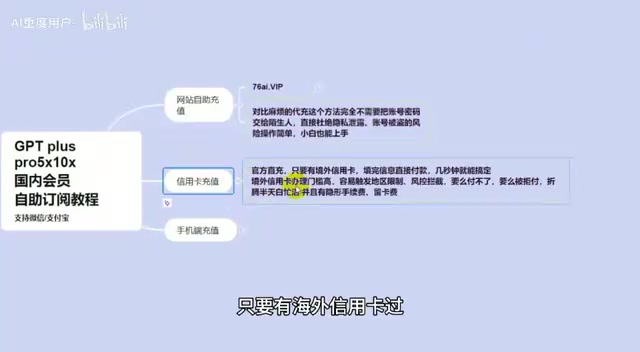
According to the summary by the Bilibili creator, there are three main paths to subscribing to ChatGPT Plus from China: self-service website top-up, official credit card payment, and in-app purchase (Apple US-region ID or Android Google Play). The three differ in barriers, cost, and risk, and beginners need to choose based on their own circumstances.
In terms of practical difficulty, the core selling point of self-service website top-up is that "you don't have to hand your account password to a stranger," thereby avoiding the risk of privacy leaks and account theft; the official credit card channel requires an overseas credit card, which is difficult for ordinary people to obtain; and in-app purchase places higher demands on your device and account environment.
Self-Service Website Top-Up: Full Process Breakdown
This is the method the tutorial highlights and recommends, and the operation roughly falls into three steps.
Step 1: Choose a Plan and Enter Your Email
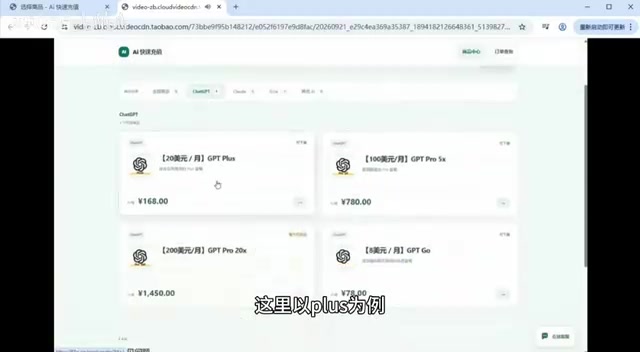
After opening the top-up website, click "Browse All Products," where you can see top-up services such as Plus, Pro, 5x, 10x, and GPT Go, with video tutorials attached to the page. After selecting the plan you need, enter your own email address as the credential for order lookup.
Step 2: Obtain the Session and Submit the Order
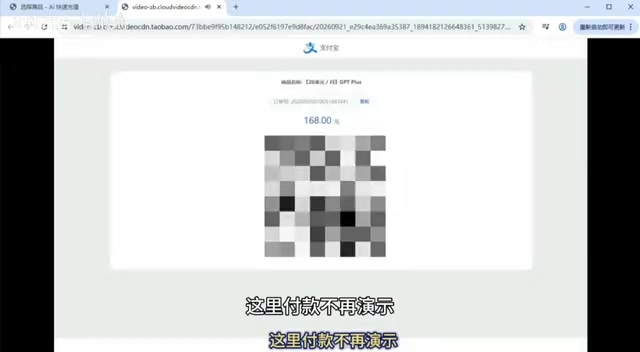
First log in to the GPT website in your browser and confirm that the lower-left corner shows the free version. Then return to the top-up website and click "Obtain Session"; the page will display a piece of code—if the code is relatively short, it means you are not logged in correctly. You need to copy it completely from beginning to end (including the brackets), paste it back into the top-up website, confirm the account is correct, and then choose a payment method to submit the order.
What Is a Session: Here, a Session refers to a string of credentials generated after the browser establishes a logged-in state with the ChatGPT website (usually existing in the form of a Cookie, in the shape of a longer JSON or encoded string). Once the top-up website obtains this credential, it can call OpenAI's interfaces as you to complete the subscription activation without needing your account password.
For this reason, a Session is essentially equivalent to a time-limited pass: it is not the same as a password, but whoever holds it can operate your account for a period of time. The tutorial emphasizes that "if the code is too short, the login was not successful" precisely because valid session information cannot be captured when you are not logged in. During the operation, you should avoid sending the Session in plain text to unknown individuals, and after the top-up is complete, you may also consider logging out of all devices in ChatGPT settings to invalidate the old session.
Step 3: Wait for It to Arrive and Refresh to Verify
After the order is submitted, it enters a processing state, and after a short wait it will show that the top-up was successful. Return to the GPT website and refresh the page to see the Plus badge; if it does not appear, you can refresh a couple more times. The website provides online customer service if you encounter problems, and supports automatic delivery around the clock.
Official Credit Card Top-Up: Where the Barriers Are
The core requirement of the official channel is holding an overseas credit card. According to the tutorial, even with a card it is easy to trigger regional restriction controls, resulting in limited payments and repeated hassles, along with hidden fees such as card opening fees and card retention fees, making the overall rate relatively high. For beginners without experience using overseas cards, this path is not friendly.
Regional Risk Controls and Hidden Fees: OpenAI's payment risk control comprehensively assesses the country of the card-issuing bank, billing address, login IP, and account history; a mismatch in any one dimension may trigger a decline. The so-called "getting past the risk controls" means keeping this information as consistent as possible, for example by using a card and network environment that match the account's region.
In addition, virtual credit card providers usually charge card opening fees, top-up processing fees, and monthly card retention fees; after adding currency conversion costs, the actual expenditure is often higher than the face value. Once such a card is flagged by risk control, it may also affect other users on the same card segment, causing subsequent subscription failures—which is why the tutorial advises beginners without experience using overseas cards to choose carefully.
In-App Purchase: A Dual Test of Device and Environment
Apple users need a US-region ID plus gift cards, while Android users need Google Play. The tutorial specifically points out that the Android side requires the device to have a complete GMS framework, and to use a global US-region IP to register a new Google account and bind an overseas-currency card. The payment environment is strictly reviewed—once the IP is identified as a data center proxy rather than a real residential IP, the account may be locked immediately, and it will most likely get stuck at the environment verification step.
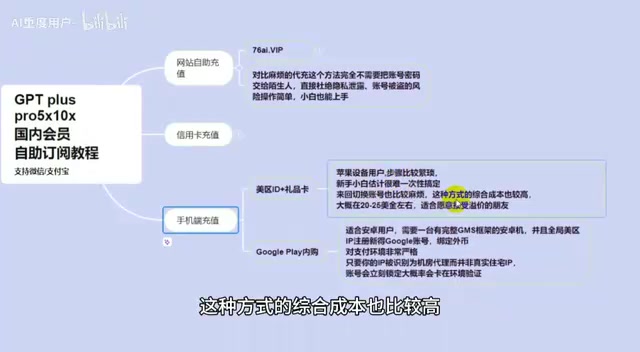
In terms of overall cost, the tutorial gives an in-app purchase price range of about 20 to 25 USD, suitable for those willing to accept a premium.
GMS Framework and Residential IP: GMS (Google Mobile Services) is the collective name for Google's mobile services, including basic components such as the Play Store, account login, and payments. Most Android phones sold in China do not have GMS preinstalled or do not fully support it, so the first step in in-app purchase is often solving the framework problem; otherwise, you cannot even open the Play Store properly.
A residential IP refers to an address assigned by a home broadband operator to a real user, as opposed to the data center IPs used by data centers and cloud servers. Google's risk control system will judge a large number of requests from data centers as proxies or bulk operations, thereby triggering account locks. What the tutorial calls "getting stuck at environment verification" is mostly caused by the IP type being identified, and this is the fundamental reason why in-app purchase, although not high in unit price, actually has an unstable success rate.
Side-by-Side Comparison of the Three Methods and Recommendations
In terms of security, self-service website top-up does not involve handing over account passwords and has the lowest risk; the official credit card channel is secure but has high barriers to obtaining; and in-app purchase fails on environment verification. In terms of operational complexity, self-service website top-up is open to iOS, Android, and the web, and its process is more standardized; the official channel is limited by credit cards; and in-app purchase requires a series of preliminary actions such as switching regions and registering a new account.
It should be noted that the stability and compliance of such third-party top-up services are borne by the service providers themselves. When choosing, users should prioritize confirming after-sales and warranty terms, and avoid disclosing sensitive account information in unnecessary scenarios. The specific websites mentioned in the tutorial are only for process demonstration; readers can refer to their operational logic and judge service reliability on their own.
One-line Summary
A comparison of the three paths for subscribing to ChatGPT Plus from China, with a focus on breaking down the Session authorization process for self-service website top-up.
Paragraph Summary
Based on a hands-on Bilibili tutorial, the article outlines three paths for users in China to subscribe to ChatGPT Plus: self-service website top-up, official credit card top-up, and in-app purchase (Apple US-region ID or Android Google Play). The biggest advantage of self-service website top-up is that no account password needs to be handed over; you only need to log in to the GPT official website, obtain a Session credential, and submit an order. The process is divided into three steps: choosing a plan and entering an email, obtaining the Session and submitting the order, and waiting for it to arrive and refreshing to verify. The official credit card channel requires an overseas card, easily triggers regional risk controls, and incurs hidden costs such as card opening fees. In-app purchase is constrained by the GMS framework and residential IP environment, with an overall cost of about 20 to 25 USD. The article finally reminds readers that the stability and compliance of third-party top-ups require users to confirm after-sales terms themselves and avoid leaking sensitive account information.
Related articles

Hunter Rescues Educated Youth: The Mountain-Chasing System Launches a New Warm-Hearted Viral Drama Formula
Bilibili's early-access period short drama *Everyone Thinks I'm a Poor Hunter* opens with a snowy-night rescue of an educated youth. Hunter Chen Shan activates the mountain-chasing system, using realistic hypothermia first-aid details and mutual-probing character dynamics to deliver a warm-hearted period drama without the sleaze.

Riemann Hypothesis Proven by AI? The Truth Has Nothing to Do With Your Reality
34-year-old mathematician Levent Alpöge claims to have proven the Riemann Hypothesis and Generalized Riemann Hypothesis with Claude, releasing 17 million lines of formal verification code. This article sorts out the facts, debunks myths about RSA collapse and new material revolutions, and analyzes the true significance of mathematics-AI collaboration.

G3 Test Drive Gone Wrong: Why Is the "Dog Poop Gun" So Hard to Use?
Bilibili creator tests the G3 rifle, from skeleton barrel and 50-round drum to combat failure, calling it a "dog poop gun." Analyzing the gap between mods and real gameplay.