ChatGPT Plus Subscription Methods Compared: Risk and Cost Analysis of Three Options

A risk and cost breakdown of three ways to subscribe to ChatGPT Plus, exposing hidden dangers in proxy payment promotions.
Using proxy payment promotions circulating on Bilibili as a starting point, this article examines the technical logic and risks of three ChatGPT Plus subscription methods: third-party proxy payment, foreign credit card direct payment, and mobile in-app purchase. It highlights that proxy payment requires submitting a Session Token — effectively handing over login access — while foreign credit cards carry high setup barriers and hidden fees, and mobile in-app purchases are costly and prone to IP-related risk controls. The article urges users to see through commercial marketing, weigh convenience against security, and prioritize official payment channels for long-term account stability.
Introduction: Spotting Bias in Recharge Tutorials
Recently, a wave of "tutorial" videos about ChatGPT Plus subscriptions has been circulating on platforms like Bilibili, typically marketed under slogans like "easiest method online" or "safe, stable, and backed by after-sales support." These videos funnel users toward third-party proxy payment websites. At their core, they are commercial promotions — not neutral technical guides.
This article does not endorse any third-party proxy payment platform. Instead, it uses this trend as a starting point to walk through the main methods for activating a ChatGPT Plus subscription, objectively analyzing the cost, risks, and target audience for each — so readers can make informed decisions. Any operation involving account security or payment security deserves careful scrutiny.
The Technical Logic Behind Three Main Subscription Methods
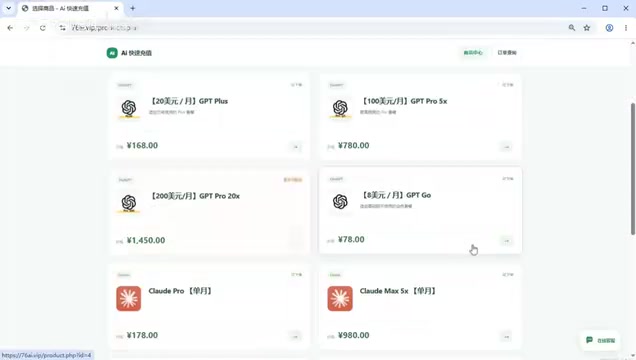
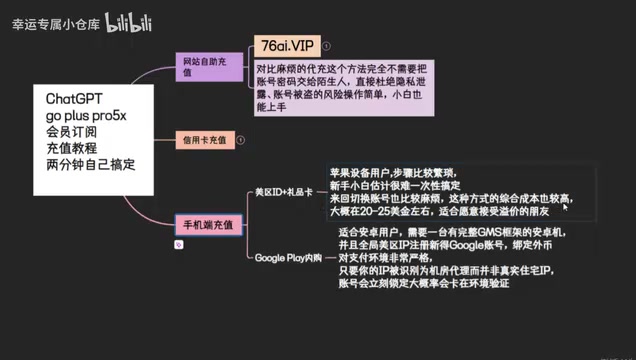
There are currently three main paths to subscribing to ChatGPT Plus: third-party proxy payment sites, direct payment via a foreign credit card, and in-app purchases on mobile. The three differ significantly in terms of setup difficulty, fee structure, and security.
It's worth clarifying upfront: OpenAI does not offer any concept like a "5x membership." Plus and Pro are the officially defined subscription tiers. Inflated claims in promotional language are themselves a red flag.
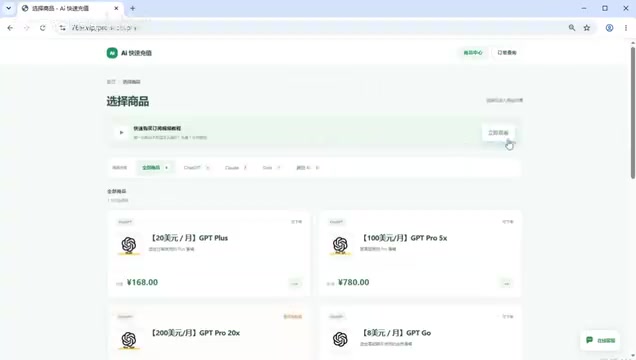
Third-Party Proxy Payment: Hidden Security Risks Behind the Convenience
The method most heavily promoted in these videos involves obtaining your account's Session Token (session credential) and submitting it to a third-party website to complete the payment. The pitch that "you don't need to hand over your username or password" is misleading — users are actually asked to copy session data from their browser and paste it into an external platform.
This comes with risks that are being seriously downplayed. A Session Token is equivalent to login credentials. Anyone who holds it can access your account as if they were you, until the token expires or you manually sign out. Handing it to an unknown platform does not eliminate the risk of privacy exposure or account hijacking — it just changes the form. Furthermore, third-party proxy payments typically violate OpenAI's Terms of Service, meaning there is a real possibility of your account being banned by OpenAI.
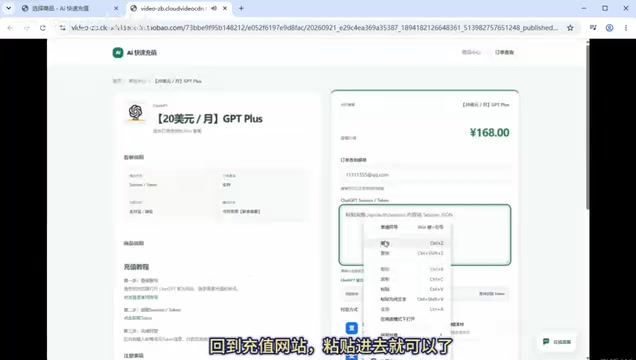
A Session Token is an encrypted string issued by a server after a user logs in, stored in the browser's cookies or local storage. It serves as proof for subsequent requests that "you have already authenticated," saving you from re-entering your password each time. Token validity periods typically range from a few hours to several weeks, depending on the platform's policy. From a technical standpoint, a Session Token is nearly equivalent to a username and password in terms of access privileges — whoever holds the token can directly invoke all account functions, including viewing conversation history, modifying account settings, and even binding new payment methods. For this reason, "Session Hijacking" is classified as a high-risk attack vector in cybersecurity. Pasting that string into a third-party website is the equivalent of handing a copied house key to a stranger. Even if the token eventually expires on its own, your data is fully exposed during that window.
Foreign Credit Card Direct Payment: Higher Barriers and Hidden Costs
Paying directly through the official channel with a foreign credit card is the closest thing to a "legitimate" method — the payment itself takes only seconds. However, even promotional content acknowledges its drawbacks: obtaining a foreign credit card involves a high barrier to entry, transactions are prone to being declined by regional risk controls, and there are hidden costs such as card issuance fees and maintenance fees. When factored together, these can add up to around ¥180 in extra expenses.
For users who already have a usable foreign credit card, this remains the safest option — both funds and account access stay entirely in your own hands, with no third-party intermediary involved.
Mobile In-App Purchase: Complicated Process and Obvious Premium
Apple users can subscribe by switching to a foreign Apple ID region paired with a gift card, while Android users must rely on a device with a complete GMS framework and make purchases through Google Play. Both approaches share the same core problems: the process is cumbersome and the costs are noticeably higher.
According to the video, the all-in cost for iOS in-app purchase is approximately $20–$25, which is significantly higher than the official Plus price of around $11.65 (taxes vary by region). The Android path is even more demanding — if your IP is identified as a data center proxy rather than a genuine residential connection, your account can easily be locked during the environment verification step. This premium is essentially a "convenience tax" paid for circumventing regional restrictions.
GMS (Google Mobile Services) is a core services framework that Google provides for Android devices, encompassing the Google Play Store, Google Play Services, Gmail, Maps, and other foundational components. Android phones sold in mainland China do not come with GMS pre-installed due to regulatory requirements, meaning users cannot directly purchase in-app subscriptions through Google Play. To use Google Play to purchase ChatGPT Plus, a device must have a complete GMS environment installed and must maintain a network exit IP that is recognized as a genuine residential broadband IP — not a data center proxy IP. Google's and OpenAI's risk control systems check IP quality; data center IPs are blacklisted because they are heavily associated with automated scripts. Triggering this check can result in account lockouts or payment rejections, which is the primary reason why the Android in-app purchase success rate is far lower than on iOS.
A Rational Look at Proxy Payment Promotions: Key Reminders
Taken together, promotional videos that frame third-party proxy payment as the optimal solution are largely motivated by commercial interests. As a user, it's important to recognize a few facts clearly:
Session Tokens are not risk-free. Any operation that asks you to copy session tokens or login credentials into an external website should be treated with extreme caution. These credentials are no less sensitive than your actual account password.
"After-sales support" does not mean real protection. A third-party platform's after-sales promise carries no enforceable weight. If your account is banned for violating OpenAI's Terms of Service, the proxy payment provider will typically disclaim responsibility, leaving you with little recourse.
Prioritize official channels. Where possible, subscribe through payment methods officially supported by OpenAI. While the barrier is slightly higher, it is the best long-term choice for both account security and financial security.
Conclusion
In the face of an ever-growing stream of "subscription tutorials," the ability to evaluate information critically matters more than chasing convenience. As a tool you plan to use long-term, the stability and security of your ChatGPT account are worth far more than saving a few dozen yuan. Before making any payment decision, weigh convenience, cost, and risk — then choose the method that best fits your situation while keeping risk at an acceptable level. That is the smart move.
Related articles

JobRunner MCP Server: AI Agents Can Now Fix Failed Java Jobs
JobRunner launches an open-source MCP server enabling AI agents to view cluster status, diagnose failures, and recover Java jobs—incident response from any cloud coding environment or existing agent.

MLAI Digital Launches 9 Security Agents: MCP Server Safeguards the Full Lifecycle of Agentic AI
MLAI Digital launches Security MCP Server with nine built-in specialized security agents covering vulnerability discovery, attack simulation, prompt injection detection, API and infrastructure assessment, and accelerated remediation—embedding security validation across the full Agentic AI lifecycle from development to production.

Running Isaac Lab on H100 GPUs: Exploring Better Approaches
Exploring optimization methods for running Isaac Lab on NVIDIA H100 GPUs, including MIG configuration, mixed precision, TensorRT acceleration, and community experience to improve robotics simulation and reinforcement learning efficiency.