ChatGPT Plus Subscription Methods Compared: Safety and Efficiency Analysis of Four Payment Options

A technical breakdown of four ways to subscribe to ChatGPT Plus, with a focus on safety risks of third-party top-up services.
This article addresses the payment barriers Chinese users face when upgrading to ChatGPT Plus, comparing four methods: overseas credit cards, Apple ID gift cards, Google Play regional payments, and third-party self-service top-up. It explains how popular third-party platforms use iOS automation to handle overseas billing, with users paying via Alipay after submitting a session token. The article also objectively highlights the risks: token exposure and potential subscription cancellations due to platform controls.
The biggest headache for users in China trying to subscribe to ChatGPT Plus often isn't the $20/month fee — it's the payment process. Overseas credit cards, regional restrictions, and declined transactions leave many users stuck at the final step of upgrading. To address this pain point, several payment workarounds have emerged. This article outlines and compares the most common options, helping readers understand how they work and what risks they carry.
Overview of Four Main Payment Methods
There are currently four main paths to activating ChatGPT Plus: direct payment with an overseas credit card, using an Apple ID with gift cards, Google Play regional payment, and third-party self-service top-up platforms. These four approaches differ significantly in terms of difficulty, success rate, and security.
Paying directly with a credit card is the native method officially supported by OpenAI, but the barrier is high for users in China — it requires a credit card that supports international transactions, and payments are frequently declined due to fraud detection. The Apple ID + gift card approach requires switching account regions and purchasing region-specific gift cards, making it a cumbersome process that can easily cause account issues if done incorrectly.

From a user experience standpoint, the first three methods share two common problems: payment channels are often flagged as high-risk and rejected, and steps like region-switching and card binding are not user-friendly for the average person.
How Third-Party Self-Service Top-Up Works
Third-party self-service top-up platforms have gained traction in recent years, recommended by many content creators. The core mechanism involves completing the subscription payment through an automated iOS process, then linking the Plus membership to the user's own ChatGPT account.
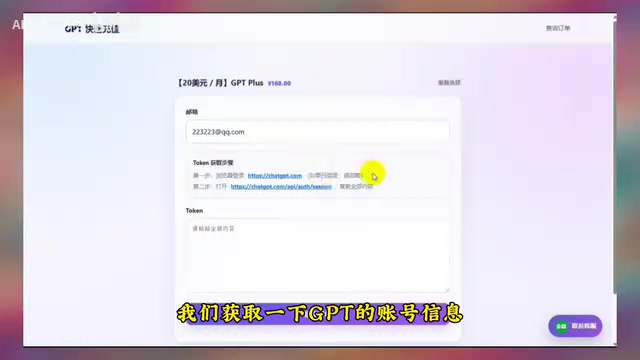
Based on demonstrated workflows, the process involves several key steps: log into your ChatGPT account in a browser, navigate to the top-up page to select a plan and enter an email address for order tracking, follow the prompts to retrieve and paste your account information code, then confirm the order and pay via Alipay.
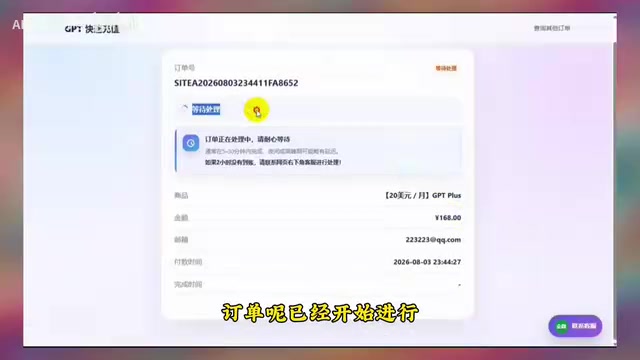
Once payment is made, the order enters processing. Closing the page at this point does not affect the top-up. When the page shows a successful top-up, go back to ChatGPT and refresh — the Plus badge should appear. If it doesn't show up immediately, refreshing a few more times usually does the trick.
The main appeal of this method is that it bypasses the hassle of obtaining an overseas card or switching regions. Users simply need to visit the designated URL while logged in, and the process is completed in two steps. It also works across Apple, Android, and web platforms.
Technical Implementation and Potential Risks
The reason third-party top-up services can offer "Alipay direct payment" is that the service provider uses an iOS device on the backend to automate the subscription and billing process. The user pays in Chinese yuan (RMB), while the actual overseas subscription charge is handled by the third party.

It's worth being objective here: while this type of third-party top-up service is convenient, it carries risks that shouldn't be overlooked. Submitting your ChatGPT account information (the session code) to a third-party website means your account security is, to some degree, dependent on that party's trustworthiness. Additionally, subscriptions established through unofficial channels may be subject to platform risk controls, cancellations, or unexpected service interruptions. Any claims of "after-sales support" or "guarantees" are ultimately just promises from the service provider, with no official backing.
The iOS "automated order and billing" mechanism technically relies on Apple's In-App Purchase (IAP) system. The service provider typically holds one or more Apple IDs linked to overseas payment methods, and uses scripts or automation tools to complete the ChatGPT Plus subscription within the App Store, then associates that subscription with the user's account. Because Apple subscriptions are tied to an Apple ID rather than directly to a ChatGPT account, if the provider's Apple ID runs into issues — such as getting banned or having a refund dispute trigger a subscription reversal — the user's Plus benefits could be cut off at any time. Furthermore, the "account information code" that users submit is typically ChatGPT's Session Token, which grants access equivalent to direct account entry. If misused, all conversation history and linked account information could be exposed.
How to Make a Rational Choice
For users seeking stability and long-term use, the official credit card route — despite its higher barrier — remains the gold standard for account security. Third-party self-service top-up wins on convenience and low barrier to entry, making it more suitable for short-term or one-off needs, but users should carefully weigh the potential downsides: account compromise, benefit interruption, and so on.
Before using any top-up service, it's advisable not to enter sensitive information on unfamiliar websites, to use a disposable backup account whenever possible, and to keep order receipts in case you need to dispute a charge later. The trade-off between convenience and security ultimately comes down to your own judgment.
This article is intended solely as a technical overview and comparison of common top-up methods and does not constitute a recommendation of any specific third-party service.
For users who genuinely need ChatGPT Plus but cannot obtain an overseas credit card, virtual credit cards (such as Depay, OneKey Card, etc.) represent a middle ground between official channels and third-party top-up services. These platforms allow users to load funds via cryptocurrency or other means to obtain a Visa/Mastercard virtual card for international payments, which can then be used to subscribe directly on the OpenAI website. Compared to using a proxy top-up service, a virtual card subscription establishes the billing relationship directly between the user's own ChatGPT account and OpenAI's official payment system, keeping full account control in the user's hands. The main barriers are that some familiarity with cryptocurrency operations is required, and some virtual card platforms carry their own compliance and reliability risks — evaluate each platform's reputation independently before proceeding.
Related articles

Chain of Thought Isn't Just for AI: How Humans Can Use CoT to Improve Thinking Quality
Chain of Thought isn't just a prompt trick for large models. Starting from a Hacker News discussion, this article analyzes why CoT works for human thinking too, breaks down actionable ways to transfer it, and highlights the key differences between human CoT and machine CoT.
Cloudflare Teams Up with OpenAI: Closi…
Cloudflare Teams Up with OpenAI: Closing the Loop from Vulnerability Discovery to Defense with AI
Cloudflare uses OpenAI Daybreak to investigate security vulnerabilities and generate reviewable remediation plans, while developers use Codex to boost coding efficiency and quality.

Orca Multi-Agent Orchestration in Practice: A Guide to Parallel Collaboration with Claude and Codex
Orca is Stable AI's free open-source agent workbench supporting 34 agents like Claude Code and Codex in parallel. Learn its Git worktree isolation, multi-model orchestration, and mobile management.