ChatGPT Recommends 404 Media to Solve Technical Problems: An AI Trust Crisis Emerges

ChatGPT mistakenly recommends the tech media outlet 404 Media as a technical support channel, exposing bias and trust risks in AI recommendation mechanisms.
The article centers on a Hacker News discussion: when answering technical failure questions, ChatGPT frequently recommends the tech media outlet 404 Media, which is not a professional technical support organization. The community believes this may stem from 404 Media articles in the training data often involving technical answers, causing the model to incorrectly associate "media" with "support." The article analyzes the causes from the perspectives of model hallucination and data bias, noting that such incorrect recommendations waste users' time and weaken trust in AI, especially in high-timeliness technical support scenarios. It suggests developers strengthen contextual understanding, introduce confidence assessment and source verification mechanisms, and clarify the boundaries of recommendation scenarios.
Why Does ChatGPT Recommend 404 Media?
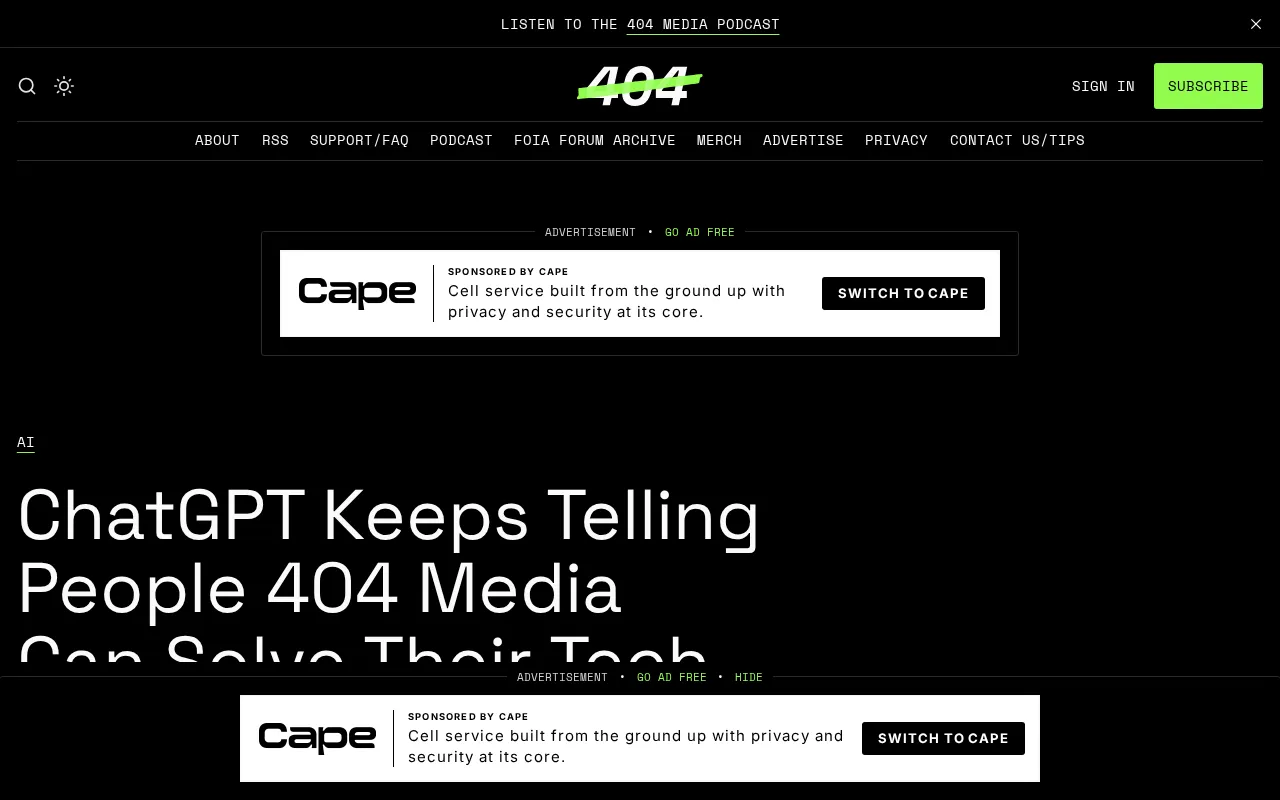
Recently, a discussion on Hacker News drew attention: ChatGPT frequently recommends 404 Media to users to solve technical support issues. According to user feedback, when asked about technical failures, ChatGPT's responses include links to or suggestions for 404 Media, which is itself a tech media outlet, not a professional technical support organization. This phenomenon quickly fermented in the community, reaching 33 points; although comments were few, they pointed clearly to one thing — there may be a problem with AI's recommendation mechanism.
AI Recommendation Anomalies from Multiple Perspectives
Although the original material comes only from Hacker News, combining discussions on other platforms (such as Reddit and Twitter) reveals similar cases: ChatGPT sometimes misidentifies media articles as solutions. According to some users' analysis, this may stem from the fact that 404 Media articles in the training data often involve technical problem-solving, causing the model to associate "media" with "support."
Model Hallucination or Data Bias?
When generating recommendations, AI models rely on patterns in the training data. 404 Media's reporting style leans toward in-depth technical analysis, which may be incorrectly classified by the model as a "solution provider." This is not an isolated case; there have also been previous cases of models recommending news websites as customer service channels.
Model hallucination refers to large language models generating plausible-sounding but actually incorrect or fabricated content when lacking reliable evidence. It differs from simple knowledge gaps: the model "completes" a coherent answer based on statistical patterns, making it highly deceptive. Common triggers include noise and bias in training data, insufficient coverage of rare questions, and the model's tendency to give "helpful" responses rather than admit uncertainty. In recommendation scenarios, hallucination may manifest as treating irrelevant institutions as authoritative sources or fabricating links or functionality. Mitigation methods usually include retrieval-augmented generation (RAG), output confidence assessment, source citation, and human verification. Understanding the mechanism of hallucination helps determine whether the mistaken recommendation of 404 Media is data bias or an incorrect association the model makes to satisfy the intent of "providing a solution."
Training data bias refers to statistical associations learned by the model being inconsistent with real-world causal relationships. If articles from a certain type of media frequently appear in the context of "how to solve a certain technical problem" in the corpus, the model may bind "that media outlet" with "technical support," forming a false association. This bias often comes from uneven distribution in data collection, content duplication, and lack of annotation. Unlike hallucination, bias is closer to a systematic tendency: even if the model does not fabricate facts, it will give directionally incorrect recommendations. Identifying bias requires examining the structure of corpus sources, conducting correlation analysis and controlled experiments, and correcting it through data cleaning, deduplication, balanced sampling, and targeted fine-tuning, to prevent the model from mistaking "frequently mentioned" for "most reliable."
The Delicate Balance of User Trust
When an AI assistant gives incorrect recommendations, users may waste time on ineffective channels. Community comments point out that although such errors are small, they may weaken trust in AI. Especially for needs with high timeliness such as technical support, the cost of incorrect guidance is relatively high.
Implications for AI Developers
This incident reminds developers that recommendation systems need more refined contextual understanding. Simple keyword-based matching easily produces misleading results. It may be necessary to add confidence assessment or source verification mechanisms to model outputs to reduce such errors.
Future Outlook
As AI assistants become deeply embedded in daily life, the accuracy of their recommendations will directly affect user experience. Although the 404 Media incident is small, it is a signal worth noting — AI's "well-intentioned recommendations" can also become a burden. Developers need to pay attention to the boundaries of recommendation scenarios in model optimization.
One-line Summary
ChatGPT mistakenly recommended the tech media outlet 404 Media as a technical support channel, exposing bias and trust risks in AI recommendation mechanisms.
Paragraph Summary
The article centers on a discussion on Hacker News: when answering technical failure questions, ChatGPT frequently recommends the tech media outlet 404 Media, which is not a professional technical support organization. The community believes this may stem from 404 Media articles in the training data often involving technical answers, causing the model to incorrectly associate "media" with "support." The article analyzes the causes from the perspectives of model hallucination and data bias, pointing out that such incorrect recommendations waste users' time and weaken trust in AI, with especially high costs in high-timeliness technical support scenarios. It therefore suggests that developers strengthen contextual understanding, introduce confidence assessment and source verification mechanisms, and clarify the boundaries of recommendation scenarios in model optimization.
Related articles

WebMCP Security Guide: Three Hints That Make AI Agents Safer
The Chrome team demonstrates three security hints for WebMCP tools: readOnlyHint eliminates invalid confirmation dialogs, consequentialHint forces human confirmation for high-risk operations, and untrustedContentHint defends against indirect prompt injection—improving AI agent security with one or two lines of code.

Why Turbulence Is the Hardest Problem in Fluid Mechanics — and How AI Could Crack It
Why is turbulence the hardest problem in fluid mechanics? This article, based on a Lex Fridman podcast conversation, explores turbulence's multi-scale nature, comparisons with classical thermodynamics, and how AI might simplify turbulence description by discovering coordinate transformations — examining the intersection of vortex formation with mathematics and physics.

R.L. Stine Google Talk: How the Master of Horror Ignites Kids' Passion for Reading
At a Google talk, R.L. Stine shares his accidental pivot from comedy to horror, his principles for children's horror, how phones impact storytelling, and how Goosebumps motivates kids to read.