ChatGPT Replied in Krio Across Devices? A Reddit Post Sparks Privacy Speculation

A Reddit post sparks AI cross-device data speculation — coincidence and account sharing are the more likely culprits.
A Reddit post claimed that a father received a Krio-language AI response shortly after his child had searched for related content on a separate device, raising suspicions about cross-device data linkage. The article breaks down more plausible explanations: the human tendency to find patterns in random events; shared AI accounts whose memory features naturally create the illusion of data linkage; and the fact that mainstream LLM training is an offline batch process, making it technically impossible for a single search to influence another user's response within hours. The piece also acknowledges the real underlying issues — insufficient data transparency and users' inability to trace unexpected model outputs — offering practical self-check steps and calling on AI companies to address privacy transparency directly.
An Intriguing User Experience
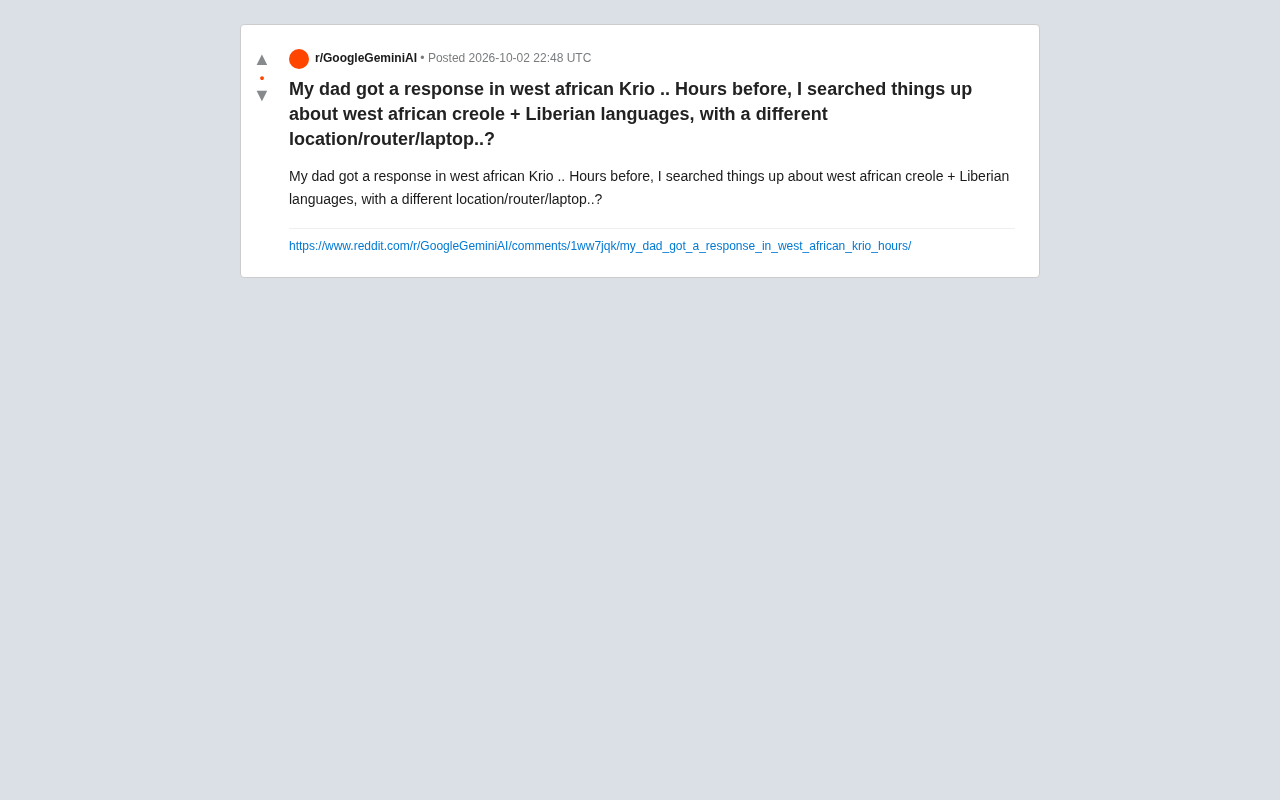
A Reddit post recently sparked widespread discussion. The user claimed that their father received a response written in West African Krio while using an AI assistant — and just a few hours earlier, the poster themselves had searched for content related to West African Krio and Liberian languages on a different laptop, a different router, and in a different location.
The seemingly coincidental connection left the poster baffled: could an AI system be quietly linking behavioral data across different devices, networks, and accounts?
Why This Raises Alarms
Krio is one of the major lingua francas of Sierra Leone, and Liberia has a similar English-based Creole variant. For most users, the odds of an AI assistant spontaneously outputting such a niche language are quite low. It's precisely because of that rarity that the poster connected their father's response to their own search from a few hours prior.
This touches on a widespread user anxiety: could our search and conversation data be linked across devices and accounts? When something that happened on Device A appears to influence the output on Device B, it's only natural to suspect that data is being aggregated into a centralized profile.
More Plausible Technical Explanations
Before interpreting this as a "privacy breach," there are several more straightforward technical reasons worth considering first.
Coincidence and the Small-Sample Illusion
The human brain is wired to find patterns in random events. AI models sometimes switch languages when answering open-ended or ambiguous questions — especially when the input contains ambiguous phrasing, non-English words, or when the model misreads the user's intent. A one-off Krio response could easily be random model behavior rather than the result of any data linkage.
Hidden Sharing of Home Networks and Accounts
Even though the poster emphasized using "a different router and location," if the father and child share the same AI account, the same login credentials, or have ever logged in on the same device, then conversation history, memory features (like ChatGPT's Memory), or personalization settings could produce cross-session effects. Many AI products' "memory" features are specifically designed to maintain context across conversations.
ChatGPT's Memory feature launched officially in early 2024, allowing the model to retain user preferences, background information, and past interactions across different conversations. These memory entries are stored at the account level — not the device level — meaning that as long as you're logged into the same account, the model can access the same memory pool regardless of which device or network you're using. Beyond ChatGPT, products like Google Gemini and Claude have similar cross-session context retention mechanisms. In a household where an account is shared, a memory entry triggered by one family member (e.g., "user is interested in a certain language") could easily be activated during another family member's conversation — producing a seemingly mysterious "data linkage" effect that is, in reality, just the account's normal functionality at work.
The Boundary Between Model Training and User Data
A common misconception is worth clearing up: mainstream large language models do not in real time inject one user's search from a few hours ago into another user's response. Model weight training happens offline in batches, and a single search cannot alter the model's outputs for others within hours. The claim that "I searched for something, and a few hours later it appeared in someone else's response" simply doesn't hold up technically.
Large language model training typically involves two stages — pre-training and fine-tuning — both of which are completed offline on static datasets and can take weeks or even months. Once a model is deployed, its weights are fixed; everyday user conversations do not immediately feed back into the model's parameters. Some service providers periodically collect user feedback for use in training future versions, but this too is processed in batches with significant delay — it is not a real-time pipeline. A few products offer so-called "web search" or "real-time retrieval" features, but those temporarily pull in external information during inference and are entirely separate from modifying model weights. Understanding this distinction is key to grasping why "influencing someone else's response within a few hours" is technically near-impossible.
What This Post Really Reflects
Although this particular case is most likely a coincidence, the user concerns it surfaces are genuine and worth taking seriously:
- Lack of data transparency: Users often have no clear picture of what AI products actually collect and how accounts are linked across devices.
- The double-edged sword of memory features: Personalized memory improves the experience, but also makes users worry that "it remembers too much."
- No verifiable explanations: When a model produces an unexpected output, users have almost no way to trace the cause and are left to speculate based on instinct.
What Users Can Do
If you encounter a similar "eerie connection," here are a few steps to investigate:
- Check whether the devices involved are logged into the same AI account or share a login state.
- Review and clear the AI assistant's "memory" or history settings.
- Try to reproduce the issue — run the same test in a fresh private session with a brand-new account and see if the result is consistent.
- Only if you can reliably reproduce cross-account data linkage should you report it to the service provider and preserve the evidence.
Conclusion
The Reddit post itself is nothing more than an unverified personal account, lacking reproducible evidence or technical logs — there's simply no basis for concluding that an AI system has cross-device data linkage. The more reasonable interpretation is that this is likely the product of random model behavior combined with the human tendency to find patterns. But the conversation it has sparked around privacy transparency is precisely the kind of issue that today's AI products urgently need to address head-on.
Related articles

Chain of Thought Isn't Just for AI: How Humans Can Use CoT to Improve Thinking Quality
Chain of Thought isn't just a prompt trick for large models. Starting from a Hacker News discussion, this article analyzes why CoT works for human thinking too, breaks down actionable ways to transfer it, and highlights the key differences between human CoT and machine CoT.
Cloudflare Teams Up with OpenAI: Closi…
Cloudflare Teams Up with OpenAI: Closing the Loop from Vulnerability Discovery to Defense with AI
Cloudflare uses OpenAI Daybreak to investigate security vulnerabilities and generate reviewable remediation plans, while developers use Codex to boost coding efficiency and quality.

Orca Multi-Agent Orchestration in Practice: A Guide to Parallel Collaboration with Claude and Codex
Orca is Stable AI's free open-source agent workbench supporting 34 agents like Claude Code and Codex in parallel. Learn its Git worktree isolation, multi-model orchestration, and mobile management.