ChatGPT's Female Users Exceed 50%: How AI Is Integrating Into Women's Work and Lives
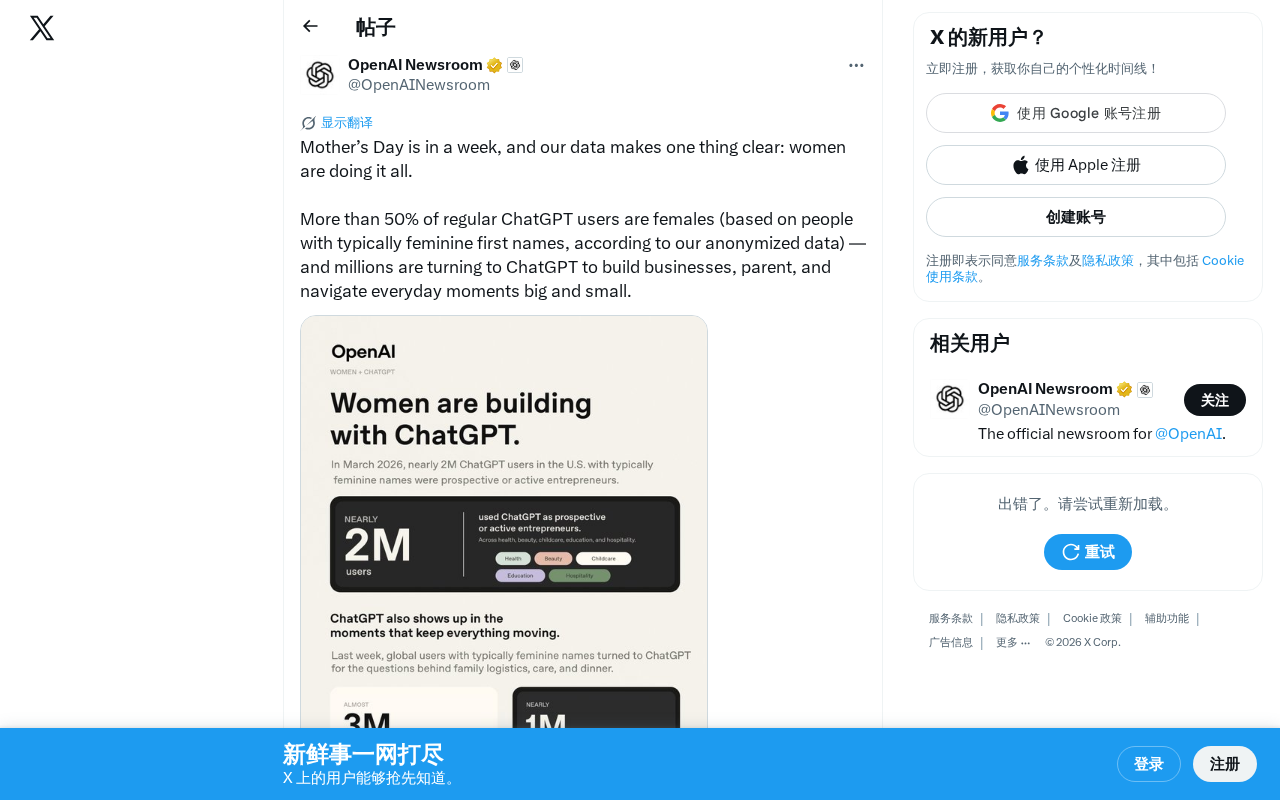
ChatGPT's female users surpass 50%, signaling AI's transformation from geek tool to mass infrastructure.
OpenAI revealed that women now account for over 50% of ChatGPT's regular users, shattering the stereotype of male-dominated AI tool usage. Women primarily use ChatGPT across three core scenarios: entrepreneurship and business, parenting and family, and everyday tasks. This data reveals three deeper trends: AI tool interaction barriers have dropped to near zero achieving "de-technicalization," productivity tools are evolving into life tools, and the gender digital divide is narrowing.
OpenAI recently disclosed a striking set of user data: among ChatGPT's regular users, women now account for more than 50%. This figure shatters the stereotype that AI tools are "primarily used by male tech enthusiasts" and reveals a deeper shift—AI is becoming deeply integrated into women's work and daily lives.
What Does a Female Majority Mean?
This data comes from OpenAI's analysis of anonymized user information, based on statistical inference from "names that are typically female." While this methodology has certain limitations, the 50%+ share still sends a clear signal: the user profile of AI tools is undergoing a fundamental transformation.
Looking back at the history of tech product adoption—from personal computers to smartphones, from social media to short-video platforms—every critical inflection point in technology adoption has been accompanied by a massive influx of female users. This pattern aligns closely with the S-shaped diffusion curve described by Everett Rogers in Diffusion of Innovations—large-scale female adoption is often the hallmark signal of a product crossing from the "early adopter stage" to the "early majority stage." Take social media as an example: Facebook's female users first surpassed males around 2009, after which the platform's monthly active users rapidly climbed from 200 million to the billion-user level. The logic behind this pattern is that female user groups tend to have needs more closely aligned with high-frequency daily life scenarios, and when a product meets these needs, its usage frequency and stickiness typically exceed those of the early male user base, which tends toward exploratory use. When female users exceed half of the user base, it typically means the technology has transformed from a "geek toy" into "mass infrastructure." ChatGPT is experiencing this inflection point right now.
How Millions of Women Are Using ChatGPT
In its statement, OpenAI specifically mentioned that millions of women are using ChatGPT to accomplish tasks across three core scenarios.
Entrepreneurship and Business
A growing number of female entrepreneurs are using ChatGPT as a "virtual co-founder." From writing business plans and analyzing market data to designing marketing copy and handling client emails, AI has dramatically lowered the technical barriers and labor costs of starting a business. For women running solo ventures or small businesses, ChatGPT functions as a versatile assistant, helping them accomplish more with fewer resources.
Parenting and Family
Parenting is a highly representative use case. Tutoring children with homework, creating nutritious meal plans, navigating tricky parent-child communication issues—ChatGPT is becoming a "parenting advisor" for many mothers. On a technical level, this relies on the powerful knowledge integration and personalized output capabilities of large language models—they can synthesize knowledge from pediatric medicine, developmental psychology, education, and other fields to provide contextually relevant suggestions. In the traditional information retrieval era, this would have required significant time spent filtering and comparing sources. This doesn't mean AI replaces human judgment; rather, in an age of information overload, it provides busy parents with a channel for quickly obtaining reference opinions.
However, from a sociological perspective, this use case also touches on deeper gender division of labor issues. According to OECD data, in most member countries, women still spend 1.5 to 3 times more time on unpaid housework and childcare than men. When AI tools are marketed specifically as "parenting advisors" and primarily used by women, there is a risk: efficiency gains from technology may be used to fill in more parenting tasks rather than genuinely freeing up women's time autonomy.
Everyday Moments Big and Small
OpenAI used "everyday moments big and small" to describe the third category. This encompasses planning travel itineraries, comparing products for purchase, handling workplace emails, preparing for interviews, and various other daily needs. The value of AI lies not in replacing thought, but in accelerating decision-making processes and reducing repetitive labor.
Deeper Trends Behind the Data
The timing of this data release—one week before Mother's Day—clearly carries marketing considerations, but the trends it reveals deserve serious attention.
First, the "de-technicalization" of AI tools is complete. One of the core breakthroughs of the Large Language Model (LLM) technology underlying ChatGPT is reducing the barrier of human-computer interaction to near zero. Previously, effective communication with computers required mastery of specific command syntax, programming languages, or at least structured query logic—skills that have historically been closely tied to male-dominated STEM education systems. Through pre-training on massive human language corpora, LLMs have acquired the ability to understand ambiguous expressions, fill in missing contextual information, and tolerate grammatical errors. Users can ask questions in colloquial, fragmented, or even emotionally charged language, and the system can still understand intent and provide effective responses. This "zero learning cost" interaction paradigm fundamentally expanded the potential user base of AI tools from "technically proficient individuals" to all adults with basic language expression abilities. This is the most far-reaching democratization process in the history of human-computer interaction revolutions, and it is the fundamental reason for the rapid growth of ChatGPT's female user base.
Second, "productivity tools" are evolving into "life tools." Early AI application scenarios were concentrated in professional domains like programming and data analysis. Now they have expanded to encompass parenting, shopping, social interactions, and all aspects of life. The boundaries of tools are blurring, and AI is becoming a general-purpose capability.
Third, the gender digital divide is narrowing. The Gender Digital Divide refers to the systematic differences between men and women in access to information technology, usage capabilities, and degree of benefit derived. This concept was first proposed in the 1990s during the early days of internet adoption, when women accounted for less than 30% of global internet users, and this divide in developing countries often overlapped with structural factors such as unequal educational resources and low levels of economic independence. Within the tech industry itself, women have long been underrepresented in core positions such as software engineering and AI research, which in turn has influenced the starting points and feature priorities of product design. The data showing ChatGPT's female users exceeding half is a concrete manifestation of consumer-grade AI products breaking through this historical barrier at the "last mile"—at least at the consumer AI product level, the gender gap is not widening but actually narrowing.
Limitations and Considerations Worth Noting
Of course, we also need to remain cautious. OpenAI's statistical method—based on "names that are typically female"
Related articles
 Industry Insights
The IRS Mobile App Debate: A Trust Crisis in Government Digital Transformation
The IRS's proposed mobile app has sparked heated debate. This article analyzes the core arguments, exploring data security, privacy, and the trust crisis in government digital transformation.
 Industry Insights
IRS Fully Embraces Claude AI, Accelerating Federal Government's AI Adoption
The IRS is recruiting staff with 24/7 Claude AI access, marking Anthropic's breakthrough into the federal government. Explore the strategic implications and tax use cases.
 Industry Insights
Nadella Introduces the Loopcraft Framework: Building AI Ecosystems Through Feedback Loops
Microsoft CEO Satya Nadella's Loopcraft framework explains how to build frontier AI ecosystems through nested feedback loops across technology, business, and ecosystem dimensions.