ChatGPT Said a Professor's Name Never Mentioned? AI Memory and Hallucination Mechanisms Explained

Explaining how ChatGPT's memory feature and hallucination mechanisms can surface information users forgot they shared.
A Reddit user was shocked when ChatGPT mentioned a professor's name they claimed never to have shared. This article explains how ChatGPT's cross-session memory feature stores information from past conversations, why AI hallucinations occur, and why this likely isn't a data breach. It also provides practical tips for managing AI memory settings and protecting privacy.
A Disturbing "Black Mirror Moment"
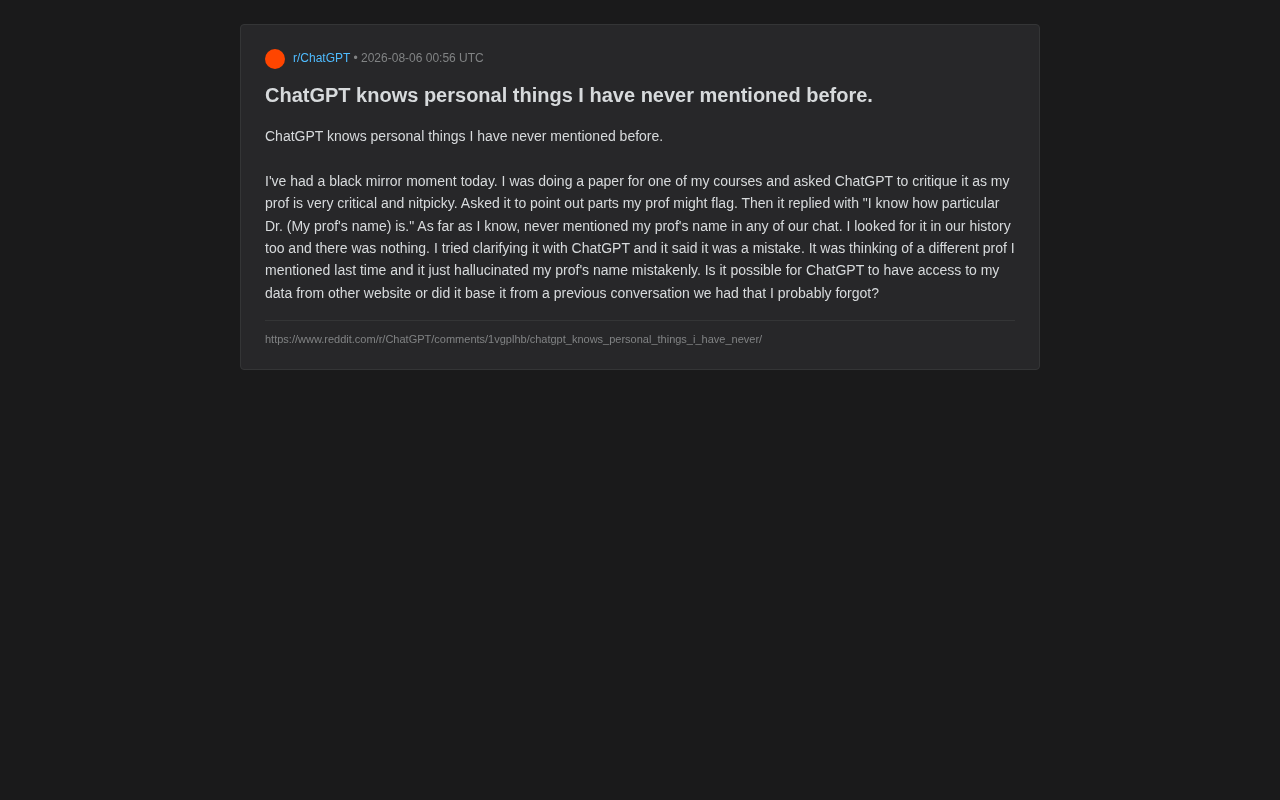
Recently, a Reddit user shared an experience that sent chills down his spine. He was writing a course paper and asked ChatGPT to review it from the perspective of a "strict, nitpicky professor," pointing out which parts might get criticized. To his surprise, ChatGPT responded: "I know how particular Dr. [professor's name] is."
The problem? The user claimed he had never mentioned this professor's name in any conversation. He even searched through his entire chat history and found no trace of it. When he pressed ChatGPT for an explanation, the AI called it a "slip-up," saying it had "confused" a professor the user mentioned previously and "hallucinated" the name.
This raises a question many users share: Can ChatGPT actually access my data from other websites? Or did it simply make an inference based on some conversation I've long forgotten?
How ChatGPT's Cross-Session Memory Works
To understand this phenomenon, we first need to understand the Memory feature that OpenAI has rolled out and gradually expanded.
Definition and Mechanism of the Memory Feature
ChatGPT's memory feature allows it to remember key information about users across different conversation windows. This means that even when you start a brand new conversation, ChatGPT may "remember" preferences, background details, and even specific information you mentioned in previous conversations.
This is completely different from the traditional assumption that "each conversation is independent." Many users mistakenly believe that clearing or starting a new conversation means the AI "forgets everything," but the memory feature breaks this boundary.
From a technical standpoint, OpenAI began rolling out the memory feature to select users in February 2024, then officially opened it to all paid users in April. The underlying implementation doesn't simply save complete conversation logs. Instead, it uses an extraction mechanism to abstract key information from conversations (such as user preferences, personal background, work scenarios, etc.) into structured short sentences stored in an independent memory layer. These memory entries are injected into the context window as part of the system prompt in subsequent conversations, thereby influencing how the model responds. This means the memory feature is essentially a form of "persistent prompt engineering" — it changes the input the model sees, rather than the model's parameters themselves.
Why Users "Can't Find" the Information Source
In the case above, the user searched through his current conversation history and found nothing — this is precisely the typical manifestation of the memory feature:
- Information is stored in a separate memory bank, not within any specific conversation
- The user may have casually mentioned the professor's name in a conversation weeks or even months ago
- The memory feature automatically extracts information it deems "worth remembering," often without the user realizing it
In other words, that "never mentioned" name was very likely mentioned at some point — the user simply forgot. This also reveals a cognitive asymmetry problem: human memory is selective and decays over time, while AI memory, once written, is persistent and precise. This disparity is precisely what creates the "uncanny valley effect."
AI Hallucination Mechanisms: Why Models "Fabricate" Information
ChatGPT's own explanation was "hallucination" — it admitted to confusing different professors. This explanation also deserves serious consideration.
Definition of AI Hallucination
Hallucination refers to large language models generating content that appears plausible but is actually inaccurate or lacks factual basis. When the model lacks clear information in its context, it "fills in the blanks" and outputs the statistically most likely answer.
The root cause of the hallucination problem lies in the generation mechanism of large language models — it's fundamentally a probabilistic prediction system that generates text token by token based on statistical patterns in training data. When the model faces scenarios with insufficient information, it doesn't return "no results" like a database would; instead, it selects the most probable output based on probability distributions. This mechanism is particularly prominent in autoregressive generation: each newly generated token is conditioned on the preceding text, and once early generation produces biased content, subsequent outputs "self-reinforce" in the wrong direction, forming a fluent but inaccurate narrative. Academics categorize hallucinations into "intrinsic hallucinations" (contradicting input information) and "extrinsic hallucinations" (unverifiable from input information). If this case is indeed a hallucination, it likely falls into the latter category.
In this case, there are two possibilities:
- Genuine memory retrieval: The model actually extracted the correct professor's name from its memory bank or a long conversation
- Pure hallucination generation: The model fabricated or misattributed the name based on a different professor the user previously mentioned
Interestingly, if this truly were a hallucination, the probability of the name coincidentally being correct is extremely low — unless the user had indeed mentioned it before. This, in turn, supports the memory feature as the more likely explanation.
The Model's Tendency to "Deflect"
One important point: ChatGPT's explanations of its own behavior are not necessarily reliable. When pressed, it may tend to provide an innocuous-sounding answer ("it was just a slip-up"), but this doesn't mean it truly understands what happened internally. Large language models don't possess genuine "self-awareness" — their explanations of "why I said that" may themselves be a form of hallucination.
This touches on a core Explainability challenge in AI. A large language model's "self-explanation" is essentially another text generation process — it doesn't have the ability to trace back and inspect its own reasoning path the way program debugging does. This is similar to the limitations of "verbal reports" in cognitive science — when humans are asked about their decision-making reasons, they often provide post-hoc rationalizations rather than accurate accounts of their cognitive processes. OpenAI's research team has acknowledged in multiple papers that a model's Chain-of-Thought output doesn't necessarily reflect the true path of its internal computation. Therefore, when ChatGPT says "this was a hallucination" or "I got confused," that explanation itself may simply be the "safest" response it generates when questioned, rather than an accurate description of its internal state.
Can ChatGPT Leak User Privacy Data?
Users' biggest concern is whether "ChatGPT secretly accessed my data from other websites." Based on the current technical architecture, this concern can essentially be ruled out:
- Standard ChatGPT cannot proactively access your private data on other websites, social media, or school systems
- Unless you actively enable web browsing and the relevant information is publicly searchable
- OpenAI's memory feature only stores information you provide within ChatGPT conversations
From a system architecture perspective, ChatGPT runs in OpenAI's closed server environment and does not have the ability to initiate external network requests to access user data on third-party websites. Even the web browsing feature (Browse with Bing) can only retrieve publicly indexable web content, and it's only activated when the user triggers it or when the model determines it needs real-time information. OpenAI's privacy policy explicitly states that there is strict isolation between user conversation data and third-party platform data. However, it's worth noting that if users have uploaded documents containing personal information (such as course syllabi, email screenshots, or academic paper drafts) to ChatGPT for analysis, the information in those documents may also be captured and stored by the memory feature — a data exposure pathway many users easily overlook.
Therefore, the most reasonable explanation remains: this information came from your historical interactions with ChatGPT — you just didn't notice or have long since forgotten.
How to Manage and Control Your AI Memory
This incident also reminds all users: it's time to reassess how much information you're sharing with AI.
Practical Recommendations
-
Check your memory settings: In ChatGPT's "Settings → Personalization → Memory," you can view what information the AI has remembered about you and delete entries individually or clear them all.
-
Use temporary conversation mode: If you don't want a particular conversation to be recorded in long-term memory, you can enable "Temporary Chat" mode. When temporary chat mode is active, the conversation won't appear in your history and won't trigger the memory feature's information extraction. However, note that temporary conversations will still read existing memory entries as context (i.e., the AI still "knows" you) — it just won't write new content to the memory bank. This is similar to a browser's "incognito mode" — it prevents new data accumulation but doesn't erase your existing digital profile. If users need a completely anonymous interaction experience, they should use ChatGPT without logging in, or thoroughly clear their memory bank before entering temporary mode.
-
Be cautious sharing sensitive information: Avoid revealing real names, specific institutions, health conditions, and other private information in conversations — especially information involving third parties (such as professors or colleagues).
-
Regularly audit your memory bank: Develop the habit of periodically reviewing and cleaning your memory bank to maintain awareness of how much the AI "knows" about you.
-
Be mindful of file upload contents: Before uploading documents, check whether they contain sensitive information you don't want the AI to remember long-term, such as others' contact details or internal organizational identifiers.
Conclusion: Finding Balance Between AI Convenience and Privacy Protection
This Reddit user's "Black Mirror moment" fundamentally reflects the cognitive shock brought about by AI memory features — when a machine remembers what we've said better than we do ourselves, that feeling of being "seen through" is inevitably unsettling.
From a technical perspective, however, this is neither a data breach nor some mysterious surveillance. It's an "information echo" arising from the interplay between the memory feature and hallucination mechanisms. It reminds us: while enjoying the convenience of AI personalization, we also need to actively manage our digital footprints.
This incident also reflects a broader industry trend: as AI systems evolve from stateless tools into "digital assistants" with persistent memory, traditional privacy frameworks face fundamental challenges. How does the EU's General Data Protection Regulation (GDPR) "right to be forgotten" apply to AI memory systems? Where are the boundaries of user responsibility for third-party information in AI memory? These questions will become core issues facing both regulators and the tech industry in the coming years.
Understanding how AI remembers and how it makes mistakes is the first step toward a healthy coexistence with these intelligent tools.
Related articles

Felix Rieseberg Personal Homepage
Felix Rieseberg's personal homepage sparks attention on Hacker News. This article covers the Slack engineer's technical background, the rise and fall of nativefier, and the value of a developer homepage as a tech calling card.

@ai-sdk/vue 3.0.306 Patch Release Syncs with [email protected] Update
@ai-sdk/vue 3.0.306 released, synced with [email protected]. A routine patch release for the Vercel AI SDK ecosystem with no public API changes; the Vue adapter layer stays version-aligned with the core package.

Gemini 4 Argon API Launches: The Era of Million-Token Output Begins
Google launches Gemini 4 Argon with sparse MoE architecture, up to 1M output tokens, and a 68.90% Vals Index score, available across API, AI Studio, and the Gemini app.