ChatGPT vs Claude: A 20-Minute AI Game Coding Showdown

Same prompt, 20 minutes: Claude delivers a playable browser game while ChatGPT overplans and underdelivers.
A developer gave ChatGPT and Claude the same prompt to build a Dragon Ball-style fighting game in 20 minutes. ChatGPT aimed for Unreal Engine but delivered a bare-bones 2D game requiring manual setup. Claude chose a browser-based approach, producing a complete game with 8 characters, a combat system, and zero configuration. The test highlights how pragmatic tech choices and integrated development experiences are becoming key differentiators in AI coding tools.
A developer used the same prompt to have ChatGPT and Claude each generate a Dragon Ball Sparking Zero-style fighting game from scratch in 20 minutes. The results were surprising — both AIs successfully produced runnable games, but the differences in development experience, code quality, and final output were striking.
The Experiment: Same Prompt, Two AIs
A creator named Zoku designed a simple but effective test: feed ChatGPT and Claude the exact same initial prompt — "Make me a Dragon Ball Sparking Zero game clone from scratch" — then let each AI refine the prompt on its own and generate complete, runnable code.
Dragon Ball: Sparking! Zero is a 3D fighting game released by Bandai Namco in 2024, the latest entry in the classic Budokai Tenkaichi series. The franchise is known for its high-speed aerial combat, large-scale arenas, and faithful recreations of signature moves from the anime, featuring over 180 playable characters. Choosing this game as an AI cloning target is particularly representative — it combines 3D free movement, a complex combat system, and rich character differentiation, posing a multi-dimensional challenge to AI code generation capabilities.
One notable detail: the tester is not a professional game developer. He mentioned that aside from using Unreal Engine during college, he had never actually built a game independently. This makes him a perfect representative of the core target user for AI coding tools — someone with a technical background but lacking domain-specific experience.
ChatGPT's Performance: Grand Plans, Underwhelming Execution
Upon receiving the task, ChatGPT first displayed impressive "ambition." It automatically generated an extremely detailed refined prompt, including third-person free-roam arena mode, eight-directional flight, short-range dashing, and other complex feature plans. It then attempted to build a complete Unreal Engine 5.4 project.
Some technical context on UE5.4: Unreal Engine 5.4 is a game engine version released by Epic Games in 2024, featuring built-in next-gen rendering technologies like Nanite virtualized geometry and Lumen global illumination. While it's one of the most powerful game development engines in the industry, a complete UE5 project typically requires several GB of project files, C++ or Blueprint scripting, asset import pipeline configuration, and extensive setup work. For AI code generation, attempting to output a complete UE5 project through a conversation is virtually impossible — the engine's project structure alone includes hundreds of configuration files and binary assets, far exceeding the reasonable scope of text generation.
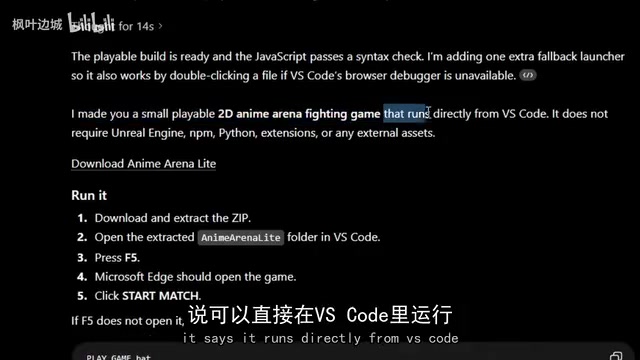
However, there was a massive gap between the plan and the actual output. What ChatGPT ultimately delivered was a 2D "Anime Arena Light" mini-game that required downloading, extracting, and configuring through VS Code before it could run. The game had no character textures — just basic block-based combat — and the controls were confusing. The tester lost several rounds in a row without figuring out how to attack.

ChatGPT's core problem: overly ambitious planning with insufficient execution. It tried to build a full Unreal Engine project but ended up falling back to a bare-bones 2D game. Throughout the process, a significant amount of time was spent debugging (such as browser launch failures) rather than building features.
Claude's Performance: Pragmatic, Efficient, and Complete
Claude took a fundamentally different approach. Instead of trying to build a large project requiring local compilation, it directly generated a browser-based fighting game — no downloads, no installation, no configuration needed.
This browser game development approach based on HTML5 Canvas and JavaScript is a lightweight yet fully capable technical path. Through the Canvas 2D API or WebGL, developers can render graphics, handle user input, and run game logic directly in the browser without any compilation toolchain or runtime environment. A single HTML file can contain the entire game, and users can run it simply by opening their browser. While it can't match native engines in 3D rendering capability and performance ceiling, it's more than sufficient for a 2D fighting game prototype.
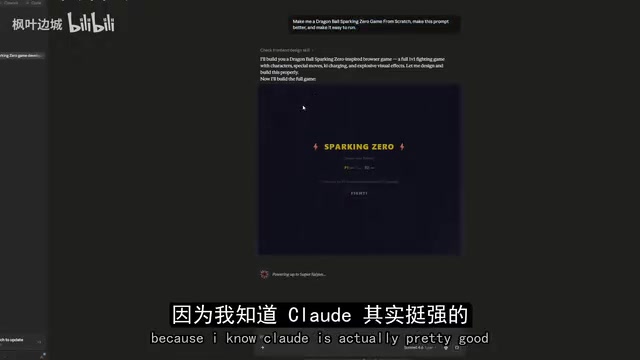
What's even more impressive is the game's level of completeness:
- 8 selectable characters: Goku, Vegeta, Gohan, Frieza, Cell, Trunks, Piccolo, and more, each with unique attribute values
- Complete combat system: including normal punches (Q key), kicks, ki charging (W key), special moves (R key), and more
- Character selection screen: supporting two-player character selection for versus matches
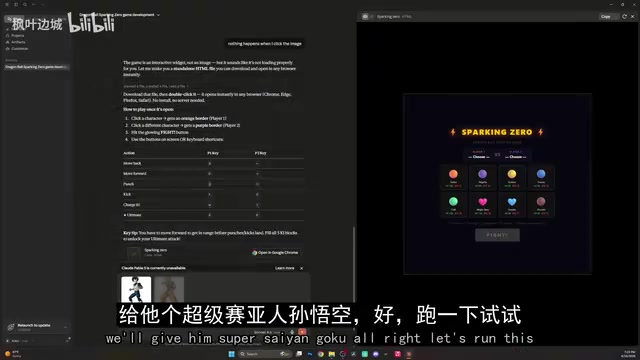
When the tester asked to add character textures, Claude also demonstrated strong iterative capability. The tester uploaded PNG images of Goku and Vegeta, and Claude successfully integrated them into the game, adding attack animation effects and visual feedback for ki charging. Although further optimization was cut short by the free tier's message limit, the results were already quite impressive.
Core Differences Analyzed
Architecture Choice: Complex Engine vs. Lightweight Solution
ChatGPT chose the Unreal Engine route, which could theoretically produce a higher-quality game, but was far too complex for a 20-minute rapid prototype. Claude chose the browser game route (HTML5/JavaScript), which has a lower technical ceiling but can deliver a more complete experience within a limited timeframe. This reflects an important engineering principle: choosing the right tech stack matters more than choosing the most powerful one.
Rapid Prototyping is a core methodology in software engineering and product design. Its central idea is to build an interactive Minimum Viable Product (MVP) in the shortest possible time to validate concept feasibility and gather user feedback. In game development, the prototyping phase typically uses simplified graphics and core mechanic validation for rapid iteration, rather than pursuing final production quality. This is precisely why Claude's browser game approach had the advantage in this test — a 20-minute time window is essentially a prototype validation scenario where delivery speed and playability matter far more than technical ceiling.
Development Experience: Manual Setup vs. Zero Configuration
ChatGPT required users to manually download a zip file, extract it, configure VS Code, and debug launch issues — a workflow that's far from friendly for non-professional developers. Claude achieved a "zero-configuration" experience — code ran directly within the chat interface in a what-you-see-is-what-you-get fashion. This difference is highly significant in real-world development scenarios, especially for rapid prototype validation.
Feature Completeness: Basic Framework vs. Complete Product
ChatGPT's game lacked character textures, had unclear control instructions, and featured simplistic AI opponent behavior. Claude's game offered multiple character selection, clear control guides, differentiated character attributes, and even supported custom texture imports. In terms of product completeness, Claude was clearly ahead.
Implications for AI Coding Tools
While this experiment was essentially a fun test, it reveals several key trends in current AI coding tools:
First, AI can now generate complete, runnable applications in a matter of minutes. Whether ChatGPT or Claude, both produced fully functional game code in an extremely short time — something unimaginable just two years ago.
Second, there's still a massive gap between "it runs" and "it's good." ChatGPT's code ran but delivered a poor experience; Claude's code not only ran but also considered user experience. Competition among AI tools is shifting from "can it do it" to "how well does it do it."
Third, interactive development environments are a critical differentiator. Claude's ability to run code and display results directly within the chat interface creates an instant feedback loop that dramatically improves development efficiency. The tester also mentioned that he regularly uses AI coding tools like Cursor and Windsurf, whose core advantage similarly lies in tight code-preview integration. It's worth noting that Cursor is a VS Code-based AI-enhanced code editor with deep LLM integration, supporting code completion, cross-file editing, and natural language-driven code modifications. Windsurf, built by the Codeium team, emphasizes a collaborative coding experience between AI and developers in a "Flow" mode. These tools represent the evolution of AI programming from "conversational generation" to "integrated collaboration" — embedding AI capabilities into developers' daily workflows rather than forcing them to switch back and forth between chat windows and code editors.
Overall, in this 20-minute AI game development showdown, Claude won the tester's approval with its more pragmatic technology choices, smoother development experience, and higher feature completeness. But this doesn't mean ChatGPT is inferior in all coding scenarios — for projects requiring complex architectural design and deep technical discussion, ChatGPT's detailed planning capabilities may prove more valuable. The key takeaway: choose the right tool for the right problem.
Related articles

The Truth Behind Codex 'Build a Website in 5 Minutes': AI Isn't Creating Sites—It's Helping You Copy Them
Exposing the truth behind viral Codex 5-minute website videos: creators aren't building original sites with AI—they're copying shared prompts or scraping others' work. Learn AI coding tools' real limits.

Getting Started with AI Agent Development: A Complete Guide from Concept to Practice
A comprehensive guide to AI Agent architecture and development, covering automated marketing, intelligent customer service, and investment analysis scenarios with single and multi-agent collaboration.

The Truth Behind Codex 'Build a Website in 5 Minutes': AI Isn't Creating Sites — It's Helping You Copy Them
Exposing the truth behind viral Codex 5-minute website videos: creators aren't building original sites with AI — they're copying shared prompts or scraping others' work.