ChatGPT vs Gemini vs Claude: Who Can Build Mario 64 from Scratch?

Three top AI models clone Super Mario 64 from scratch—Gemini wins with best playability.
A YouTuber tested ChatGPT 5.2, Gemini 3 Pro, and Claude 4.5 with the same prompt to clone Super Mario 64 from scratch. ChatGPT generated 2,700 lines with the best visuals but ran at only 1-2 fps. Gemini was fastest to generate, most playable, and best at iterative fixes. Claude suffered from collision detection failures and unintuitive controls. Final ranking: Gemini first. The test shows that multi-system coordination in 3D game development remains a major challenge for AI.
What happens when the three top AI models are asked to build a clone of Super Mario 64 from scratch? A YouTuber tested ChatGPT 5.2, Gemini 3 Pro, and Claude 4.5 using the same prompt, and the results were a mix of surprises and spectacular failures. This head-to-head AI coding showdown reveals the true capabilities of current large language models when it comes to complex 3D game development.
It's worth noting that Super Mario 64, released in 1996, was the first truly successful 3D platformer in gaming history, developed by Nintendo's Shigeru Miyamoto team. While its graphics look primitive by today's standards, the underlying technical complexity far exceeds what meets the eye. The game features a sophisticated character state machine (Mario has over 200 action states), an octree-based collision detection system, dynamic camera AI, and a rendering pipeline deeply optimized for N64 hardware. The original game's C source code is approximately 500,000 lines, developed and debugged by dozens of engineers over more than two years. Asking an AI to recreate the core experience of such a game in a single conversation is essentially testing AI's ability to understand multiple complex systems working in coordination.
ChatGPT 5.2: Best Visuals, But Only 1-2 Frames Per Second
The test started with ChatGPT 5.2. With thinking mode enabled, ChatGPT took a full 8 minutes to finish code generation, outputting 2,700 lines of code in one go—the most code the creator had ever seen in a single iteration.
However, more code doesn't mean better quality. On the first run, the game looked quite good visually, but the entire game was frozen—completely unresponsive. After a fix, the character could finally move, but the frame rate was abysmal—roughly 1 to 2 frames per second, essentially a "slideshow."
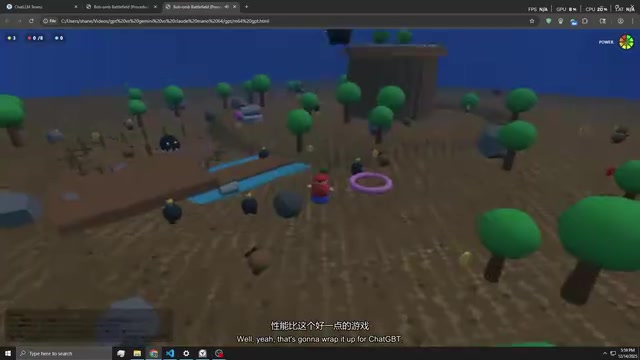
The creator asked ChatGPT multiple times to optimize performance, even adjusting a parameter to 0.75 as suggested to improve frame rate, but the results were negligible. Ultimately, ChatGPT's version was unplayable due to severe performance issues. That said, the visual quality of ChatGPT's output was genuinely the best among the three.
This exposes a noteworthy problem: ChatGPT tends to generate more complex, visually polished code, but lacks consideration for browser-side performance bottlenecks. The 2,700 lines of code likely contained large amounts of unoptimized rendering logic that overwhelmed the browser.
3D games in the browser typically rely on WebGL (Web Graphics Library) technology, using JavaScript to invoke the GPU for graphics rendering. However, compared to native game engines (like Unity or Unreal Engine), WebGL has significant performance overhead: JavaScript's garbage collection causes frame rate fluctuations, DOM interaction with the rendering pipeline adds latency, and the browser's security sandbox restricts direct hardware access. An unoptimized 3D scene with too many draw calls, unmerged meshes, or real-time lighting calculations can easily drag frame rates to single digits. Professional browser 3D game developers typically need to use object pooling, LOD (Level of Detail) systems, and batch rendering to ensure smooth performance. ChatGPT clearly didn't factor in these browser-specific performance constraints.
Gemini 3 Pro: Most Playable, Best Overall Experience
Gemini 3 Pro performed noticeably differently. First, its generation speed was much faster—nearly instant. Even more conveniently, the generated game could run directly within the chat interface, with no need to paste code into a separate HTML file.
The initial version had some obvious physics issues: excessive ground friction made movement extremely slow, jump height was insufficient, and the boss couldn't be defeated. But the overall framework was playable, already delivering a basic 3D platformer experience.
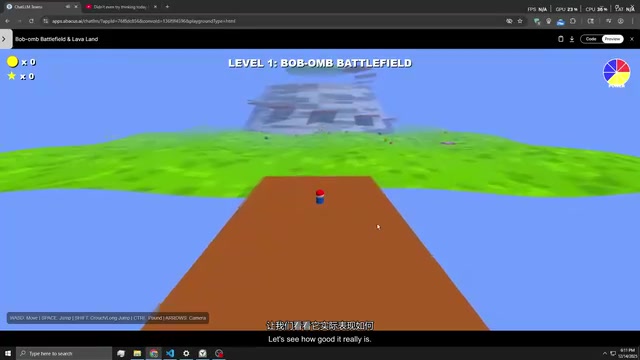
After one round of feedback and fixes, Gemini's version improved dramatically:
- Movement feel greatly improved, with smooth and natural character control
- Boss fight logic fixed, allowing players to defeat enemies by jumping on them
- Multiple classic levels added, including Womp's Fortress, Jolly Roger Bay, and Cool Cool Mountain
While level quality varied—Jolly Roger Bay had almost nothing to do, Cool Cool Mountain only featured a single snowman—Womp's Fortress was relatively well-designed without serious bugs like characters clipping through geometry. Gemini also automatically generated a hub area for level selection, demonstrating its understanding of overall game structure.
Gemini's core advantage lies in its "playability-first" strategy. Rather than pursuing extreme visual fidelity, it ensured smooth frame rates and functional game mechanics—which is precisely the most important foundation in game development.
Gemini's excellent performance during iterative fixes also reflects how AI-assisted programming is shifting from a "one-shot generation" paradigm to a "conversational iterative development" approach. This pattern resembles rapid prototype iteration in agile development: first generate a minimum viable product (MVP), then continuously improve through user feedback. This places unique demands on AI model capabilities—not only understanding the code itself, but also understanding the mapping between natural language bug descriptions (like "movement is too slow") and specific code parameters (like friction coefficients or velocity vectors). Recent research from Google DeepMind suggests that model capability in "understanding and fixing existing code" is growing even faster than "generating correct code from scratch."
Claude 4.5: Mediocre Results with Severe Collision Detection Issues
The creator first tested with Claude Sonnet 4.5. The problems with this version were immediately obvious: camera control used the I, J, K, L keys—extremely counterintuitive—and character movement direction didn't change with camera rotation, resulting in a terrible control experience.
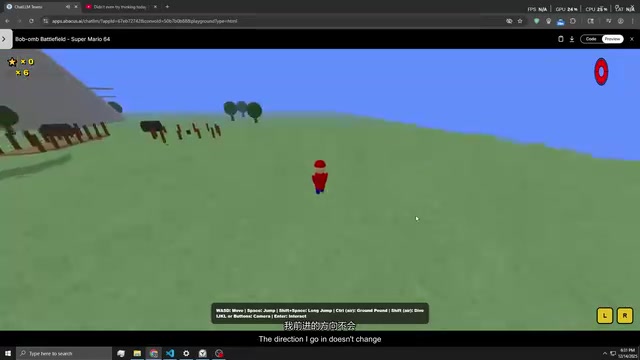
After adding levels, performance across stages was also disappointing. Cool Cool Mountain even had a bug where the character moved at supersonic speed, making the overall experience quite rough.
Realizing a weaker model (Sonnet) had been used, the creator retested with Claude Opus 4.5. The Opus version showed some improvement:
- Goomba character models were relatively realistic and could be defeated by jumping on them
- Classic enemies like Chain Chomps were included
- Some interesting interactions appeared, such as being grabbed by an enemy and thrown into the air

However, the Opus version also had fatal flaws: platform collision detection had severe issues, with the character passing straight through stairs, making it impossible to reach the boss fight area. Unexplainable teleportation bugs also appeared.
Collision Detection is one of the most challenging techniques in 3D game development. In 3D space, collision detection requires real-time determination of contact between hundreds of objects, using methods including AABB (Axis-Aligned Bounding Box), OBB (Oriented Bounding Box), and mesh-based precise detection. Even more complex is Collision Response—when a character steps on a platform, the system needs to correctly calculate the normal direction, prevent penetration, and apply appropriate friction. The clipping bugs in Claude's version typically stem from the "tunneling effect" in discrete collision detection: when objects move too fast, they may completely pass through a thin platform within a single frame without being detected. Professional engines typically use Continuous Collision Detection (CCD) or Raycasting to solve this problem, but correctly implementing these techniques requires deep mathematical and physics knowledge—clearly beyond the capability of current AI to generate in a single pass.
Overall, both Claude versions were too simplistic and lacked a complete game experience.
AI Model Coding Ability Rankings and Detailed Comparison
The creator's final ranking: Gemini first, ChatGPT second, Claude third.
| Model | Visual Quality | Performance | Playability | Level Richness |
|---|---|---|---|---|
| ChatGPT 5.2 | ⭐⭐⭐⭐ | ⭐ | ⭐ | ⭐⭐ |
| Gemini 3 Pro | ⭐⭐⭐ | ⭐⭐⭐⭐ | ⭐⭐⭐⭐ | ⭐⭐⭐ |
| Claude 4.5 | ⭐⭐ | ⭐⭐⭐ | ⭐⭐ | ⭐⭐ |
The three models exhibited distinctly different coding styles, closely tied to their training data, alignment strategies, and architectural design. ChatGPT (based on the GPT series) tends to generate thorough, well-commented code, likely influenced by the abundance of tutorial and documentation-style code in its training data. Gemini (based on Google's multimodal architecture) focuses more on practicality and runtime efficiency, likely benefiting from training on Google's massive internal engineering codebase. Claude (based on Anthropic's Constitutional AI approach) is relatively conservative, tending to generate safe, concise but potentially feature-incomplete code. Additionally, model context window size affects code generation quality—larger context windows allow models to "remember" earlier architectural decisions when generating subsequent code, maintaining consistency and systematicity.
This test reveals several thought-provoking trends:
Code Volume ≠ Code Quality
ChatGPT generated 2,700 lines of code in one shot but produced a nearly unplayable game. In contrast, Gemini likely generated more concise code yet delivered a better gaming experience. When evaluating AI coding ability, you can't just look at code "scale"—you need to consider code "efficiency" and "practicality." This phenomenon has a classic counterpart in software engineering—"Code Bloat," referring to programs containing more code than actually needed, leading to performance degradation and maintenance difficulty. Good software engineering practice emphasizes the YAGNI principle (You Aren't Gonna Need It)—don't implement features you don't currently need. ChatGPT's output directly violated this principle.
Iterative Fix Capability Determines Real-World Usability
Gemini performed best at receiving feedback and making fixes, accurately understanding problems like "movement is too slow" or "boss can't be killed" and effectively resolving them. This conversational iterative development capability may be more practically valuable than generating perfect code in a single shot. In real software development workflows, requirement changes and bug fixes account for over 60% of developer work time, making an AI model's "repair intelligence" potentially more practically significant than its "generation intelligence."
3D Game Development Remains a Tough Nut for AI
Even Gemini's best version is worlds apart from the real Super Mario 64. 3D game development involves coordinating multiple complex systems including physics engines, collision detection, level design, and AI behavior. Current large language models still struggle to handle this level of system complexity within a single conversation. This is fundamentally a "combinatorial explosion" problem: when multiple subsystems need to work correctly simultaneously, any error in one component causes the entire experience to collapse. The physics engine must coordinate with the collision system, the collision system must coordinate with level geometry, the camera system must coordinate with character controls—this multi-system coupling complexity grows exponentially, far exceeding current AI models' planning capabilities.
How Far Is AI from Independently Developing 3D Games?
While this AI coding showdown has an entertainment element, it provides an intuitive lens for observing the different coding style differences across models. ChatGPT pursues "big and comprehensive," Gemini focuses on "stable and usable," and Claude is relatively conservative. For developers, which AI coding assistant to choose depends on which dimension you value most—if you're after rapid prototype validation, Gemini is currently the more pragmatic choice.
As model capabilities continue to evolve, perhaps in the near future, AI will truly be able to generate a complete, playable 3D game from scratch. But at least today, they still need continuous human guidance and feedback to deliver a passing grade. Looking at the technical roadmap, future breakthroughs may come from several directions: longer context windows allowing AI to maintain more complex code architectures; multi-agent collaboration letting different AIs handle physics, rendering, level design, and other subsystems separately; and deep integration with professional game engines, freeing AI from implementing low-level technology from scratch so it can focus on creative design decisions.
Key Takeaways
- Gemini 3 Pro performed best among the three, winning with smooth frame rates and playability, successfully delivering a basic 3D platformer experience
- ChatGPT 5.2 generated 2,700 lines of code with the best visuals, but severe performance issues (1-2 fps) made the game nearly unplayable
- Claude 4.5 (both Sonnet and Opus versions) performed weakest overall, with counterintuitive controls and collision detection failures
- Gemini demonstrated the strongest iterative fix capability, accurately understanding feedback and effectively improving physics systems, boss logic, and level design
- 3D game development remains a major challenge for current AI, involving coordination of physics engines, collision detection, and other multi-system dependencies that are difficult to handle perfectly in a single conversation
Related articles
 Product Reviews
The Programmer's Desk Setup Guide: Building a Workspace That Feels Like Home
Discover how programmers build productive, comfortable workspaces. From multi-monitor setups to ergonomic design, explore the desk philosophy that drives focus and flow.
 Product Reviews
Qoder vs Cursor Real-World Comparison: Which $20/Month AI IDE Is Better?
Hands-on comparison of Qoder vs Cursor AI IDEs: Agent autonomy, human interaction count, and architecture decisions. Qoder needed only 2 interactions vs Cursor's 8.
 Product Reviews
Cursor Cloud Agent Demo: Eliminating Bottlenecks Across the Entire Software Development Lifecycle
Deep analysis of Cursor's Cloud Agent demo showing how cloud VMs, automated test artifacts, and a full-chain control plane systematically eliminate human bottlenecks across the software development lifecycle.