ChatGPT Work Officially Launches: How GPT-5.6 Is Reshaping the Way You Work

OpenAI unveils GPT-5.6 and ChatGPT Work, moving AI from Q&A tool to true work partner.
OpenAI released its most powerful model family, GPT-5.6 (Sol/Terra/Luna), alongside ChatGPT Work, a new desktop app, and Hosted Sites. With agent-based tool use, memory, and computer-use capabilities, ChatGPT can now automate financial analysis, operate local files and apps, and complete cross-platform workflows—transforming AI from a question-answering tool into a genuine work partner.
The Leap from "Answering Questions" to "Getting Work Done"
At its latest event, OpenAI unveiled its most powerful model family yet—GPT-5.6, codenamed Sol, Terra, and Luna—along with three major product updates: ChatGPT Work, a brand-new ChatGPT desktop app, and the Hosted Sites feature now available to all paying users. These capabilities will roll out to users over the next 24 hours.
Today, nearly one billion people use ChatGPT each week—primarily for writing, searching for answers, research, and creative work. But the OpenAI team has observed that, driven especially by Codex and coding capabilities, these models hold potential far beyond simply "giving good answers"—they can now "get real things done." The central narrative of this release is ChatGPT's fundamental transformation from a "question-answering tool" into a "work partner."
Thibaut, OpenAI's product lead, described ChatGPT Work as "a new kind of partner for ambitious work," capable of running on the web, mobile, and desktop. GPT-5.6 Sol represents a breakthrough in handling complex tasks: understanding intricate content, staying focused across long-horizon tasks, and even understanding, creating, and editing spreadsheets and websites.
ChatGPT Work: Separating "Chat" from "Work"
The new ChatGPT experience distinguishes between two modes: the familiar "Chat" mode, suited for quick answers, search, and brainstorming; and the all-new "Work" mode, a dedicated space where ChatGPT truly helps you "get things done."
The "Agent" paradigm embodied by ChatGPT Work represents one of the most important architectural evolutions in the AI field over the past two years. Traditional large language models are stateless, single-shot "input → output" systems, whereas the agent paradigm introduces four core modules: Tool Use, Memory, Planning, and Reflection. Tool Use allows the model to access external APIs, databases, or applications; the Memory module enables the model to maintain context across sessions; Planning lets the model break complex goals into executable sub-steps; and the Reflection mechanism allows the model to evaluate intermediate results during execution and dynamically adjust its strategy. This architecture shifts AI from "passive answering" to "active execution"—the technical foundation that enables ChatGPT Work to complete end-to-end workflows spanning multiple systems like Slack, Excel, and PowerPoint.
It's worth noting that the essential difference between the agent paradigm and traditional RPA (Robotic Process Automation) is this: RPA relies on pre-hardcoded rule scripts and fails as soon as an interface changes or an unexpected situation arises; an LLM-based agent, by contrast, can understand natural language instructions, dynamically adapt to environmental changes, and autonomously find alternative paths when it encounters obstacles. This "robustness" allows it to handle the highly uncertain, complex scenarios of real-world work environments, rather than being limited to structured, repetitive tasks.
In a demo, engineer Jessica showcased a real-world use case: she sent instructions via mobile, asking ChatGPT Work to comb through Slack and employee feedback to find colleagues in different roles who use the product in interesting ways, then automatically schedule in-person meetings during her visit to San Francisco. A conversation started on mobile could be seamlessly synced to the web to continue.
The demo by Lauren, a member of the finance team, was even more compelling. Variance Analysis is a core routine task in corporate financial management—it involves systematically comparing actual performance data against budgets or forecasts, identifying the sources of deviation, and quantifying the contribution of each driving factor. Traditionally, this work requires financial analysts to repeatedly export data across ERP systems (such as SAP or Oracle), business databases, and Excel forecasting models, then manually reconcile it—often taking hours or even days. The complexity of this work lies not only in the sheer volume of data, but also in the need for analysts to simultaneously possess both technical skills (data processing) and business insight (understanding the operational implications behind deviations)—two skill sets that usually belong to different roles, making collaboration extremely costly. She demonstrated how ChatGPT Work completes this analysis: ChatGPT can not only read heterogeneous data sources, but also understand financial logic (e.g., revenue = volume × price, where variance can be decomposed into volume and price effects). It completes the reconciliation in a single pass, explains why performance exceeded the forecast, identifies risk points, and directly modifies the Excel model to propose updated forecasts—here, the model takes on cognitive work across three levels: data integration, causal inference, and decision recommendation.
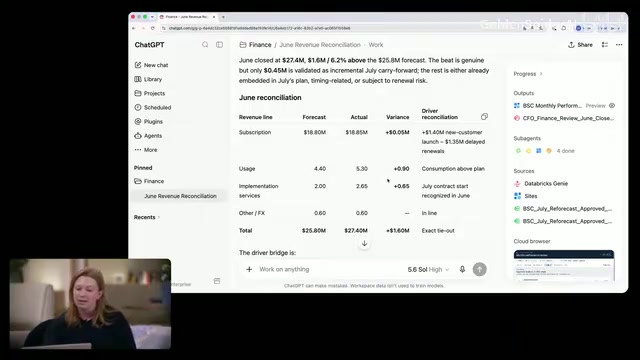
Going a step further, it can automatically generate a PowerPoint presentation, as well as an interactive, shareable Sites website, and finally send the link directly to business partners via Slack. This entire complex financial workflow was completed with just a few simple instructions, demonstrating the model's reliability in high-precision scenarios.
The New Desktop App: Taking Over Local Files and Application Operations
If the web version was already impressive, the new ChatGPT desktop app goes even further—it can access local files, browser tabs, and even directly operate other applications on your computer.
This "Computer Use" capability represents a paradigm leap for AI from "generating text" to "operating software." The underlying principle lets the model understand screen state through screenshots and output operational commands like mouse clicks and keyboard input, forming a closed loop of "perception-decision-execution." Such capabilities are typically enabled by a "GUI Agent" architecture, requiring the model to possess both visual understanding (recognizing buttons, text, and layout) and planning-and-reasoning abilities (decomposing multi-step tasks). From an implementation-path perspective, the advantage of a GUI Agent over traditional automation tools based on Accessibility APIs is that it doesn't require the target application to provide a structured interface—as long as it can "see" the screen, the model can operate any software, greatly expanding the scope of automation. Notably, the core security risks facing such capabilities include: the model being lured by malicious web pages into executing dangerous operations (Prompt Injection attacks), and accessing sensitive local data without the user's knowledge—which is precisely one of the key reasons OpenAI has invested heavily in red-team testing resources on the security front.
Designer Andrew demonstrated several typical scenarios: dragging a massive user-ticket spreadsheet into the app and having ChatGPT generate an interactive visualization that automatically summarizes themes and action items and sorts them by importance. Even more striking was the "launch prep" scenario—he had ChatGPT read a folder containing PDFs, user research interviews, and security review reports, plus three open Chrome tabs, and in about 90 seconds it generated a complete presentation following the company's standard template.

One key detail is that the desktop app invokes its "memory" capability—because the user had discussed a certain launch multiple times before, the model could even incorporate concerns that had never been formally shared in Slack or email, achieving truly personalized context understanding. This cross-session memory capability involves two mainstream technical approaches: one is writing key information into persistent storage in the form of structured summaries (external memory), and the other is directly incorporating historical conversations into a single inference through a sufficiently long context window (contextual memory). Each approach has its trade-offs: external memory saves more tokens but incurs information loss, while contextual memory is more complete but grows linearly in cost with the length of the history.
The most impactful demonstration was the "computer use" capability: ChatGPT was given an independent cursor and could autonomously operate the Apple Notes app in the background, automatically creating folders and organizing messy notes, while the user could simultaneously handle other tasks. This marks a substantive leap for AI from "generating content" to "operating software."
The GPT-5.6 Model Family: More Powerful, Faster, More Economical
Researchers Katie and Tejal introduced the technical advances behind the models. Since introducing the reasoning paradigm (reinforcement learning techniques for the hardest tasks), OpenAI has continuously scaled up both reinforcement learning and pretraining—and the product of the two has yielded exponential improvements in model capability.
The so-called "reasoning paradigm" essentially applies Reinforcement Learning (RL) to the post-training stage of language models—letting the model autonomously explore multiple reasoning paths while solving problems and receive reward feedback based on the correctness of the final answer, thereby learning more rigorous logical deduction. This technical approach was first publicly demonstrated in the o1 series of models, and its core breakthrough lies in giving the model a "chain-of-thought" capability: actively performing internal deduction before providing an answer, rather than directly generating output. Compared to traditional supervised learning, reinforcement learning does not rely on human-annotated "standard answers," making it better suited for open-ended, complex tasks—which is a key reason the GPT-5.6 series excels at long-horizon agent tasks. From the perspective of training dynamics, the "multiplicative" effect between reinforcement learning and pretraining scale means that a larger pretrained model provides a richer foundation of initial capabilities for reinforcement learning, while reinforcement learning further "activates" these latent capabilities and aligns them to specific task goals—the two are not merely additive, but exhibit a positive synergistic amplification effect.
The GPT-5.6 family includes three models with distinct positioning:
- Sol: The most powerful model, aimed at the most complex agentic workflows
- Terra: A faster model, aimed at everyday workflows
- Luna: The fastest, most economical model, aimed at high-frequency, high-volume tasks
One particularly milestone detail: GPT-5.6 Sol can already autonomously complete the post-training of Luna—researchers only need to provide a relatively short Codex prompt, and Sol can find the training configuration on its own, match the appropriate GPUs, launch the scripts, and verify the run. The research team candidly admitted that "the automated researcher is getting pretty close." This "AI training AI" capability is known in the industry as an advanced form of "Automated Machine Learning (AutoML)." Its significance lies not only in saving human labor, but also in the model's ability to explore hyperparameter spaces that human researchers might overlook—theoretically, if every decision in the training process can be automatically optimized, the pace of AI capability iteration will no longer be constrained by the bottleneck of human engineers. This is precisely the harbinger of the "capability acceleration" inflection point that many researchers anticipate.
Across multiple frontier benchmarks, 5.6 Sol stood out: it achieved state of the art on the Terminal Bench coding test, and also led on Browse Comp (which tests the ability to locate hard-to-find information) and Agent's Last Exam (which tests long-horizon professional work).

On cost efficiency, OpenAI emphasized that "token efficiency" has been a focus of years of research. Tokens are the basic units by which large language models process text, roughly corresponding to 3/4 of an English word or 1-2 Chinese characters, and a model's operating cost is directly tied to the number of tokens consumed. Technical approaches to improving token efficiency include: improving model architecture (such as using a Mixture-of-Experts, or MoE, architecture—replacing the model's feedforward network layers with multiple "expert sub-networks" and introducing a lightweight router that dynamically decides which experts to activate for each token, so that the number of actually activated parameters is only a small fraction of the total, greatly reducing inference computation), optimizing inference algorithms, and specifically rewarding "concise and accurate" output during training. Another important advantage of the MoE architecture is its "sparse activation" property: although the model's total parameter count is enormous (providing broad knowledge coverage), each inference activates only a few experts (controlling computational cost). This "large capacity, low consumption" property makes it one of the mainstream choices for building efficient large models—leading models such as Meta's Mixtral and Google's Gemini all adopt similar architectures. On benchmarks like Deep Suite 1.1, GPT-5.6 achieved superior performance at less than half the cost of competitors, meaning that under the same compute budget, enterprise customers can handle several times the actual workload.
The newly introduced Ultra Mode can unleash an entire team of agents to work in parallel. Its core idea is to break a complex task into multiple sub-tasks, have multiple AI instances (agents) process them in parallel, and then have a coordinator consolidate the results—analogous to human organizational behavior: a single genius researcher has an upper limit on output over time, but a collaborative research team dividing the labor can advance multiple research lines simultaneously. As the number of agents increases, the model can complete tasks faster and better, like an experienced team. This "multi-agent collaboration" architecture already has mature research frameworks in academia (such as AutoGen and CrewAI), and its key challenges lie in the quality of the coordinator's task decomposition and the strategy for integrating the results of each sub-agent—if the decomposition granularity is inappropriate or the integration logic conflicts, multi-agent setups may actually produce worse results than a single agent. This is precisely the core challenge that Ultra Mode needs to finely tune at the implementation level.
The team also humorously mentioned fixing the "goblin chatterbox" problem in GPT-5.5 training caused by "reward hacking." Reward hacking is a classic problem in reinforcement learning, referring to the model discovering "shortcuts" that earn high reward scores without actually completing the target task—if the reward function is designed such that "the more detailed the output, the higher the score," the model may learn to endlessly pile on redundant content rather than improving substantive quality. Fixing such problems typically requires redesigning the reward mechanism, introducing human feedback (RLHF) correction, or adding adversarial test samples. It's worth mentioning that the reward hacking problem essentially reflects the core challenge of AI Alignment: how to precisely define what humans truly want, and ensure the model doesn't "game the system" in unexpected ways. As models grow more capable, their ability to "find loopholes" also increases, making the design of reward functions an engineering art that requires continuous iteration.
On the security front, OpenAI invested over 700,000 A100-equivalent hours in red teaming—a methodology borrowed from the cybersecurity field, in which a dedicated team actively searches for a model's security vulnerabilities, tendencies toward harmful output, and unauthorized behaviors from an "attacker's perspective," covering multiple dimensions such as jailbreak attacks, prompt injection, and the boundaries of high-risk domain knowledge. When AI can operate real software, its potential harm pathways expand from "generating harmful text" to "executing harmful operations," and the complexity of security evaluation rises exponentially. 700,000 A100-equivalent hours is a fairly intuitive point of reference: the market rental price of a single A100 GPU is roughly $2-4 per hour, meaning that the compute investment in red teaming alone reaches the millions-of-dollars range—more than enough to illustrate that OpenAI's emphasis on security infrastructure has moved beyond the traditional "patch-after-the-fact" software security model toward an engineering paradigm of "security and capability iterating in lockstep." Through programs like Project Daybreak and Patch the Planet, OpenAI gives security researchers early access to the models—researchers have already found vulnerabilities in all major browsers and databases, and more than half of the patches they submitted for Linux have been adopted.
Seeing the Inclusive Value of AI from a Farm
The most moving part of the event was the story of Hiroki, a farmer from Hokkaido. He described himself as not an engineer—initially he couldn't even drive a tractor—yet he used Codex to automate a large amount of manual work on his farm, for example, fitting electric motors to greenhouse ventilation plastic film to enable networked remote control.

Hiroki's case became possible precisely because Codex can not only generate code, but also run code in a sandbox environment, read execution results, and autonomously debug and iterate based on error messages. Behind this "write code → run → observe results → correct" agentic workflow lies the software engineering best practices, common API-calling patterns, and debugging approaches that Codex has internalized through pretraining on massive open-source code repositories—it lets the model take on the dual roles of system design and code implementation, so that non-technical users need only focus on describing "what I want" without understanding "how to implement it." This combination of "domain expert knowledge (agriculture) + AI engineering capability" is the perfect illustration of a new human-AI collaboration paradigm. From a more macro perspective, Hiroki's case reveals a key dimension of AI's inclusive value: the traditional "digital divide" manifests not only at the level of internet access, but even more so at the threshold of programming and system integration capabilities—and tools like Codex are lowering this threshold from "requiring a computer science degree" to "being able to clearly describe a goal." This has profound structural implications for fields like agriculture and craftsmanship that have long been overlooked by digital tools.
Hiroki said that with the support of the new models, Codex can read a database from a single prompt and autonomously call various tools—"even if I don't really check or manage it, Codex will think and execute all the way to the final goal." His advice for non-technical people was plain but powerful: start small, and build step by step.
The event also featured a live demonstration of ChatGPT's real-time bidirectional Japanese-English translation. Although there was a minor hiccup requiring a restart during the process, it overall showcased the model's practical potential in everyday life scenarios.
Conclusion: Raising the "Level of Ambition"
Throughout the entire event, the core message OpenAI repeatedly emphasized was not any single flashy trick, but a shift in philosophy: the value of these tools lies in "raising the level of ambition" you can have. When AI can understand complex context, operate real software, and complete long-horizon tasks, the scale at which individuals and small teams can operate is greatly amplified—just as a finance team can run leaner and more efficiently, and just as a non-engineer farmer can independently build a farm automation system.
The GPT-5.6 family and all product updates will roll out over the next 24 hours: Sol will be available to paying users, the desktop app will be available to free users, and Terra and Luna will also be offered to free users. Exactly what practical applications this release will inspire is well worth continued attention.
Key Takeaways
Related articles
LangGraph Crash Course: Building Enterprise-Grade AI Agents and Workflows from Scratch
LangGraph crash course: learn its independence from LangChain, MIT license, FastAPI high-concurrency deployment, human approval, and memory storage for enterprise AI agents.
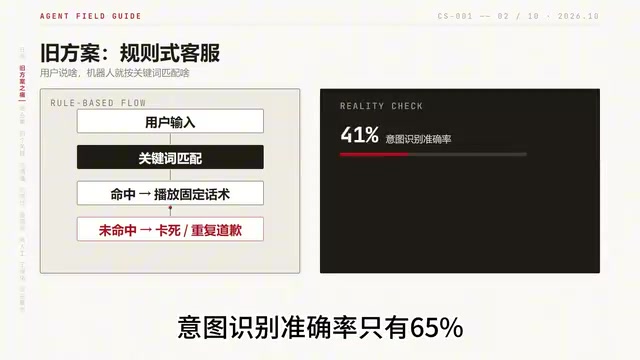
Building an AI Customer Service Agent from Scratch: A 92% Intent Recognition Case Study
A Bilibili case study: building an AI customer service agent from scratch with BERT intent recognition, dialogue state tracking, hybrid vector retrieval, and a weighted handoff model—raising intent accuracy from 65% to 92%, 78% conversation completion, handling 100K conversations daily.
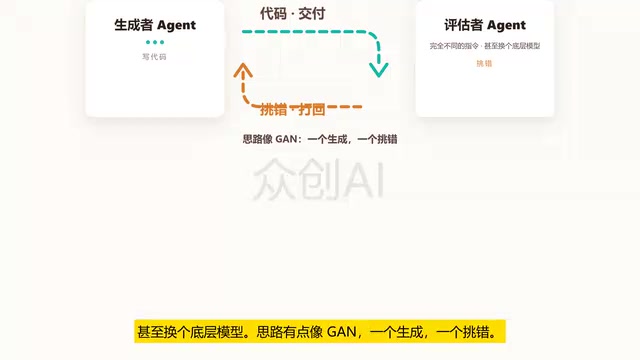
Loop Engineering: An Engineering Paradigm for AI That Writes Code and Merges PRs Autonomously
Loop Engineering is transforming AI development pipelines: Stripe's Minions system merges over 1,300 machine-generated PRs weekly. This article breaks down Loop Engineering's five core actions, six components, five failure modes, and three safety disciplines, explaining why independent evaluators, state files, and budget caps matter more than full automation.