LangGraph Crash Course: Building Enterprise-Grade AI Agents and Workflows from Scratch
LangGraph: an independent agent orchestration framework built on low-level primitives, human approval, and FastAPI high concurrency.
This article outlines LangGraph's core design philosophy and enterprise deployment points. Developers choose it for reliability (human approval checkpoints before tool calls), low-level extensibility (coding multi-agent systems rather than dragging), and first-class streaming. LangGraph and LangChain are independent frameworks; the latter no longer includes an agent module but is often used together. Built on FastAPI, it offers high concurrency and millisecond streaming, and can run privately without the official platform. It distinguishes short-term session memory from long-term cross-session memory. The MIT License ensures copyright safety for commercial use. For simple Q&A, use Dify or Coze; for fine control over decisions and collaboration topologies, choose LangGraph.
LangGraph Crash Course: Building Enterprise-Grade AI Agents and Workflows from Scratch
If you're looking for a framework that can genuinely let you "hand-craft" highly reliable, high-concurrency AI agents, LangGraph may be the most worthwhile investment in the current Python ecosystem. This article is based on a hands-on tutorial from Bilibili, combined with official documentation, and covers LangGraph's core design philosophy, its relationship with LangChain, deployment performance advantages, and key decision points in enterprise development.
Why Choose LangGraph? Three Core Reasons
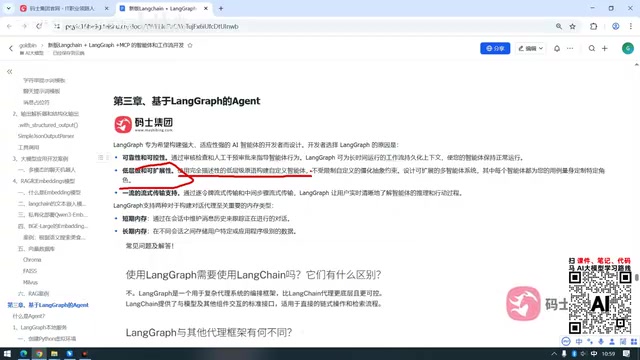
According to the video tutorial, developers choose LangGraph for three main reasons: reliability, low-level extensibility, and first-class streaming support.
Reliability and Human Intervention
LangGraph allows you to insert review checkpoints before an agent calls a tool. This means that for high-risk operations (such as database writes or external API calls), you can require human approval before execution continues. This "human-in-the-loop" design is crucial in enterprise scenarios and offers a level of control that many drag-and-drop agent-building tools struggle to provide.
Human-in-the-Loop refers to a design paradigm that introduces human judgment and intervention at key points in an automated process. In agent systems, the model may autonomously decide to call tools (such as sending emails, modifying databases, or executing payments), and a misjudgment can have serious consequences. LangGraph sets an interrupt point before a tool call, pausing the system to wait for human approval before resuming execution. This relies on the state graph's checkpoint mechanism: the state after each node executes is persisted, and after human confirmation, execution resumes from that checkpoint. Compared with fully autonomous agents, this mode sacrifices some efficiency but significantly reduces the probability of high-risk operations going out of control—a necessary condition for deployment in heavily regulated scenarios such as finance, healthcare, and operations.
Low-Level Primitives: Write Code Yourself, Don't Drag and Drop
The tutorial author specifically emphasizes that there are two paths to agent development: one is building with tools like Dify and Coze through drag-and-drop buttons; the other is "hand-crafting agents" by writing code with low-level primitives. In the Python ecosystem, the first choice for hand-crafting agents is LangGraph rather than LangChain. LangGraph provides fully descriptive low-level primitives and does not restrict how you define the roles and collaboration patterns of a custom multi-agent system, offering far greater flexibility than rigid abstract constraints.
Low-level primitives mean the framework provides only the minimal foundational building blocks needed to construct a system, rather than encapsulated high-level features. LangGraph's core primitives include nodes (a node, i.e., an execution function), edges (edge, i.e., transition rules between nodes), state (state, i.e., the shared data structure passed between nodes), and checkpoints (checkpoint, i.e., state snapshots). Developers use these primitives to compose loops, branches, parallelism, and subgraphs themselves, thereby precisely controlling every step of the agent's behavior. In contrast, platforms like Dify and Coze provide high-level abstractions where users orchestrate via drag-and-drop—quick to get started but difficult to express complex topologies or insert custom logic. The cost of low-level primitives is a steeper learning curve and more code, in exchange for complete visibility and debuggability of system behavior.
What Exactly Is the Relationship Between LangGraph and LangChain?
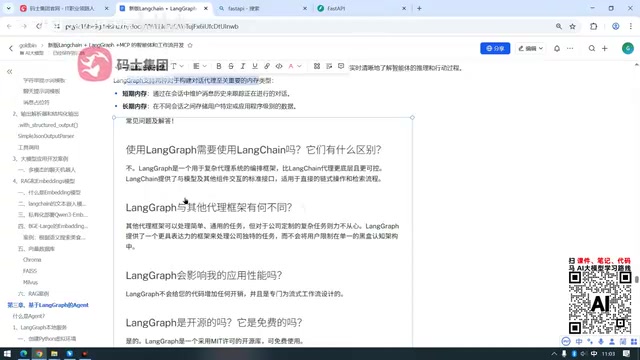
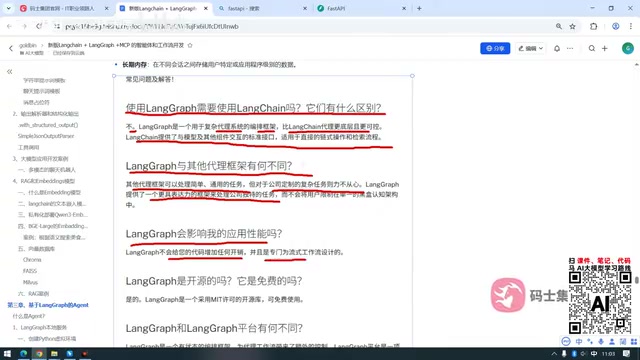
This is one of the most frequently asked questions in the community. The official documentation's answer is clear: LangGraph does not depend on LangChain to be used; they are two independent frameworks.
LangGraph is a low-level framework designed specifically for complex agent systems; LangChain provides standard interfaces for interacting with models and other components, suitable for chained operations and retrieval flows. The tutorial notes that agent development in LangChain has been fully migrated to LangGraph, and the next version of LangChain will no longer include the agent module.
But in practice, the two are often used together—LangGraph handles agent orchestration, while LangChain provides convenient interfaces for model invocation, tool wrapping, and more. You can also skip LangChain entirely and write the invocation logic yourself, though you'll lose some ready-made integration conveniences.
Performance and Deployment: High Concurrency with FastAPI
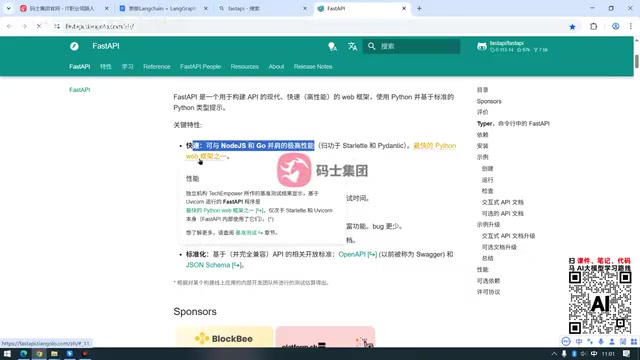
LangGraph's deployment is built on FastAPI, one of the fastest Web frameworks in the Python ecosystem. The official claim is that it can match the performance of Node.js and Go backend frameworks and can speed up feature development by roughly 200% to 300%.
This means agents built with LangGraph inherently have high-concurrency processing capabilities. The tutorial mentions that as long as model inference is fast enough, the entire agent's response can reach millisecond levels. LangGraph itself adds no extra overhead to your code and is designed specifically for streaming workflows.
For enterprise deployment, the tutorial distinguishes two scenarios: local development environment testing and server production environment deployment. Notably, production deployment can completely bypass the official LangGraph platform, using private servers with Docker and FastAPI—especially important for enterprises sensitive about data security.
FastAPI is a modern asynchronous Web framework built on Python type annotations, running on top of Starlette (an ASGI framework) and Uvicorn (an ASGI server). Its high-concurrency capability comes from the asynchronous I/O model: while waiting for model inference, database queries, or external API responses, the event loop can switch to handling other requests instead of blocking threads as traditional synchronous frameworks do. FastAPI also uses Pydantic for request validation and automatically generates OpenAPI documentation. LangGraph's choice of it as the deployment foundation means agent services can be exposed directly via standard HTTP/WebSocket interfaces and naturally support streaming responses (Server-Sent Events)—this is also the technical basis for its millisecond-level streaming output capability.
Storage Mechanisms: Short-Term Memory and Long-Term Memory
LangGraph supports two storage modes. Short-term storage tracks the chat history and context within the current session, supporting decision continuity within a single conversation; long-term storage saves history across sessions, similar to how you can still see previous chat content when you open DeepSeekAd a week later. Both can be stored in memory or in a relational database, depending on the deployment architecture.
Open-Source License and Enterprise Copyright Safety
LangGraph is open-sourced under the MIT License, the same as DeepSeek. This means using LangGraph to develop agents or workflows internally within an enterprise carries no copyright concerns whatsoever. The tutorial author specifically notes that tools like LangSmith, which require uploading data to official servers, are typically not adopted in domestic enterprise environments, and LangGraph's open-source nature neatly avoids this concern.
The MIT License is one of the most permissive open-source licenses. It only requires users to retain the original author's copyright and license notices when distributing the software; it does not restrict commercial use, modification, redistribution, or private deployment, nor does it require derivative works to be open-sourced. This stands in sharp contrast to copyleft licenses like the GPL, which require derivative works based on their code to also be released under the GPL. For enterprises, the MIT License means LangGraph can be embedded in closed-source commercial products and deployed privately on internal networks without disclosing proprietary code. Note that the license covers the framework code itself; enterprises still need to independently assess the compliance of the models they call, third-party tools, and data sources.
Differences from Other Agent Frameworks
The official documentation notes that other agent frameworks can handle simple general-purpose tasks but often fall short when facing complex company-customized services. LangGraph is more expressive and suited to handling unique business logic. If you're just building a simple Q&A bot, tools like Dify or Coze are sufficient; but if you need fine-grained control over every decision step, tool-call approval, and multi-agent collaboration topology, LangGraph is the more appropriate choice.
Conclusion
LangGraph's positioning is clear: give developers who need deep customization and strong control a low-level toolbox. It doesn't pursue out-of-the-box convenience; instead, it trades low-level primitives for flexibility, reliability, and performance. For teams preparing to deploy AI agents in enterprise-grade projects, understanding the division of labor between LangGraph and LangChain, mastering the FastAPI deployment path, and clarifying the copyright freedom granted by the open-source license are three things that must be sorted out before getting started.
One-line Summary
LangGraph is an independent agent orchestration framework centered on low-level primitives, human approval, and FastAPI-based high concurrency.
Paragraph Summary
This article outlines LangGraph's core design philosophy and key points for enterprise deployment. The three main reasons developers choose it are reliability (human approval checkpoints before tool calls), low-level extensibility (building multi-agent systems with code rather than drag-and-drop), and first-class streaming support. LangGraph and LangChain are two independent frameworks; the latter no longer includes an agent module, but the two are often used together. Deployment is built on FastAPI, offering high concurrency and millisecond-level streaming responses, and production environments can run privately without the official platform. Storage distinguishes short-term session memory from cross-session long-term memory. The MIT License guarantees no copyright risk for enterprise commercial use. The article recommends Dify or Coze for simple Q&A scenarios and LangGraph when fine-grained control over decisions and collaboration topologies is needed.
Related articles

Frontend to AI Agent Development: A Frontline Architect Explains Career Paths and Opportunities
A frontline AI architect explains the industry changes and practical paths for frontend developers transitioning to AI Agent development: why pure frontend jobs are disappearing, why Agent + full-stack has become mainstream in hiring, and three transformation routes—Agent development engineer, FDE, and remote contracting—along with corresponding learning strategies.

How to Choose an AI Agent Development Course: Five Pitfall-Avoidance Guidelines
A mechanical-engineering career changer's two-year pitfall-tested checklist for screening AI Agent development courses: complete delivery pipeline, resume-worthy projects, real development perspective, update frequency, and coaching feedback—with concrete judgment methods and pitfall-avoidance tips.

Coze AI Agent Building for Beginners: A Zero-Code AI Agent Development Guide
Coze, ByteDance's one-stop AI application development platform, supports zero-code drag-and-drop AI agent building. This article outlines Coze's core concepts, three advantages, differences between the domestic and international versions, and the distinction between agents and apps, helping beginners quickly get started with AI Agent development.