Cheap OpenAI-Compatible APIs: The Opportunity and Pain Points of Cloud-Hosted Open-Source LLMs
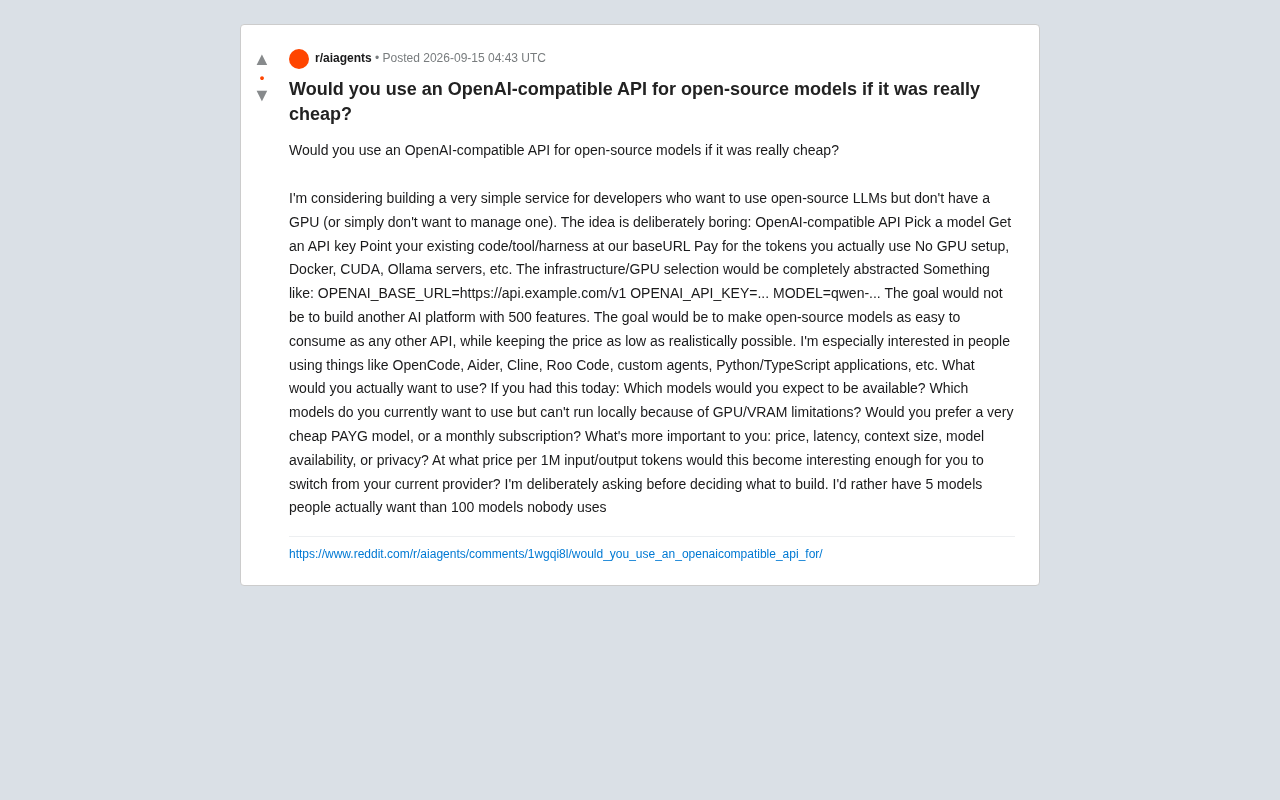
A developer proposes a minimal, cheap OpenAI-compatible API for open-source LLMs and validates demand before building.
A developer posted on Reddit proposing a "boring but practical" idea: a cheap, OpenAI-compatible hosted API for open-source models like Qwen and Llama, requiring only a URL swap with no GPU or CUDA setup. Targeting users of AI coding tools like Aider and Cline, the core pitch is zero migration cost. Rather than building immediately, the author sought community input on which models to prioritize, preferred pricing models (PAYG vs. subscription), key tradeoffs (price/latency/privacy), and acceptable price thresholds. The space faces real challenges around thin margins and the tension between simplicity and low cost, but demand is genuine as open-source models increasingly rival closed-source alternatives.
A "Boring but Practical" Product Idea
A developer posted an interesting question on Reddit: if there were a truly cheap, OpenAI-compatible API service for open-source models, would you use it?
The author deliberately described the idea as "boring" — because it has no ambition to become yet another feature-bloated AI platform. Instead, it focuses on doing one thing well: making open-source LLMs as easy to call as any ordinary API. The entire workflow is stripped down to its essentials:
- OpenAI-compatible API interface
- Pick a model
- Get an API key
- Point your existing code or tools to a new
baseURL - Pay only for the tokens you consume
No messing with GPUs, Docker, CUDA, or self-hosted Ollama servers — all the underlying infrastructure and hardware choices are fully abstracted away. Configuration is as simple as swapping three environment variables:
OPENAI_BASE_URL=https://api.example.com/v1
OPENAI_API_KEY=...
MODEL=qwen-...
Why This Idea Hits a Real Pain Point
The barrier to running open-source models locally is much higher than most people expect. Running models like Qwen or Llama with non-trivial parameter counts typically requires substantial VRAM and a capable GPU — exactly what a large portion of developers don't have. Even when the hardware is available, installing CUDA, maintaining an Ollama or vLLM service, and dealing with version compatibility issues all add up to a persistent operational burden.
The author precisely targets a specific audience: developers using AI coding tools like OpenCode, Aider, Cline, and Roo Code, as well as engineers building custom agents and Python/TypeScript applications. What these users have in common is that they're already comfortable with the OpenAI-style interface — they just want a cheaper backend without touching a single line of existing code.
The phrase "OpenAI-compatible" is the linchpin of the entire idea. It means zero migration cost: any project already integrated with the OpenAI SDK can switch to an open-source model backend simply by changing a URL. This plug-and-play experience is precisely what many open-source model hosting services have been missing.
The tools mentioned here represent the mainstream AI-assisted coding ecosystem today. Aider is a terminal-based AI pair programming tool that works directly with Git repositories. Cline (formerly Claude Dev) and Roo Code are VS Code extensions capable of autonomously reading and writing files and executing commands. OpenCode is a terminal-based AI coding assistant. What they share is the use of a standard OpenAI-compatible interface to call models — so swapping out the baseURL and API key is all it takes to switch backends, with no changes to the tool itself. Ollama is currently the most popular local model runtime, supporting one-click downloading and running of open-source models. vLLM is a high-performance inference engine designed for production environments, supporting continuous batching to maximize GPU utilization — but both require users to supply their own hardware and handle operations themselves.
What the Author Actually Wants to Figure Out
To the author's credit, they chose to validate demand before building, rather than working in isolation. As they put it: "I'd rather have 5 models people actually want than 100 models nobody uses." To that end, they raised a series of questions to probe the market's real preferences:
Model Selection
Which models do users want available? Especially those that are "wanted but unrunnable due to GPU/VRAM constraints" — a need that typically points to 70B+ parameter open-source models, which are exactly the ones personal hardware struggles most to handle.
Pricing Model
Do users prefer ultra-low pay-as-you-go (PAYG) pricing, or a monthly subscription? This is really a tradeoff between usage frequency and cost predictability. Heavy users may value the certainty of a subscription, while occasional developers tend to prefer paying only for what they use.
Core Tradeoffs
Price, latency, context length, model availability, privacy — which matters most? There's no universal answer. Users building agents are sensitive to context length and latency; teams handling sensitive data prioritize privacy; individual developers are often most focused on price.
Price Threshold
What per-million-token pricing for input/output would be cheap enough to make you switch from your current provider? This is the most practical question — and arguably the make-or-break factor for whether a service like this can survive.
The Real Challenges in This Space
Breaking down the idea, the vision is appealing, but execution is far from easy. Hosting open-source models is fundamentally a thin-margin infrastructure business that puts you in direct competition with established players. To get prices to "truly cheap" levels, a provider needs to push GPU utilization, batching schedules, and model quantization to their absolute limits — otherwise it's hard to stay profitable while staying cheap.
There's also an inherent tension between "simple" and "low-cost." Abstracting away all infrastructure details means the provider absorbs the full complexity of operations, and that cost ultimately gets folded into the per-token price. Finding a sustainable balance between a frictionless experience and viable pricing is the biggest challenge for this category of product.
That said, the demand is real. As open-source models like Qwen and Llama continue to close the gap with closed-source ones, there's genuine market space for an open-source model API that is both affordable and pleasant to use. For developers who are cost-conscious and want to avoid lock-in with a single closed-source vendor, this kind of service offers an attractive middle ground.
Model quantization, mentioned in the article, is the key technical lever for reducing deployment costs: by compressing model weights from FP16 (16-bit floating point) to INT8 or INT4 precision, VRAM requirements and inference costs drop significantly while keeping accuracy loss within acceptable bounds. Batching is the other key to maximizing GPU utilization — inference services combine multiple concurrent requests into a single batch for simultaneous processing, avoiding GPU idle time while waiting on individual requests. Established competitors in this space include Together AI, Fireworks AI, and OpenRouter, all of which have spent years building scale advantages in this market. New entrants looking to differentiate on price typically need to focus optimization on specific models or regions rather than going broad, since it's very difficult to undercut the per-token costs of the leading players across the board.
What Developers Can Take Away
Setting aside whether this specific product will succeed, the author's approach is worth emulating: validate demand first, then decide what to build. Rather than stacking a hundred features all at once, focus on the handful of models and use cases users actually need.
If you're a user of tools like Aider or Cline, or you've hit the ceiling of local GPU compute while building agents, it's worth thinking through your own answers: which models matter most to you? What's your price floor? These straightforward questions are ultimately what will determine whether open-source models can truly go mainstream.
Related articles
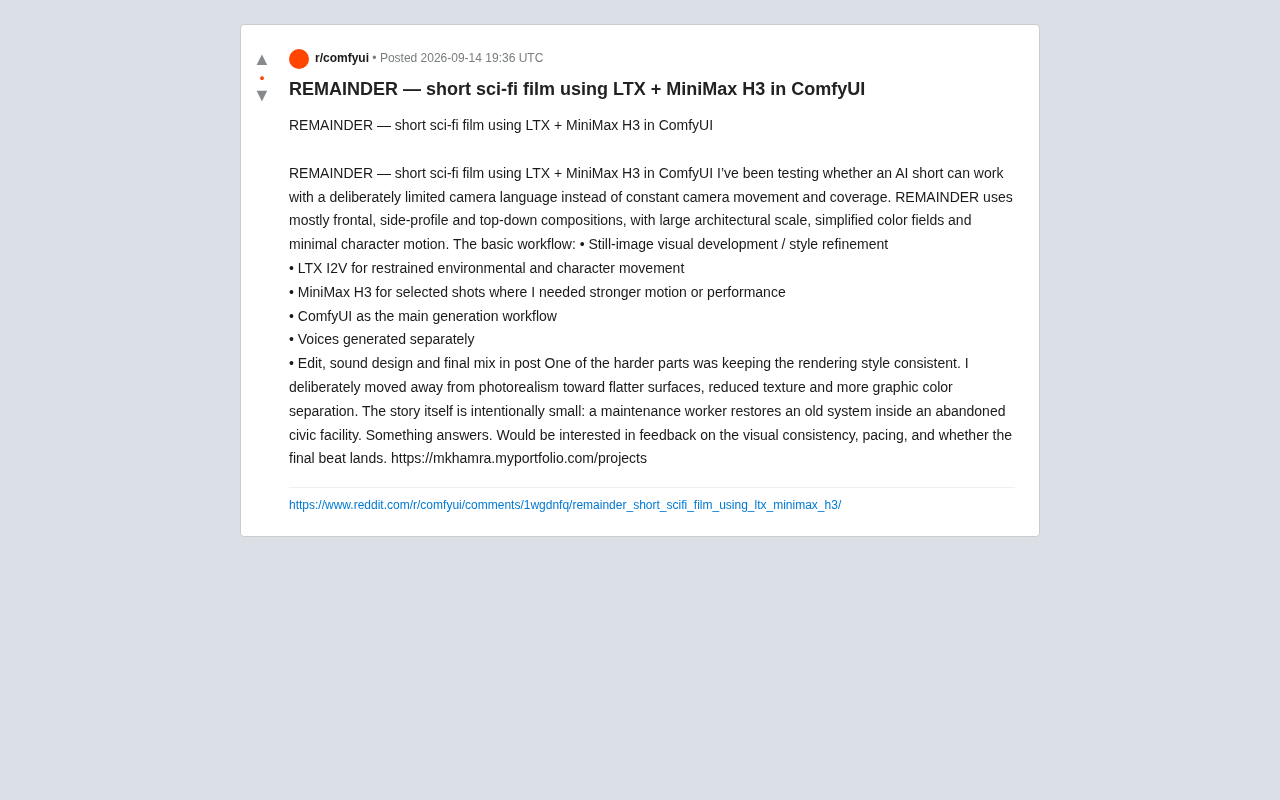
Building an AI Sci-Fi Short with LTX + MiniMax H3: Restrained Cinematography in ComfyUI
Sci-fi short REMAINDER uses LTX, MiniMax H3, and ComfyUI with restrained cinematography and flat aesthetics to solve visual consistency in AI filmmaking.

LangChain Deep Agents vs. MDA: Clearing Up the Confusion for Developers
What's the difference between LangChain's Deep Agents and MDA (Managed Deep Agents)? We break down create_deep_agent vs. define_deep_agent and help developers choose.
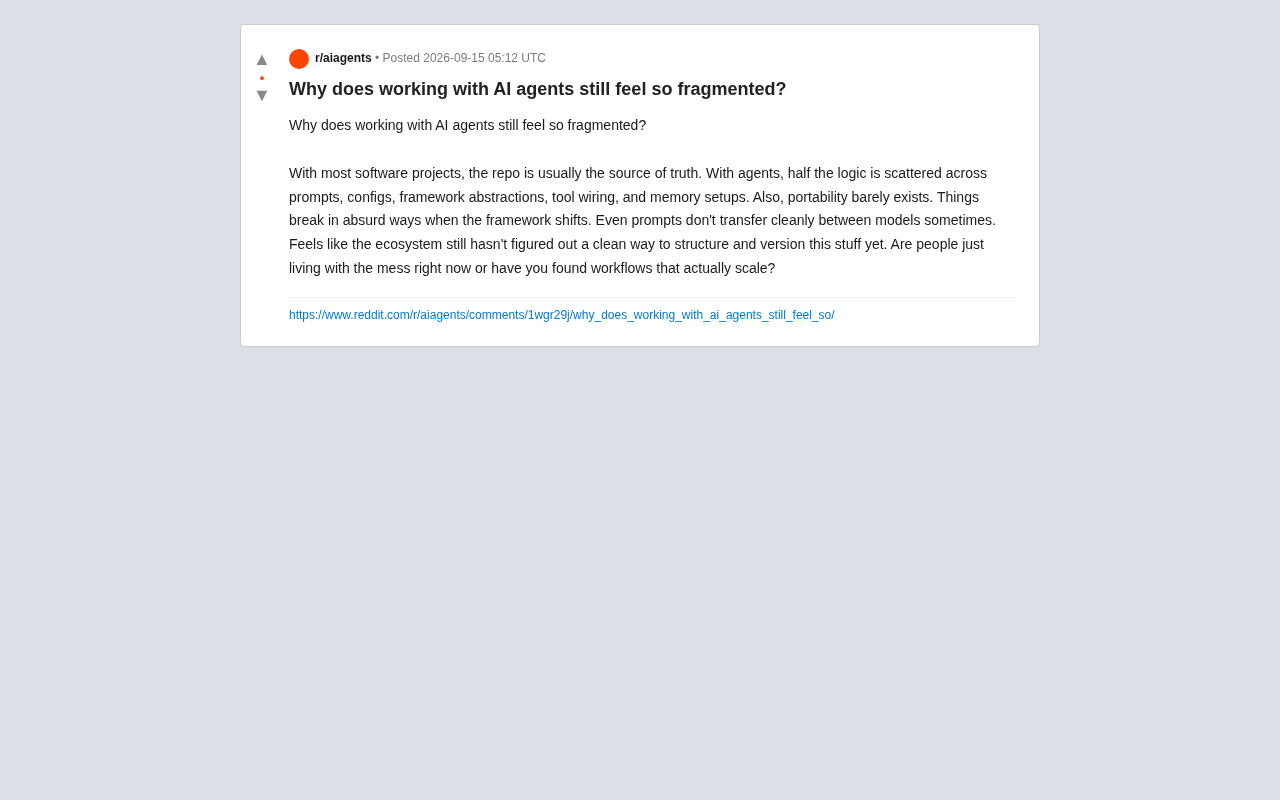
Why Is AI Agent Development So Fragmented? The Real Causes and How to Work Around Them
Why does AI Agent development feel so fragmented? Logic scattered across prompts, configs, and frameworks makes portability nearly impossible. Here's why — and how to cope.