ChickyTutor: The AI Language Tutor That Gets to Know You Better Every Day

ChickyTutor blends an interactive whiteboard and human-AI hybrid lessons to bring real tutoring into AI language practice.
ChickyTutor is an AI language learning app that earned 95 upvotes and a top-5 finish on Product Hunt. Its latest update introduces an interactive whiteboard that embeds visual grammar explanations and exercises directly into live spoken conversations, breaking the traditional app pattern of siloed instruction and practice. The product promises continuously accumulating personalized memory to adapt dynamically to each learner, though implementation details remain undisclosed. A new blended French course — pairing human teachers with AI daily practice — positions ChickyTutor as a tool that augments rather than replaces human instruction. An Android app also launched alongside the update.
When AI Language Practice Meets an Interactive Whiteboard
Language learning apps are everywhere, but most are stuck in the loop of drilling vocabulary and mechanical repetition. ChickyTutor landed 95 upvotes on Product Hunt, finishing fifth for the day — and it's taking aim at a more fundamental problem: how can an AI practice partner both hold a real conversation and explain concepts as clearly as a human teacher?
Founder Phanos Anastasiou highlighted in the launch notes that the centerpiece of this update is an interactive whiteboard — bringing visual instruction into the context of spoken practice. While in conversation, learners can ask about a grammar rule, see example sentences, work through a practice exercise, and then discuss it with the AI tutor — all within the same seamless session.
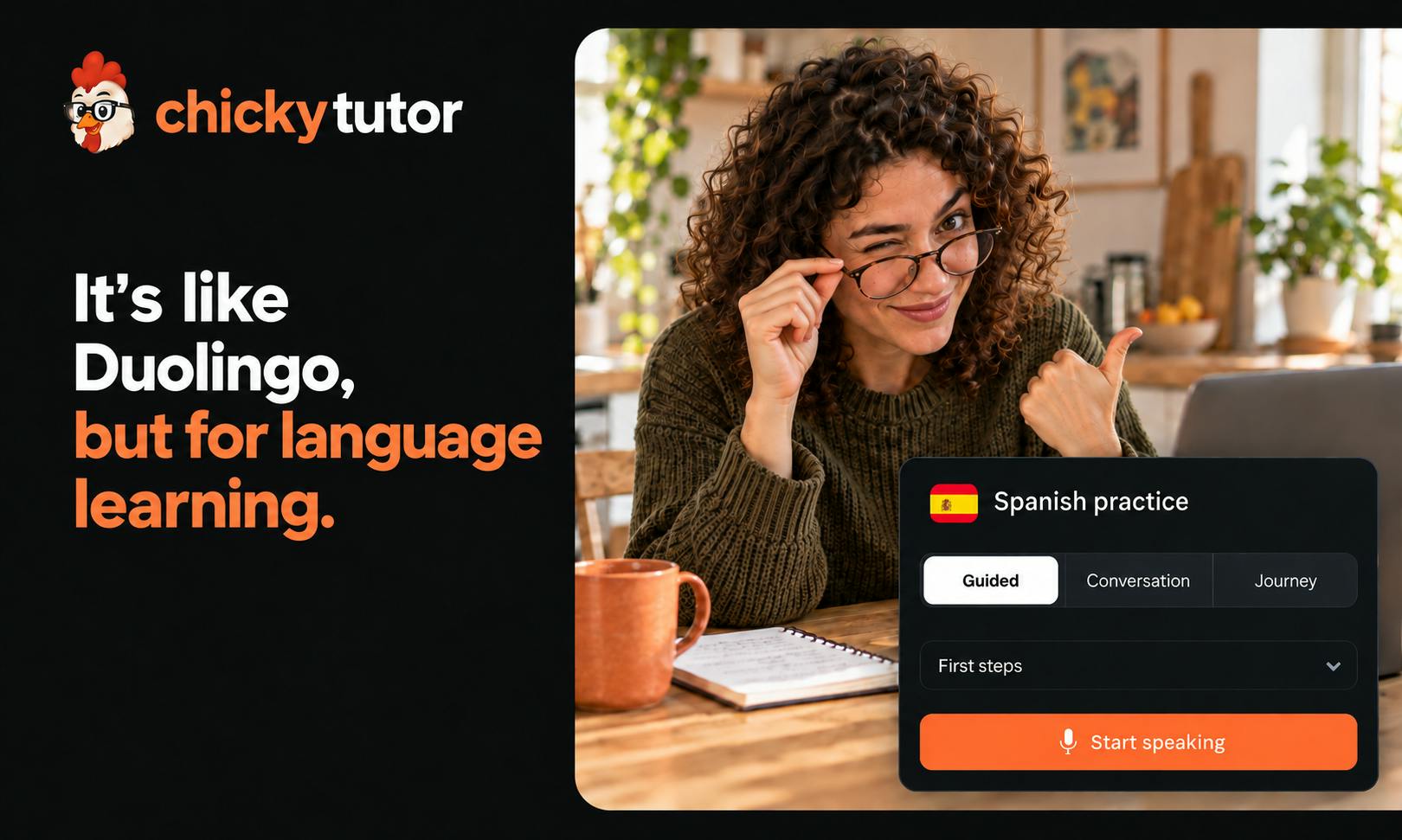
This design philosophy is worth examining. Traditional language apps tend to split "explanation" and "practice" into disconnected modules. ChickyTutor tries to weave them together inside a single natural conversation — much closer to the experience of working with a human tutor.
The Personalization Logic Behind "Getting to Know You"
The product's tagline is "A private language tutor that knows you better every day." That line captures what sets it apart from general-purpose chatbots: continuously accumulated, personalized memory.
In an ideal implementation, such an AI tutor would remember grammar points you repeatedly get wrong, the boundaries of your vocabulary, the topics you prefer, and adjust the difficulty and focus of future lessons accordingly. This is exactly where large language models shine in educational settings — instead of a one-size-fits-all curriculum, the system dynamically adapts to each learner's progress.
That said, based on publicly available information, the team hasn't gone into detail about how this "memory" is technically implemented or which dimensions of learning data it actually tracks. The real-world effectiveness of this capability remains to be seen through hands-on use.
There are generally two technical approaches for giving LLMs "memory." The first is summarizing conversation history into the System Prompt, so the model "reads" a learner's profile at the start of each session. The second uses an external vector database (such as Pinecone or Weaviate) for semantic retrieval of learning records, dynamically pulling in relevant context as needed. The first approach is cheaper to implement but limited in capacity; the second scales better but is significantly more complex to engineer. In an educational context, the quality of "memory" also depends on how well the system structures learning data — simply remembering "what the user talked about" is a fundamentally different technical challenge from tracking "which grammar point was missed, how many times, and in what pattern." The latter requires a dedicated error-analysis module, well beyond what general conversational capability can handle on its own.
Blended Learning: AI Practice Partner + Human Teacher
ChickyTutor also revealed a notable new direction — a partnership with L'école de français to launch a blended learning model for French (chickytutor.com/hybrid/french).
The approach is straightforward: human teachers lead the formal lessons, while the AI handles daily reinforcement practice between sessions. This "human instruction + AI daily practice" combination speaks directly to a long-running debate in AI education — is AI replacing teachers, or augmenting them?
ChickyTutor comes down firmly on the latter side. Human teachers handle systematic instruction and emotional connection; AI handles high-frequency, low-cost, always-available practice. With a clear division of labor, this hybrid approach may actually be more practical than either a pure-AI or pure-human solution. For a skill like language learning — where you need to open your mouth constantly — the value of "practicing every day between classes" should not be underestimated.
Blended Learning has a long research history in educational technology, typically referring to the systematic integration of face-to-face instruction with online self-directed learning. Its core value lies in using classroom time for high-cognitive-load interactions (discussion, error correction, emotional support) while shifting low-intensity repetitive practice to out-of-class digital tools. Research from institutions like the Stanford Graduate School of Education suggests this model is especially effective for language learning — spoken fluency is highly dependent on the frequency of speaking, and scheduled human lessons rarely meet that demand. In this context, an AI practice partner serves as "deliberate practice infrastructure," filling a structural gap in human teachers' time and cost constraints — not replacing their irreplaceable role in cognitive guidance and emotional connection.
Platform Expansion and Product Maturity
Alongside this update, ChickyTutor officially launched its Android app, completing its mobile coverage. Combined with the existing web entry point, the product is moving from a single-platform experience toward true multi-device availability — typically a signal that a product is entering its growth phase.
The Product Hunt numbers — 95 upvotes, 19 comments, fifth place for the day — are a solid performance for an education product, suggesting that the concept of "visual, conversational language practice" resonates with a real user need. The product is categorized under Education, Languages, and Audio, with a clear and focused positioning.
A Few Sober Observations
ChickyTutor's product direction has genuine strengths, but a few questions remain worth watching:
- How smooth is the whiteboard interaction in practice? Seamlessly embedding visual exercises into a voice conversation is technically and experientially challenging. Whether the promised "seamlessness" holds up is the key test.
- How deep does the personalization really go? "Gets to know you better every day" could be marketing copy or a genuinely robust learning-data model — only extended use will tell.
- Language coverage: The current focus is clearly on the French hybrid course. How well other languages are supported remains unclear.
Overall, ChickyTutor represents an interesting evolution in AI language learning tools: not content to be just "a chatbot you can chat with," but genuinely trying to bring the pedagogical structure of a human tutor into an AI conversation. Its hybrid model — collaborating with human teachers rather than competing with them — also offers a relatively mature reference point for the broader question of what role AI should play in education.
Related articles

Chain of Thought Isn't Just for AI: How Humans Can Use CoT to Improve Thinking Quality
Chain of Thought isn't just a prompt trick for large models. Starting from a Hacker News discussion, this article analyzes why CoT works for human thinking too, breaks down actionable ways to transfer it, and highlights the key differences between human CoT and machine CoT.
Cloudflare Teams Up with OpenAI: Closi…
Cloudflare Teams Up with OpenAI: Closing the Loop from Vulnerability Discovery to Defense with AI
Cloudflare uses OpenAI Daybreak to investigate security vulnerabilities and generate reviewable remediation plans, while developers use Codex to boost coding efficiency and quality.

Orca Multi-Agent Orchestration in Practice: A Guide to Parallel Collaboration with Claude and Codex
Orca is Stable AI's free open-source agent workbench supporting 34 agents like Claude Code and Codex in parallel. Learn its Git worktree isolation, multi-model orchestration, and mobile management.