Chilean Spanish: The Overlooked Dialect Recognition Problem for LLMs

A viral tweet exposes how most LLMs fail to recognize Chilean Spanish, highlighting a systemic AI blind spot for low-resource language variants.
A Twitter post humorously noted that ~80% of AI models can't recognize Chilean Spanish and respond in an Argentine accent instead, sparking serious discussion about LLM linguistic capabilities. Chilean Spanish is severely underrepresented in written corpora due to its colloquial, slang-heavy nature, causing models to fall back on more dominant Spanish variants — a hidden bias rooted in data skew, not ignorance of the dialect. This is far from an isolated case: regional language variants worldwide face the same blind spot, and current benchmarks almost never test dialect recognition, keeping the problem invisible. The article calls for both balanced data supplementation and targeted evaluation to make AI truly serve a linguistically diverse world.
An Accidental "Ultimate Benchmark"
A Twitter post that sparked widespread discussion made an interesting point: Chilean Spanish might be the "ultimate benchmark" for testing a large language model's (LLM) linguistic capabilities. According to the post, roughly 80% of AI models fail to correctly identify Chilean Spanish and instead insist on responding like an Argentine.
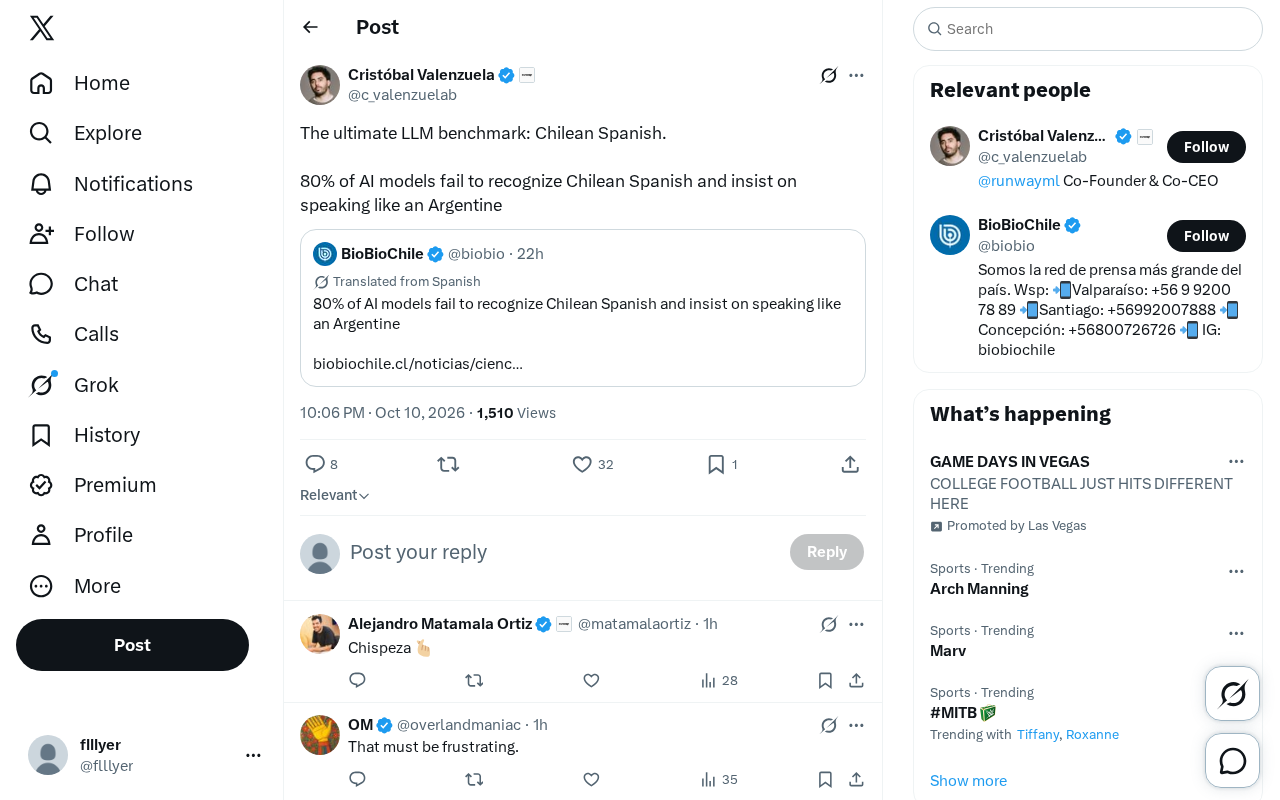
What reads like a joke actually points to a technical problem the industry has long overlooked: the systemic shortcomings of mainstream large models when handling regional dialects and low-resource language variants. While the post is tongue-in-cheek and lacks rigorous quantitative data, the phenomenon it describes deserves serious attention.
Why Chilean Spanish Is So Hard for AI
Chilean Spanish is notoriously difficult to understand — even for native Spanish speakers. Its phonetic characteristics are distinct: word-final consonants are frequently dropped or weakened, speech is rapid, and the language is packed with unique local slang (e.g., "po," "cachai," "bacán"). These features set it sharply apart from other Latin American Spanish varieties, particularly those with more "standard" phonology.
From a technical perspective, the tendency for models to "fall back" on more mainstream Spanish variants comes down to training data distribution. Spanish-language corpora on the internet are heavily concentrated around content from Spain, Mexico, and Argentina, while Chilean-specific spoken expressions make up a tiny fraction of publicly available text. When a model encounters an unfamiliar dialect as input, it gravitates toward the patterns most frequently seen in training data — and the output ends up feeling distinctly un-Chilean.
Hidden Bias from Data Skew
This isn't a simple translation error — it's a form of hidden bias caused by data distribution. The model doesn't "not know" Chilean Spanish; it's simply more likely, in probabilistic terms, to generate expressions it has seen more often. The post's observation that models "insist on speaking like Argentines" reflects the relative dominance of Argentine Spanish in web corpora and cultural output.
Linguists refer to this as Domain Shift — the degradation in model performance on data outside its training distribution. Within Spanish-language content, sources like Common Crawl contain Argentine and Mexican Spanish at proportions far exceeding their share of the Latin American population, because both countries have high internet penetration and active digital content production. Argentina in particular contributes a large volume of public text in blogging, literature, and journalism. Chilean Spanish, by contrast, is highly colloquial and slang-heavy, making it difficult for significant quantities of it to appear in formal written corpora — which compounds its statistical "invisibility." Because models are fundamentally doing weighted probability prediction, when the sample size difference between expression types reaches an order of magnitude, even if the model has "seen" Chilean expressions, they get suppressed at generation time by higher-frequency patterns.
The Broader Plight of Low-Resource Language Variants
Chilean Spanish is just the tip of the iceberg. Countless languages and dialect variants worldwide face a similar situation: they have real, active speaker communities, yet are severely underrepresented in digital corpora. Whether regional dialects, minority languages, or highly colloquial varieties, current large models broadly struggle to faithfully reproduce their register and cultural characteristics.
The practical impact is real. For a Chilean user, an AI assistant that consistently responds in an Argentine accent feels not just awkward, but potentially conveys the wrong cultural signals and undermines the localized user experience. As AI tools spread globally, this tendency toward "linguistic homogenization" risks degrading the experience for speakers of non-dominant language communities.
Researchers typically use the term "low-resource language" to describe languages with scarce training data, but Chilean Spanish is a more specific case — it's a low-resource variant: an underrepresented branch within a high-resource language (Spanish). These variants face a double bind: on one hand, because the parent language is itself well-resourced, they rarely receive dedicated optimization in multilingual models; on the other hand, existing evaluation benchmarks (such as XNLI and FLORES-200) mostly operate at the language-code level and don't distinguish regional variants within the same code — meaning Chilean Spanish recognition failures are simply invisible in standard evaluations. This keeps the "low-resource variant" problem in a long-term research blind spot, lacking both quantifiable evaluation datasets and systematic incentives for improvement.
Implications for AI Evaluation
Framing Chilean Spanish as a benchmark test is half-joking, but it raises a genuinely thought-provoking point about evaluation methodology. Mainstream benchmarks predominantly focus on reasoning, coding, and math performance in English and a handful of high-resource languages, rarely examining how broadly a model covers linguistic diversity.
Truly measuring a model's language capability shouldn't only assess its performance on "standard" languages — it should also examine whether the model can respect and reproduce regional linguistic variation. Dialect recognition, slang comprehension, and cultural context are dimensions that current evaluation frameworks tend to push to the margins.
Improving this situation requires working from the data side — introducing more diverse and balanced corpora, and deliberately supplementing training data for low-resource variants — while also adding dialect and regional variant testing to evaluation pipelines. Only then can AI genuinely serve a linguistically diverse global user base, rather than effectively "translating" everyone into whichever accent happens to be most dominant.
Conclusion
This tweet used humor to land a punch on a genuine weak spot in large language models. It reminds us that measuring AI's linguistic intelligence can't just mean chasing high scores on mainstream languages — the geographic diversity and variety of human language are equally unavoidable challenges. For AI products aspiring to global reach, figuring out how to honor the authentic expression of every language community remains a long road ahead.
Related articles

Chain of Thought Isn't Just for AI: How Humans Can Use CoT to Improve Thinking Quality
Chain of Thought isn't just a prompt trick for large models. Starting from a Hacker News discussion, this article analyzes why CoT works for human thinking too, breaks down actionable ways to transfer it, and highlights the key differences between human CoT and machine CoT.
Cloudflare Teams Up with OpenAI: Closi…
Cloudflare Teams Up with OpenAI: Closing the Loop from Vulnerability Discovery to Defense with AI
Cloudflare uses OpenAI Daybreak to investigate security vulnerabilities and generate reviewable remediation plans, while developers use Codex to boost coding efficiency and quality.

Orca Multi-Agent Orchestration in Practice: A Guide to Parallel Collaboration with Claude and Codex
Orca is Stable AI's free open-source agent workbench supporting 34 agents like Claude Code and Codex in parallel. Learn its Git worktree isolation, multi-model orchestration, and mobile management.