China's AI Labs Strike Back: Qwen, DeepSeek, and Kimi Reshape the Frontier Model Landscape

Qwen, DeepSeek, and Kimi are flooding the market with near-frontier AI models at a fraction of the cost.
China's AI labs — Qwen, DeepSeek, and Kimi — are launching a high-intensity wave of near-frontier models that undercut OpenAI and Anthropic on price by 10x or more. With open-weight releases, MoE architectures, and aggressive token pricing, these labs are proving that "good enough at a fraction of the cost" is a winning strategy, even as compute bottlenecks and distillation controversies loom.
China's AI Labs Launch a High-Intensity Offensive
The pace of the AI industry has suddenly accelerated over the past few days. According to multiple sources, the Qwen team is about to release a new open-weight model that officially claims performance comparable to leading frontier models — just below the very top closed-source offerings. Meanwhile, DeepSeekAd V4 is reportedly in testing, delivering strong performance at a fraction of the cost of frontier alternatives.
This is not an isolated event. Just days earlier, Moonshot AI's Kimi shook the entire industry, putting enormous pressure on OpenAI and Anthropic. Now, Qwen's next-generation model looks set to replay that same script. Chinese labs are releasing near-frontier-quality models at much lower prices and at an extremely high cadence — a trend that is fundamentally reshaping the competitive landscape.

Qwen's New Model: Open Weights + Price Advantage
According to an announcement from the Qwen team on X, the upcoming release features an enormous parameter count and claims the ability to continuously self-evolve. While officially positioned as "just below the top frontier models" in performance, it carries two core competitive advantages:
First, open weights — developers can freely deploy and customize the model. Second, price advantage — at equivalent performance levels, the cost is far lower than closed-source competitors. Together, these two factors are more than enough to keep OpenAI and Anthropic on high alert.
What is an open-weight model? An open-weight model makes its parameter weight files publicly available for download, allowing developers to deploy, fine-tune, and build on top of it locally — though training data and full source code are not necessarily released. This differs from fully open-source. Meta's Llama series pioneered this approach, proving that open-weight models can sustain commercial flexibility while activating a massive developer ecosystem. For enterprise users, data never needs to leave a private environment, dramatically reducing privacy compliance costs. For developers, fine-tuning for vertical use cases becomes possible without relying on API calls. This is one of the core reasons why the Qwen series has become so popular among overseas developer communities.
The "enormous parameter count" Qwen claims likely relies on a Mixture of Experts (MoE) architecture. MoE splits parameters across multiple "expert" sub-networks, activating only a small subset during each inference pass. This allows a model to advertise a massive total parameter count while keeping actual compute per inference far below that of a dense model of the same nominal size. GPT-4, Gemini 1.5, and the DeepSeek series are all believed to use similar architectures — total parameter counts may reach hundreds of billions, but only a fraction are activated per inference. This is the technical foundation that enables these models to approach frontier performance while dramatically compressing inference costs.
Notably, the model is already available for testing via Alibaba's token planAd rather than remaining in the realm of paper announcements. This "ship it as you launch it" cadence has become a defining characteristic of Chinese AI labs in recent months.
Infrastructure Is the Real Bottleneck
Kimi's official post revealed that Kimi K3 received far more attention than expected, putting enormous pressure on its GPUs — demand over the past 48 hours nearly hit the ceiling of existing compute capacity. To protect the experience for existing users, the Moonshot team even temporarily suspended new subscriptions, prioritizing compute resources for current members.
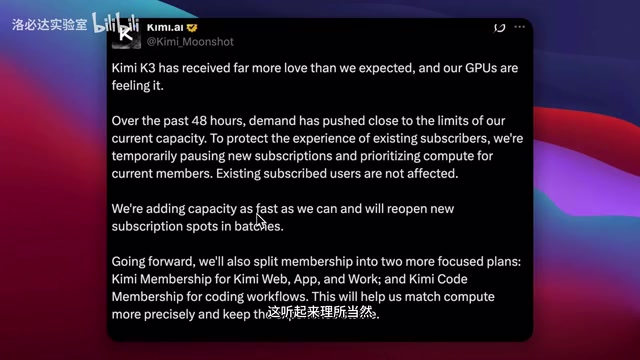
This detail signals two important things:
First, the real bottleneck is always infrastructure. Even a great model can't serve explosive demand if compute can't keep up — OpenAI and Anthropic have long faced the same kind of pressure.
Second, demand for "high-value large models" is enormous. Models that deliver high-quality results at a fraction of the cost are rapidly attracting users. Kimi's viral moment and the compute crunch that followed confirm just how real and urgent that demand is.
China's AI labs and the compute dilemma For Chinese AI labs, the compute challenge is made even more severe by U.S. export controls. Since 2022, exports of NVIDIA H100/A100 chips to China have been tightly restricted, forcing Chinese firms to stockpile early inventory, source downgraded H800/A800 variants, or pivot to domestic chips like Huawei's Ascend series. The demand curve for elastic inference compute differs fundamentally from peak training compute, and without the option to pile on unlimited hardware, using existing resources more intelligently becomes the only path forward. This has objectively pushed Chinese labs to the limits of model compression and inference optimization.
Kimi vs. Frontier Models: A Real Capability Comparison
To illustrate the gap concretely, Kimi and a top frontier model were each asked to generate a game demo in the style of Limbo.
The results are illuminating:
- Frontier model: ~2,400 lines of code, ~24,000 output tokens, cost approximately $1.20. More refined graphics, smoother character movement, a more polished background.
- Kimi: ~3,000 lines of code, ~30,000 output tokens, cost just 12 cents. The first-pass generation included more gameplay features — moving lampposts, laser effects, a nighttime transition, and more.
Kimi's core advantage is being roughly 10x cheaper, with a more complete first-pass output and richer gameplay variety. There were slightly more bugs, but the overall result was very close to frontier-model quality.
Understanding the economics of token pricing A token is the basic unit that large language models use to process text — roughly equivalent to 0.75 English words or 1.5 Chinese characters. AI services are typically priced per million tokens, split between input and output, with output tokens usually costing more since generation is more compute-intensive. GPT-4o input pricing is around $5 per million tokens. Kimi's 12 cents for 30,000 tokens works out to roughly $4 per million tokens — comparable to mainstream frontier models — yet its performance in head-to-head output comparisons still demonstrates strong value. For enterprise users making high-frequency API calls, token pricing directly determines a product's commercial viability, which is precisely why price competition so quickly moves markets.
This comparison reveals a critical insight: Chinese AI labs may not be competing for first place. What makes them genuinely popular is that results are already "close enough" at a dramatically lower price. In the game demo example, achieving 100% parity doesn't matter — if the output is good enough and costs 10x less, users have every reason to try and even migrate.
DeepSeek V4: A New Variable in the Price War
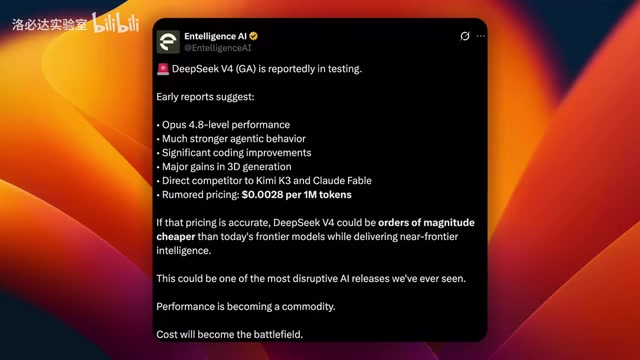
Beyond Qwen and Kimi, the DeepSeek team is also making moves. Early leaked reports indicate that DeepSeek V4 has entered testing and is set for imminent release. It reportedly approaches top-tier model performance, with notably stronger agentic capabilities, significantly improved coding, and meaningful advances in 3D generation.
Most striking is its rumored pricing: approximately $0.0028 per million tokens. If accurate, DeepSeek V4 would be several orders of magnitude cheaper than current mainstream frontier models while still delivering near-frontier intelligence.
There are, of course, voices questioning whether these models may have been produced through distillation. Knowledge distillation is a training technique that transfers knowledge from a large "teacher model" to a smaller "student model" — training the weaker model on high-quality data generated by the stronger one, thereby achieving output quality approaching the teacher's at very low cost. The controversy around Chinese labs centers on whether their training data heavily incorporates outputs from GPT-4 or Claude, effectively free-riding on OpenAI's and Anthropic's R&D investment — something both companies explicitly prohibit in their terms of service. However, distinguishing "distilled" from "independently trained" is technically extremely difficult, which makes such allegations nearly impossible to disprove.
Regardless, frontier labs face the same core pressure: either ship stronger models or dramatically improve cost and token efficiency. On the efficiency dimension, Chinese AI labs have already captured a substantial share of the market.
Notable Fault Lines and Lingering Concerns
Even as Chinese labs surge forward, several potential risks have surfaced.
Quality Consistency Controversies
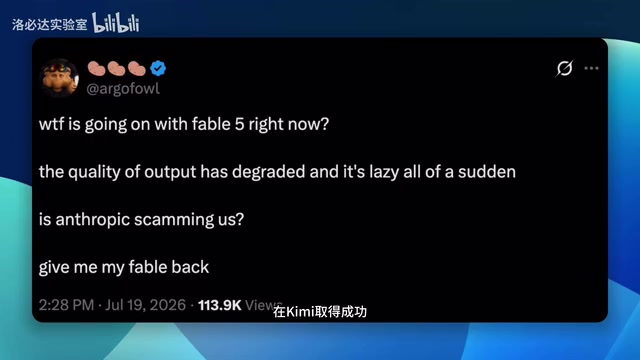
Multiple users have recently reported a decline in output quality from at least one leading frontier model. If vendors are quietly degrading model quality while expanding usage quotas, the user experience will suffer significantly. There has been no official confirmation of whether this represents an intentional adjustment or a backend issue. For premium paid products, stability is critical — once users detect quality fluctuations, trust erodes quickly and at high cost.
Google's Silence
Compared to the steady output from OpenAI and Anthropic, Google has produced almost no meaningful news recently. The next-generation Gemini Pro model originally expected mid-year has yet to materialize, and some base models are reportedly being redirected due to insufficient competitiveness. If Google continues to fall behind, it will face a two-front challenge: domestic rivals on one side and Chinese labs like Moonshot AI, Zhipu, and DeepSeek on the other.
Conclusion: A New Competitive Order in a High-Velocity Era
A clear trend is emerging in the AI industry: a growing cohort of open-source and open-weight labs are directly competing with frontier closed-source vendors using powerful, low-cost large models.
Chinese AI labs are releasing new models at a markedly accelerating pace, while in the U.S., sustained and consistent output still comes primarily from OpenAI and Anthropic. Behind this dynamic lies a persistent narrowing of the performance gap and a widening of the price gap. When "good enough" meets "cheap enough," market forces are already quietly shifting. The widespread adoption of MoE architectures, the maturation of knowledge distillation techniques, and the extreme efficiency optimizations driven by export control constraints collectively form the technical foundation of this offensive.
Whether this high-velocity, low-cost growth model can be sustained long-term remains an open question. Compute bottlenecks, cost pressures, and disputes over model provenance could all become critical variables going forward. But one thing is certain: competition in the large model space is entering a new phase — more intense, and far more diverse.
Key Takeaways
Related articles

Workbuddy for Absolute Beginners: How a Desktop AI Agent Fits Into Real Workflows
A beginner's guide to the Workbuddy desktop AI agent: installation, claiming credits, file management, and building automated workflows—compared with CodeX for fit and cost, helping professionals shift from AI question-askers to AI managers.

OpenAI's New Agent Stack: Computer Use, Decisions API, and Ultra-Fast Workflows
OpenAI Dev Day unveiled a new agent stack: Computer Use outperforms humans, Decisions API delivers ultra-low-latency classification via Luna, Agents API opens the same Computer Use capabilities, and GPT-6.1 Sol costs only one-seventh of Astra. Core updates, benchmark data, and developer insights.

Liang Wenfeng Open-Sources DeepInfo Inference Framework, Takes On U.S. Ban
DeepSeek open-sources its DeepInfo inference framework after its models, featuring GPU/CPU cross-pipelining, small-model prediction with large-model verification, and full Huawei Ascend and NVIDIA chip support—facing the U.S. federal ban head-on. This article analyzes its significance for AI deployment and open-source strategy.