Chinese AI Coding Plans Compared: How to Choose the Best Value Among 7 Models

2025 Chinese AI coding platform comparison: Zhipu AI is strongest, MiniMax is cheapest.
This article compares the coding capabilities and subscription plans of seven major Chinese AI platforms: Zhipu AI, MiniMax, ByteDance Ark, Kimi, Alibaba Bailian, Tencent Hunyuan, and Baidu Qianfan. Zhipu AI leads Tier 1 with its GLM5.1 model and MCP support, while MiniMax earns the value crown at ¥29/month. ByteDance Ark suits Doubao ecosystem users, and Kimi excels at long-text processing. Alibaba Bailian targets enterprises with higher pricing, while Tencent and Baidu serve as multi-model aggregation platforms.
Introduction
In 2025, Chinese AI models have made tremendous strides in coding capabilities, with major platforms launching subscription plans ranging from ¥29 to ¥200. Faced with so many options—Zhipu AI, MiniMax, Kimi, ByteDance Ark, Alibaba Bailian, Tencent Hunyuan, and Baidu Qianfan—how should everyday users spend their money? This article provides a horizontal comparison across all seven major platforms to help you understand each one's core strengths and ideal use cases.
Tier 1: The Strongest Overall Coding Contenders
Zhipu AI: The Ceiling of Chinese AI Coding Capability
Zhipu AI has claimed the top spot in coding among Chinese platforms thanks to its exclusive GLM5.1 model. Not only does this model produce high-quality code generation, it was also the first to support MCP (Model Context Protocol).
What is MCP? MCP is a standardized communication protocol proposed and open-sourced by Anthropic in late 2024, designed to solve the "last mile" connection problem between AI models and external tools/data sources. Before MCP, every AI application had to develop separate integration interfaces for different external services—expensive to develop and hard to reuse. MCP defines a unified Client-Server architecture that allows AI models to directly access file systems, databases, browsers, code execution environments, and other local or remote resources as if calling a standard API. For coding scenarios, MCP is particularly significant—it enables AI to go beyond merely "suggesting code" to actually reading project files, executing terminal commands, and debugging results, achieving end-to-end automated development workflows. Zhipu AI being the first Chinese platform to support MCP means its users can build more complex AI Agent applications rather than staying at the conversation level.
For regular users, the ¥49/month Lite plan is recommended, offering over 20,000 uses per month—more than enough to cover everyday needs like research, writing, and creating presentations. For developers with coding needs, GLM5.1's performance in code comprehension, generation, and debugging genuinely leads competitors at the same price point.
The Evolution of AI Coding Assistants: AI coding tools have rapidly evolved from code completion to intelligent agents. GitHub Copilot's launch in 2021 marked the beginning of practical AI-assisted programming; subsequently, with more powerful foundation models like GPT-4, capabilities expanded from single-line completion to function-level generation, and then to entire module architecture design and refactoring. Since 2024, AI-native IDEs like Cursor and Windsurf have emerged, deeply embedding large models into development environments with support for multi-file context understanding and autonomous code modification. Chinese platforms have significantly accelerated their pursuit in this track—models like GLM5.1 have achieved scores on standard programming benchmarks like HumanEval and MBPP that approach or even surpass some international competitors.
MiniMax: The Value King at ¥29/Month
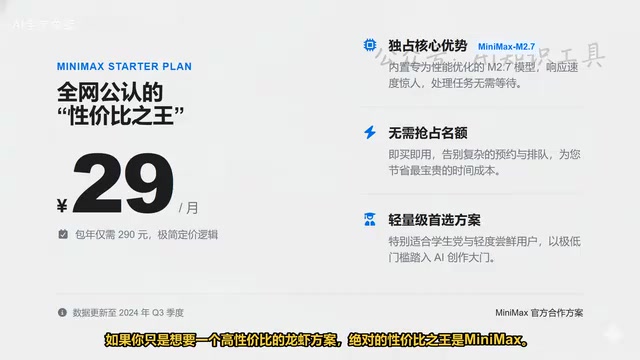
MiniMax is currently the cheapest AI subscription platform available, at ¥29/month or ¥290/year, with no need to compete for slots to access its exclusive MiniMax M2.7 model. This model's biggest advantage is its extremely fast response speed—perfectly adequate for everyday conversation, simple coding assistance, and other light-use scenarios.
For students or those who just want to casually try things out, the ¥29 Start plan is currently the lowest-barrier legitimate option. While the model's capabilities don't match GLM5.1's top-tier level, at only 60% of Zhipu's price, the value proposition is truly unbeatable.
The Logic Behind MiniMax's Low Pricing: Current Chinese AI platform subscription pricing generally adopts a "basic + premium" tiered structure, directly tied to GPU compute costs. Training and running inference on large models consumes massive amounts of high-end GPU resources, and platforms use subscriptions to distribute compute costs across users while employing "call limits" or "token quotas" as throttling mechanisms to control expenses. MiniMax can maintain its low price partly due to inference efficiency optimizations in its self-developed model, and partly due to its market strategy at this stage of commercialization—rapidly accumulating a user base through low prices, then monetizing through enterprise API services. Understanding this pricing logic helps users make more rational subscription decisions based on their actual usage frequency.
Tier 2: The Best Options for Specific Scenarios
ByteDance Ark: First Choice for Doubao Ecosystem Users
Users accustomed to the Doubao ecosystem should look at ByteDance Ark, starting at ¥40/month, supporting the latest Doubao Side 2.0 model, with subscription purchases including the useful OpenClawAd plugin.
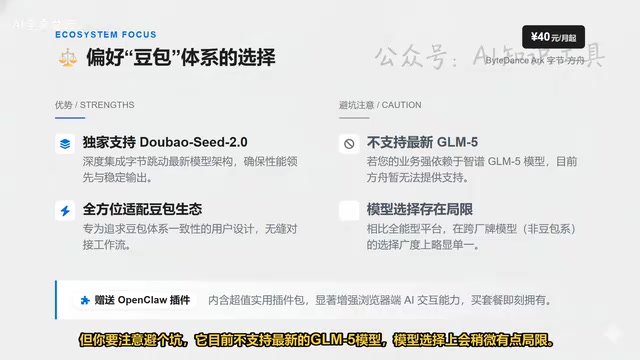
However, there's a caveat: ByteDance Ark currently doesn't support the latest GPT-5 model, presenting certain limitations in model diversity. If model variety matters to you, this is something to consider beforehand.
Kimi: The Expert at Combining Long-Text Processing with Coding
For users with heavy reading needs—such as those who need AI to help process hundreds of PDF pages daily or write 10,000+ word documents—Kimi is the best fit. Starting at ¥49/month with the Kimi K2.5 model, long-context processing capability is its core competitive advantage.
Why Is Long Context So Important? The context window is the core metric for measuring a large model's ability to handle long texts, referring to the maximum number of tokens the model can "remember" and process in a single conversation—1 token corresponds to approximately 0.75 English words or 1.5 Chinese characters. Early GPT-3 had a context window of only 4K tokens, while current mainstream models have generally reached 128K or higher. Kimi is renowned for its ultra-long context, with versions supporting millions of tokens of input—equivalent to processing thousands of PDF pages at once—offering irreplaceable advantages in scenarios like legal contract review, academic literature surveys, and large codebase analysis. Note that longer context windows mean higher inference costs and correspondingly slower response speeds—which also explains why Kimi's response speed varies across different features like Agents.
However, there's one concern with Kimi: the company has never publicly disclosed specific call limits, making usage feel somewhat like "opening a mystery box," and response speeds vary across different features (such as Agents).
Tier 3: Wait and See as Needed
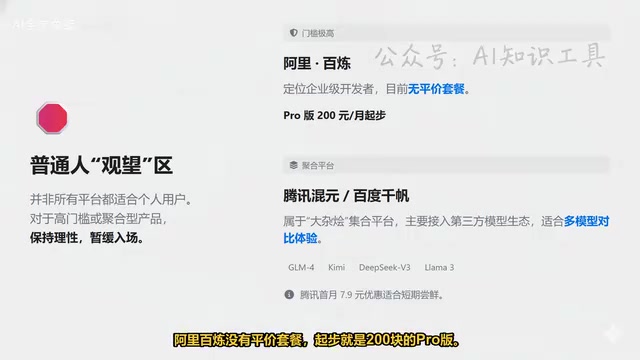
Alibaba Bailian: Enterprise-Grade Positioning, High Barrier for Individual Users
With no affordable plan available, starting at ¥200 for the Pro version, the barrier is quite high for regular users. This pricing reflects Alibaba Bailian's product positioning primarily targeting enterprise customers, emphasizing stability and SLA (Service Level Agreement) guarantees—better suited for enterprise users or developers with specific API call requirements, rather than individual light users.
Tencent Hunyuan & Baidu Qianfan: Multi-Model Aggregation Platforms
These two platforms fall into the "all-in-one" category.
Related articles
 Product Reviews
The Programmer's Desk Setup Guide: Building a Workspace That Feels Like Home
Discover how programmers build productive, comfortable workspaces. From multi-monitor setups to ergonomic design, explore the desk philosophy that drives focus and flow.
 Product Reviews
Qoder vs Cursor Real-World Comparison: Which $20/Month AI IDE Is Better?
Hands-on comparison of Qoder vs Cursor AI IDEs: Agent autonomy, human interaction count, and architecture decisions. Qoder needed only 2 interactions vs Cursor's 8.
 Product Reviews
Cursor Cloud Agent Demo: Eliminating Bottlenecks Across the Entire Software Development Lifecycle
Deep analysis of Cursor's Cloud Agent demo showing how cloud VMs, automated test artifacts, and a full-chain control plane systematically eliminate human bottlenecks across the software development lifecycle.