Chinese AI Praised Abroad but Criticized at Home: Three Mismatches Reveal the Truth Behind Divided Reviews

Three mismatches explain why Chinese AI is praised abroad but criticized at home.
Chinese AI models earn effusive praise on overseas tech communities like Hacker News and Hugging Face, yet face heavy criticism on domestic platforms. This article dissects three underlying mismatches — user identity, product form, and positioning perception — to reveal the real reasons behind the divided reviews.
An Intriguing Phenomenon of Divided Reviews
Recently, I've observed an interesting phenomenon: on overseas tech communities like Hacker News and Hugging Face, Chinese AI has received widespread praise; yet on domestic short-video and social platforms, the same products are heavily criticized. The same batch of models — why do the reviews differ so drastically between the two sides?
Hacker News is an information aggregation community under Y Combinator aimed at technologists and entrepreneurs. Its user base consists primarily of Silicon Valley engineers, independent developers, and academic researchers, with a discussion culture defined by technical rationality where emotional content gets quickly downranked. Hugging Face, meanwhile, is the world's largest open-source AI model hosting platform, gathering millions of machine learning practitioners, and is the de facto standard hub of the current open-source model ecosystem. The user profiles of these two platforms, from the very start, determined the tone and dimensions of their discussions.
Browsing through the content in overseas discussion forums, you'll find that the crowd praising Chinese AI shares a remarkably consistent profile — independent developers running their own models, engineers at small and medium-sized companies, academic researchers. What do they have in common? Every single API call comes out of their own pocket.
This difference in identity is precisely the key to understanding the entire review divide. When you're paying real money for compute, the things you care about are completely different from those of an ordinary user.
Why Overseas Developers Praise Chinese AI So Effusively
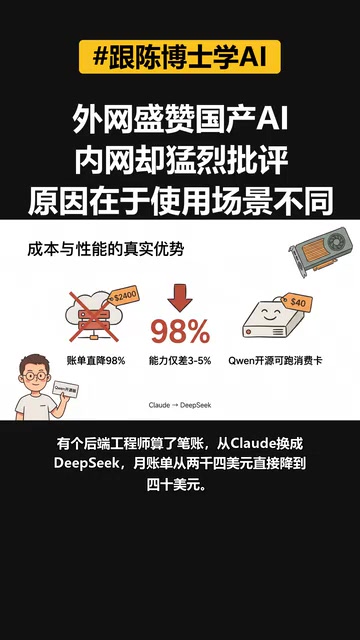
The praise from overseas developers isn't emotional — it's driven by their actual bills. One backend engineer did the math: after switching from Claude to DeepSeek, his monthly bill dropped from $2,400 straight down to $40, a 98% cost reduction, while the capability gap was a mere three to five percentage points.
In their shoes, faced with such value for money, you'd probably recommend it enthusiastically without hesitation too. This isn't blind nationalistic sentiment — it's pure business rationality.
The performance of the open-source versions is even more striking. According to hands-on feedback from overseas communities, Tongyi Qianwen's open-source models can fit onto a single consumer-grade GPU and deliver near-production-grade coding capabilities. This is backed by a mature technical pipeline: communities widely adopt quantization to compress model parameters from FP16 to INT4 format, reducing VRAM usage by 75%.
The principle behind quantization is that a neural network's weight parameters don't require the same high numerical precision during inference as they do during training. FP16 (16-bit floating point) is the mainstream format for training large models today, while INT4 (4-bit integer) trades an extremely low precision loss for a 4x storage compression ratio. This process is similar to saving a high-definition image in JPEG format — within a range imperceptible to the human eye (or to model performance), it dramatically compresses file size. The successive maturation of quantization algorithms like GPTQ, AWQ, and GGUF keeps the performance loss of quantized models within 1-3% on most tasks, which is nearly negligible. This technical advancement is the core driver bringing open-source models into the workstations of ordinary developers.
Take Qwen-7B as an example: after 4-bit quantization, a consumer-grade GPU with 24GB of VRAM can run it smoothly. The maturity of open-source inference frameworks like llama.cpp and Ollama has further pushed the deployment barrier to almost zero. llama.cpp, developed by Georgi Gerganov, implements efficient large-model inference in pure C/C++, supporting a wide range of hardware from MacBooks to Raspberry Pis. Ollama builds on this with a Docker-like model management experience, letting you pull, quantize, and start a local model service with a single command. For those in the know, this is almost a "disruptive" experience — setting up private AI services at near-zero cost. What previously required multiple A100 servers can now run on your own workstation. But for those unfamiliar, these capabilities are entirely unheard of.
The Key Is That They Use "Raw APIs"
Overseas developers call the original API interfaces, what the industry refers to as "Raw APIs." They interact directly with the underlying inference interfaces, can fully customize the System Prompt, control the temperature (the parameter determining output randomness and creativity), set top-p sampling strategies, and manage the context window across multi-turn conversations themselves.
The System Prompt is the hidden instruction layer in a large model's conversation system, injected before user input, used to define the model's role, behavioral boundaries, and output style. The temperature parameter controls the "randomness" of the model's output — the lower the value (approaching 0), the more the model tends to choose the highest-probability words, producing more conservative, deterministic output; the higher the value (approaching 2), the more diverse the model's word choices, producing more creative output but also more prone to hallucination. Top-p (nucleus sampling) is another mechanism for controlling output diversity, balancing quality and variety by dynamically selecting the set of words whose cumulative probability reaches a threshold p. The combined tuning of these three parameters is the core engineering means of fine-tuning a general-purpose large model into an assistant for a specific business scenario. They write their own system prompts, manage their own context, and build their own application logic. In other words, they face the model itself directly, with no intermediate layers interfering.
Their evaluation metrics are also hardcore: SWE-Bench scores, inference latency, whether it can be used commercially, and long-context retrieval accuracy. SWE-Bench is a benchmark for large-model coding capabilities jointly launched by Princeton University and the University of Chicago, evaluating software engineering ability by having models solve real GitHub Issues. It's regarded by the industry as one of the most authoritative metrics closest to real-world work scenarios.
SWE-Bench's design philosophy is worth understanding in depth. Unlike traditional coding benchmarks such as HumanEval, SWE-Bench doesn't test whether a model can write isolated algorithmic functions. Instead, it requires the model to understand an entire open-source code repository, comprehend a bug report, and then generate a code patch that passes the corresponding test cases. This process demands that the model simultaneously possess long-context understanding, code architecture awareness, cross-file dependency analysis, and precise code generation — a comprehensive assessment of the model's real software engineering capabilities. Achieving a high score on SWE-Bench means the model has practical value approaching that of a junior engineer in real engineering scenarios, not merely the ability to recite algorithm templates.
Inference latency determines response speed in high-concurrency production environments; long-context retrieval accuracy (such as the Needle-in-a-Haystack test) measures the model's ability to precisely locate key information within ultra-long documents of hundreds of thousands of tokens. The Needle-in-a-Haystack test randomly inserts a piece of key information (the "needle") into different positions of an ultra-long document (the "haystack"), then tests whether the model can accurately find and cite that information — a standard stress test for verifying a model's long-context capability. These are the real standards for measuring a large model's value from an engineer's perspective — they directly determine whether the AI can run stably and economically in production, not merely dazzle during a demo.
What Domestic Users Are Complaining About Is Actually "the Padded Jacket"
Now look at domestic users' complaints — equally real, equally not unjustified: the AI's copywriting doesn't have enough "Xiaohongshu flavor," it's overly conservative and evasive when asked about current events, role-play gets refused at the slightest edginess, and conversations feel less lively than ChatGPT.

But note one key distinction: what domestic users complain about is not the model's intelligence, but the product form and content strategy.
What domestic users encounter is never the raw model, but layers upon layers of packaged product. The consumer-facing product layer stacks a Safety Filter, a Content Moderation module, and business-guidance logic on top of the underlying model.
This technical architecture is typically implemented in two stages: pre-filtering and post-review. Pre-filtering scores the risk of user input through keyword matching, classification models, or another dedicated small model; requests exceeding the threshold are intercepted or rewritten before being sent to the main model. Post-review scans the main model's output a second time, truncating, replacing, or refusing to return content judged to be sensitive. The two-layer mechanism stacked together ensures compliance, but inevitably introduces extra latency in response speed, and in certain edge cases produces over-blocking (False Positives) — which is precisely the technical root of why many users feel the "model got dumber" or "speaks too timidly."
Building a content safety system is essentially an engineering trade-off problem, with the core tension being the irreconcilable tension between Precision and Recall. Increasing recall (intercepting all harmful content as much as possible) inevitably comes at the cost of precision — that is, producing more False Positives, wrongly intercepting harmless content; and vice versa. In an environment with high regulatory pressure, the asymmetry of compliance costs (the penalty for letting one piece of violating content slip through far outweighs the user complaints from over-blocking a hundred normal pieces) leads system designers to set thresholds extremely conservatively. Current mainstream safety filter systems typically adopt a multi-tiered architecture: the first tier is rule-based keyword matching (extremely low latency, about 1ms), the second is intent classification based on BERT-type models (latency about 10-50ms), and the third is semantic understanding judgment based on large models (latency about 100-500ms). Each tier seeks a balance between latency, cost, and accuracy, and the extra latency and over-blocking produced after the entire chain is stacked is exactly the direct technical source of users perceiving the "model getting dumber."
For the needs of compliance and risk control, products add extra restriction and guidance layers on top of the underlying model. The domestic regulatory environment has higher content compliance requirements, so these intermediate layers tend to be thicker and more numerous. While this packaging makes products meet regulatory requirements and reduces risk, it correspondingly diminishes the model's native flexibility. What users curse most of the time is this thick "padded jacket," not the model inside it.

The Evaluation Metrics Aren't Even on the Same Dimension
Overseas, they look at SWE-Bench, inference performance, commercial licensing; domestic ordinary users have only one simple standard — does it talk like ChatGPT.
This way of evaluating with ChatGPT as the reference has deep roots in cognitive psychology. ChatGPT launched in November 2022 and reached 100 million users within two months, bringing large models into the public eye on an unprecedented scale. This first-mover effect creates a strong "Anchoring Effect" in psychology — users set the first widely accepted product experience as the default standard, and all latecomers are measured against this ruler.
The Anchoring Effect was first proposed by psychologists Amos Tversky and Daniel Kahneman in 1974, and is one of the core concepts of behavioral economics. When making judgments, humans tend to over-rely on the first piece of information obtained (the "anchor"), with all subsequent evaluations taking place within the gravitational field of this reference point. In the consumer tech field, this effect is especially pronounced — the iPhone defined the interaction paradigm of touchscreen smartphones, WeChat defined the functional expectations of domestic instant messaging, and ChatGPT, with its fluent, characterful conversational style, defined globally "what AI conversation should look like." Once this anchor is fixed, even if latecomers comprehensively surpass it in objective capability, it's extremely hard to replace this baseline perception in users' minds — because what users evaluate isn't absolute capability at all, but the perceived deviation from the anchor.
ChatGPT's fluent, characterful, naturally-worded conversational style constitutes the public's baseline perception of "what AI should look like." For most ordinary users, ChatGPT defined "what AI should look like." All latecomers get compared on tone, spirit, and conversational feel. Once this reference anchor is fixed, the evaluation result is almost inevitable — even if they surpass ChatGPT on professional benchmarks, it's hard to score high on this invisible "spirit ruler," because this ruler was never designed for engineering capability in the first place.

Positioning Mismatch: Comparing a Coding Model on Chat Tone
The problem is that the core positioning of China's top large models was never that of a chatbot. DeepSeek focuses on reasoning and coding capabilities, while Tongyi Qianwen bets on the open-source ecosystem.
DeepSeek adopts the Mixture of Experts (MoE) architecture to achieve efficient inference — activating only some expert networks in each forward pass, drastically reducing the compute consumption per inference while maintaining high performance, giving it a structural advantage in inference cost. The core idea of the MoE architecture can be traced back to the early work of Geoffrey Hinton's team in 1991; its key innovation is the introduction of a lightweight "Gating Network" responsible for dynamically deciding which "expert" sub-networks to route the input to during each forward pass — typically activating only 1/8 to 1/4 of the total number of experts. This means an MoE model claiming to have hundreds of billions of parameters may only activate tens of billions during actual inference, thereby drastically compressing the computation (FLOPs) per inference while preserving the model's knowledge capacity. DeepSeek-V2 further refines the expert granularity and introduces a "shared expert" mechanism, avoiding knowledge redundancy while ensuring division of labor among experts — this is precisely the underlying technical root of its structural advantage in inference cost.
Tongyi Qianwen's open-source strategy takes a different path: by opening its weights to global developers, it has rapidly accumulated a massive community ecosystem, ranking among the top in downloads on Hugging Face for a long time, forming an ecosystem moat effect similar to Linux in the operating system field. This open-source ecosystem moat manifests on multiple levels: the thousands of vertical-domain fine-tuned versions produced by global developers based on the open weights form a long-tail coverage capability that closed-source models cannot replicate; inference frameworks, quantization tools, and deployment platforms deeply optimized around specific model architectures make switching costs increase over time; the large-scale academic citation and improvement feedback for open-source models form a positive flywheel of technical iteration, sometimes making the capability evolution speed of open-source models even exceed that of closed-source commercial competitors. Both strategic choices point to the enterprise and developer market, not the consumer-grade chat assistant track aimed at the general public.
Making a model that doesn't care about "tone" at all compete with ChatGPT on conversational liveliness — of course it loses. It's like comparing an off-road vehicle to a sports car on urban acceleration — the wrong track, and naturally the result looks bad.
Behind this mismatched evaluation is the gap between user expectations and product positioning. Differentiated positioning at the technical level ultimately gets reduced to a single phrase: "not good to use."
Platform Algorithms Are Fanning the Flames
Beyond the difference in perspective, platform algorithms are also amplifying this divide.
Content criticizing Chinese AI often gets far more traffic than praise. This is the inevitable result of algorithmic mechanisms: the recommendation algorithms of short-video and social platforms generally use "engagement rate" and "dwell time" as core distribution signals, and critical, controversial content is naturally more likely to spark comments and shares, and is thus judged as quality content entering a larger traffic pool. Communication scholars call this the "Algorithmic Amplification of Negativity Bias" — the human brain is inherently more sensitive to negative information, and algorithms happen to reinforce this natural tendency, forming a positive feedback loop: complaint videos get high traffic → more users see them → more emotional resonance → even more traffic.
The neuroscientific root of this phenomenon lies in humans' "Negativity Bias" — evolutionary pressure gave the human brain a higher processing priority for threatening information than for neutral or positive information, the result of millions of years of survival selection. Modern recommendation algorithms optimize for engagement rate, essentially using machine learning to amplify humans' most primal attention preferences. A study by MIT found that tweets containing emotional language spread six times faster than neutral content; MIT Media Lab's large-scale data analysis of Twitter (now X) showed that false information spreads six times faster than true information, and this difference is mainly driven by human retweeting behavior rather than bot accounts. This means the resonance between platform algorithms and user psychology is a systematic information distortion mechanism, not an isolated phenomenon.
Controversial comments are more likely to trigger secondary exposure and get repeatedly pushed by algorithms. Meanwhile, the solid technical reputation accumulated by the open-source ecosystem — rigorous benchmark reports and API value analyses — lacks both emotional tension and conformity to the short-video content format, and simply cannot penetrate the algorithm pools of short-video platforms.
Thus a structural bias forms: the people who truly understand the technology and can genuinely feel the value of Chinese AI are the silent majority, while emotional complaints are continuously amplified by algorithms.
Behind the Divide Are Three Mismatches in the Evaluation System
Chinese AI being praised abroad and criticized at home is essentially not a quality problem, but the result of three mismatches stacked together:
First, a mismatch in user identity — paying developers care about value for money and hardcore metrics, while ordinary users care about conversational experience and emotional feedback.
Second, a mismatch in product form — overseas users use raw APIs, domestic users use layer-upon-layer packaged compliance products, and most of the criticism lands on the restriction layer in between.
Third, a mismatch in positioning perception — measuring a large model that focuses on reasoning and coding by the standards of a chatbot.
Understanding these three layers of mismatch, you can see: those seemingly contradictory evaluations are actually talking past each other, each with its own reasoning. What's truly worth deep reflection for Chinese AI vendors is perhaps how to more smoothly convey excellent underlying capabilities to ordinary users within compliance constraints — this is not just a product design problem, but a systems engineering challenge requiring finding the greatest common denominator among technical boundaries, regulatory requirements, and user expectations.
Related articles

Disaster and Glory of the Apollo Program: The History We Must Revisit Before Returning to the Moon
From the fatal Apollo 1 fire to Apollo 8's daring lunar orbit to Apollo 11's successful landing—revisiting the disasters, fears, and compromises of the Apollo program and their lessons for today's return to the Moon.

Netflix Trust Exercise Turns Into Firing Trap: Where Are the Boundaries of Corporate Trust?
A Netflix employee was fired after sharing private info in a trust exercise. We analyze the risks of corporate trust exercises and how employees can protect themselves.

AMD CDNA5 Architecture Deep Dive: Technical Evolution and the AI Computing Competition Landscape
Deep analysis of AMD's CDNA5 architecture covering Chiplet packaging upgrades, HBM memory evolution, and low-precision compute optimization, examining how AMD challenges NVIDIA's AI chip dominance.