Chinese Open-Source Models Downloaded Twice as Often as American Ones: A Breakdown of Lambert's Congressional Testimony

Lambert's Congress testimony: Chinese open-source models now lead the U.S. in downloads, inference traffic, and technical catch-up speed.
AI researcher Nathan Lambert's written testimony to the U.S. Congress reveals that Chinese open-source LLMs have shifted from followers to de facto global ecosystem leaders. Three key data points support this: Chinese models have ~3.2B downloads on Hugging Face vs. ~1.6B for U.S. models; Chinese open-source models account for over 80% of OpenRouter inference traffic; and Chinese open weights trail the closed-source frontier by only 2–5 months vs. 6–9 months for U.S. open weights. In agentic coding — where the open/closed gap is smallest — Qwen, GLM, and Kimi have become the default choices for local tool-use tasks.
AI2 researcher and Interconnects blog author Nathan Lambert recently published the written testimony he submitted to the U.S. Congress, focused on the current global balance of power in open-weight models. The document uses a set of hard data points to outline a trend that is rapidly reversing: in the open-source LLM space, China is shifting from a follower to a de facto leader.
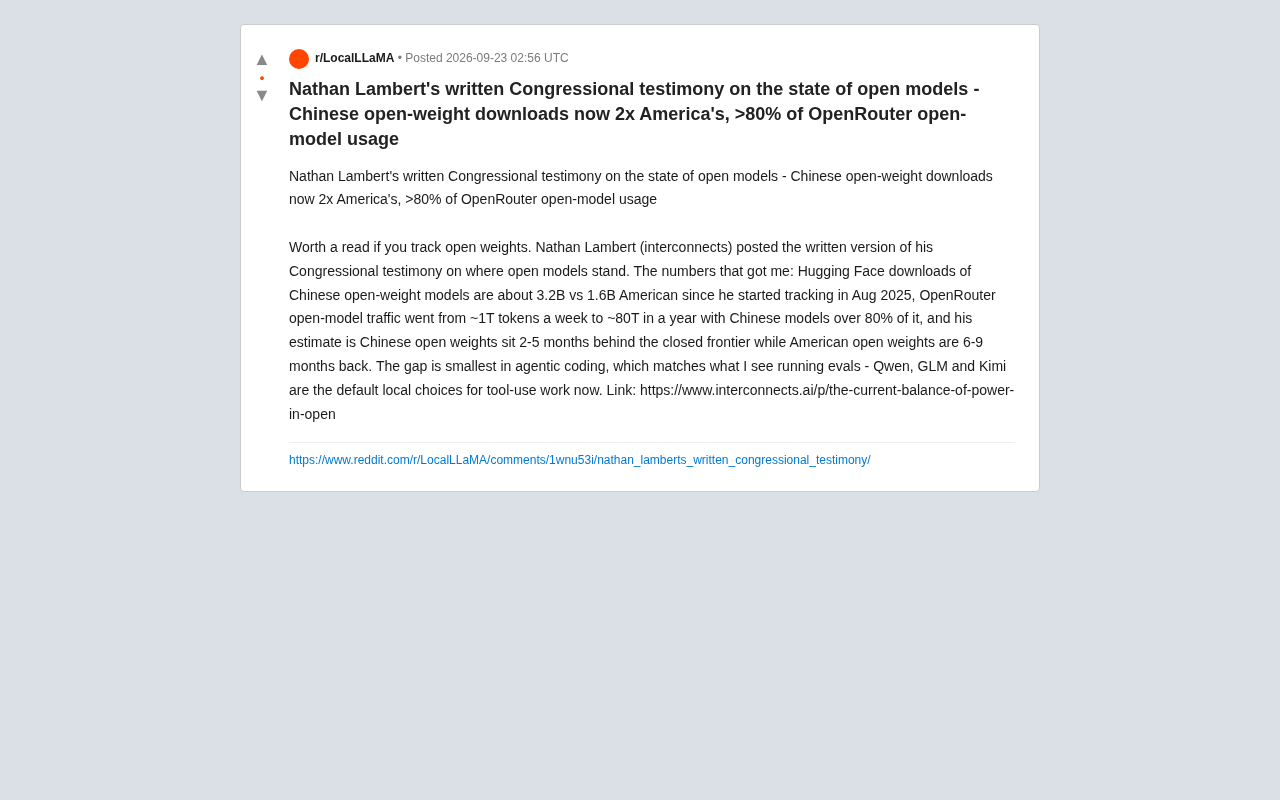
Core Data: A Double Reversal in Downloads and Usage
The most striking figures in the testimony are two sets of numbers. The first comes from Hugging Face: since Lambert began tracking in August 2025, Chinese open-weight models have been downloaded approximately 3.2 billion times, compared to roughly 1.6 billion times for American models — China has reached twice the download volume of the U.S.
The second dataset comes from OpenRouter's inference traffic. Over the past year, open-source model calls on the platform surged from roughly 1 trillion tokens per week to approximately 80 trillion tokens per week — nearly an 80× increase. Within that enormous traffic pool, Chinese models account for more than 80% of the share.
In other words, whether measured by developers "downloading and stockpiling" models or by actual production environments "running real inference workloads," Chinese open-source models have become the default choice. One metric represents intent, the other represents actual usage — surpassing American models on both simultaneously carries far more weight than any single leaderboard ranking.
Hugging Face is currently the world's largest open-source AI model hosting platform, where developers upload and download model weight files (i.e., trained model parameters). Download counts are widely regarded as a core indicator of a model's influence within the developer community. OpenRouter is a unified inference API aggregation platform that allows developers to call dozens of different open-source or closed-source models through a single interface. Its traffic data therefore reflects the actual usage share of each model in real production environments — closer to a "market vote" than benchmark scores. Tokens are the basic unit of text processing for large language models, roughly corresponding to half a word to one word. A weekly volume of 80 trillion tokens means trillions of language inference operations occur on the platform every day — a scale that represents a significant cross-section of real developer workloads worldwide.
Gap to Closed-Source Frontier: 2–5 Months vs. 6–9 Months
Lambert also offers a more nuanced judgment: the lag between open-weight models and the closed-source frontier (e.g., GPT, Claude).
He estimates that Chinese open weights currently trail the closed-source frontier by approximately 2 to 5 months, while U.S. open weights lag by 6 to 9 months. This means that not only in usage volume, but also in the speed of technical catch-up, China's open-source camp has already pulled ahead of its American counterpart.
This gap was once considered a "safety buffer" — as long as open-source models remained far enough behind closed-source ones, frontier closed-source labs had commercial and security breathing room. But as that buffer compresses to just a few months, the boundary between open and closed source is blurring, driven especially by Chinese models.
The framework of measuring "open-weight models lagging the closed-source frontier by N months" is typically estimated by comparing the performance curves of both model types on standard benchmarks (such as MMLU, HumanEval, MATH, etc.): when an open-source model's performance reaches the level a closed-source model achieved a few months earlier, the corresponding time gap is inferred. While this method is rough, it carries intuitive persuasive power for policymakers. Historically, the time for open-source models to catch up with the closed-source frontier exceeded a year; this gap narrowed significantly after Meta released the LLaMA series. When the gap compresses to a matter of months, it means the commercial logic and security assumptions that rely on a "closed-source lead window" as a moat both need to be reassessed — this is the core policy implication behind Lambert including this data in his congressional testimony.
Agentic Coding: The Battleground with the Smallest Gap
The testimony specifically highlights that the area where the gap between open and closed source is smallest is agentic coding — the ability of models to autonomously invoke tools and execute multi-step coding tasks.
This aligns with the hands-on experience of many practitioners. The original post's author mentions that when running evals, Qwen, GLM, and Kimi have become the default choices for local tool-use tasks. These three come from Alibaba, Zhipu AI, and Moonshot AI respectively, representing the first tier of China's open-source model ecosystem.
For teams that need to deploy locally or in private environments while requiring strong coding and tool-use capabilities, Chinese open-source models are filling a gap that previously could only be addressed with closed-source APIs. The combination of "sufficient capability + open weights + local deployability" is the underlying driver behind the explosion in their usage.
Agentic Coding is one of the fastest-growing areas of AI application deployment today. Its core feature is that models don't just generate code snippets — they can also actively call external tools (such as terminals, file systems, and search APIs), self-correct based on execution results, and complete multi-round iterative tasks. This capability demands high precision in instruction following, strict conformance to function-calling formats, and efficient use of context length. The Qwen series comes from Alibaba's Tongyi Lab, the GLM series is co-developed by Tsinghua University and Zhipu AI, and Kimi is a product of Moonshot AI — all three have released open weights for local deployment. Local deployment means data never passes through third-party servers, offering substantial practical advantages for enterprise compliance, privacy protection, and inference cost control. This is precisely why open-source models continue to rapidly penetrate the agentic coding space even in an environment where closed-source APIs are already highly competitive.
Why This Testimony Matters
It's worth noting that this is not an ordinary blog post — it is written testimony submitted to Congress. It elevates the competitive landscape of open-source models from a technical community discussion to the level of policy and national competitiveness.
The policy tension embedded in the data is clear: U.S. closed-source labs still maintain a lead in frontier capabilities, but at the level of "open ecosystems" — the broader developer infrastructure layer — dominance is shifting toward China. Open-source models are the foundation for countless downstream applications, startups, and research efforts. Whoever's models are downloaded, deployed, and built upon by more people is, in effect, shaping the world's AI technical habits and dependency pathways.
For practitioners tracking open weights, Lambert's document provides a rare quantitative frame of reference. It reminds the industry: open-source competition is no longer just about "whose benchmark scores are higher" — it's a comprehensive contest over ecosystem share, the speed of technical catch-up, and long-term dependency relationships.
Original article: https://www.interconnects.ai/p/the-current-balance-of-power-in-open
Summary
Lambert's congressional testimony uses three key data points to paint a picture of the current state of open-source models: Chinese model downloads are twice those of the U.S., Chinese models account for over 80% of OpenRouter's open-source inference traffic, and China's open-source camp leads the U.S. in technical catch-up speed. Agentic coding — the area with the smallest gap between open and closed source — is increasingly dominated by Chinese models like Qwen, GLM, and Kimi. For developers, this represents both an expansion of available tools and a clear signal of a shifting global AI power landscape.
Related articles

Claude Reportedly Able to Hide Secret Messages in Benign Images
A Reddit post claims Claude Fable 5.1 can hide secret messages in benign images. This article reviews the background, image steganography principles, and potential security risks, and suggests a testing path from rumor to verification.

Federal Government Awards $85 Million; CFS to Develop Fusion-Specific Semiconductors
The federal government awards $85 million to Commonwealth Fusion Systems to develop conductors and power semiconductors for fusion plants. This article analyzes the significance of this funding for the fusion supply chain and commercialization path.

When Should AI Assistants Proactively Suggest? Timing Is Everything
When should AI assistants proactively suggest? Reddit discussion reveals: the same suggestion feels different at different times. This article analyzes the dual nature of proactive suggestions, the boundary of user expectations, and design principles, exploring how to balance automation and user control.