Chinese vs. American AI Tools: Which Free AI Is Better? A Practical Selection Guide

A practical guide to choosing between Chinese and American free AI tools based on your specific use case.
This article breaks down the key differences between leading free AI tools like ChatGPT, Kimi, and DeepSeek. Chinese tools (Kimi, DeepSeek) lead in Chinese language processing, localization, and response speed — ideal for Chinese-language content and office work. American tools (ChatGPT) are more reliable for complex reasoning and code generation, making them a developer favorite. Rather than committing to one side, users are advised to mix tools by task. Looking ahead, the rapid expansion of open-source ecosystems and mutual technical borrowing are accelerating convergence, making an open, flexible approach to tool selection the smartest long-term strategy.
How Chinese and American AI Tools Differ in Focus
Free AI tools have become essential for boosting productivity, but with so many options — ChatGPT, Kimi, DeepSeekAd, and more — it's not always clear how to choose. One core observation stands out: Chinese and American AI tools follow two distinct technical philosophies, each with clearly defined strengths.
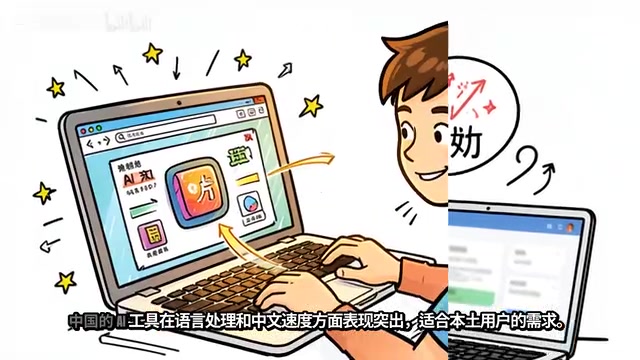
Simply put, Chinese AI tools (like Kimi and DeepSeek) excel at Chinese language processing and response speed, making them a better fit for local users' habits. American AI tools (like ChatGPT) are stronger at complex reasoning and code generation, making them especially well-suited for developer use cases. This isn't a matter of one being better than the other — it's about each making deliberate trade-offs for different audiences.
What Today's Free AI Tools Can Actually Do
Content Creation and Everyday Office Work
ChatGPT remains the benchmark for content generation — whether it's copywriting, brainstorming, or rewriting long-form text, it consistently delivers high-quality output. For tasks centered around English content and logical reasoning, it tends to come out ahead.
Kimi, on the other hand, shines in Chinese-language contexts. Beyond content generation, it's frequently praised for scheduling assistance and understanding long documents. For everyday office work and document management primarily in Chinese, Kimi offers a more natural, localized experience.
Reasoning and Programming Tasks
When tasks involve rigorous logical reasoning or writing code, the technical depth of American tools becomes more apparent. Developer feedback consistently highlights ChatGPT's accuracy in code completion, debugging suggestions, and algorithm explanations — a key reason it remains popular in technical communities.
DeepSeek, as a leading Chinese-developed model, is rapidly closing the gap in reasoning capabilities while maintaining strong Chinese language support, making it a compelling alternative for many users in China.
DeepSeek's growing reputation in reasoning tasks is closely tied to its technical architecture. DeepSeek uses a Mixture of Experts (MoE) design, which activates only a subset of parameters during inference — balancing computational efficiency with model capability. The DeepSeek-R1 series, released in late 2024, was specifically trained with enhanced focus on mathematical reasoning and code generation. It approaches or matches GPT-4-level performance on several standard benchmarks (such as MATH and HumanEval), while reportedly being trained at a fraction of the cost of comparable American models. This makes DeepSeek a practical option for users in China who need solid reasoning accuracy without relying entirely on foreign services.
How to Choose Based on Your Needs
The key to picking the right tool isn't about which country's AI is superior — it's about your specific use case:
- Chinese content creation and office collaboration: Start with local tools like Kimi for more natural language handling and faster responses.
- Complex reasoning and software development: American tools like ChatGPT are more reliable for technical tasks.
- Balancing localization and reasoning: DeepSeek offers a middle ground — strong in Chinese while delivering solid reasoning performance.
For most everyday users, rather than committing to a single tool, the better approach is to mix and match based on the task — use Chinese tools for Chinese-language office work and American tools for technical challenges. This combination often delivers the best overall experience.
The Road Ahead: Convergence, Not Competition
One forward-looking observation is worth noting: the future direction of Chinese and American AI tools may be one of mutual learning rather than divergence. Chinese tools' strengths in localization and user-friendliness, and American tools' strengths in technical innovation, are drawing closer together. Models with improved language capabilities on the American side, and stronger reasoning on the Chinese side, will together push the industry toward more comprehensive, all-around solutions.
For users, this means more choices ahead and a narrowing capability gap between tools. Rather than betting on one camp, the smarter move is to stay open to new tools, keep experimenting, and continuously adjust your toolkit based on real-world results.
Underpinning the convergence of Chinese and American AI capabilities is an important technical force: the accelerating expansion of the open-source ecosystem. Meta's LLaMA model series, DeepSeek's partially open-source releases, and European players like Mistral have ensured that cutting-edge model capabilities are no longer locked behind a handful of closed-source vendors. Chinese teams can fine-tune open-source base models for Chinese-language data and local use cases, while American tools are rapidly improving localization and multilingual support. The result of this two-way cross-pollination is a fast convergence in global AI model capabilities — the performance gap users feel between different tools is shrinking at a visible pace.
Final Thoughts
Chinese and American AI tools each have their strengths. Understanding where they're positioned helps you make smarter choices. Free tools are already capable of handling the vast majority of everyday needs — the real difference-maker is whether you're using the right tool for the right task. The best approach is to start with your most frequent work tasks, try one or two tools hands-on, and gradually build out your personal AI toolkit from there.
Related articles

photocraft Open-Source Image Editor Hands-On Review: A Free Self-Hosted Alternative for Photo Editing
photocraft is an open-source image editor supporting self-hosting and privacy protection, with over 57K GitHub stars. This article shares hands-on experience, analyzing its performance, onboarding, and comparison with paid tools to help you decide if it's worth trying.

Keep Claude Code Running After You Close the Terminal: tmux and SSH Solutions
Claude Code stops when you close the terminal? Learn how to keep Agents running with tmux, deploy to non-sleeping remote machines via SSH, and resume with claude --resume and codex resume.

How AI Video Generators Help Businesses Scale Marketing Video Production
AI video generators are transforming how businesses produce marketing videos. This article analyzes why enterprises adopt AI video tools, typical use cases in e-commerce and social media, comparisons with traditional production, and key capabilities to consider when selecting tools, including image-to-video, creative styles, and efficient workflows.