How AI Video Generators Help Businesses Scale Marketing Video Production

AI video generation lets businesses rapidly batch-produce marketing videos from images and text, compressing creative testing from weeks to hours.
The article explains that traditional marketing video production is costly, slow, and dependent on film crews, struggling to meet growing content demands across social media, ads, and e-commerce. AI video tools produce videos from product images and text, accelerating use cases like e-commerce showcases, TikTok/Reels/Shorts, multi-version ad testing, product demos, and brand storytelling. It compares AI versus traditional production on cost, speed, and scalability, and highlights four selection criteria: visual quality, image-to-video capability, creative styles, and efficient workflows. Using Vidnix's four-step process, it stresses AI augments rather than replaces creativity, enabling rapid iteration and content scaling.
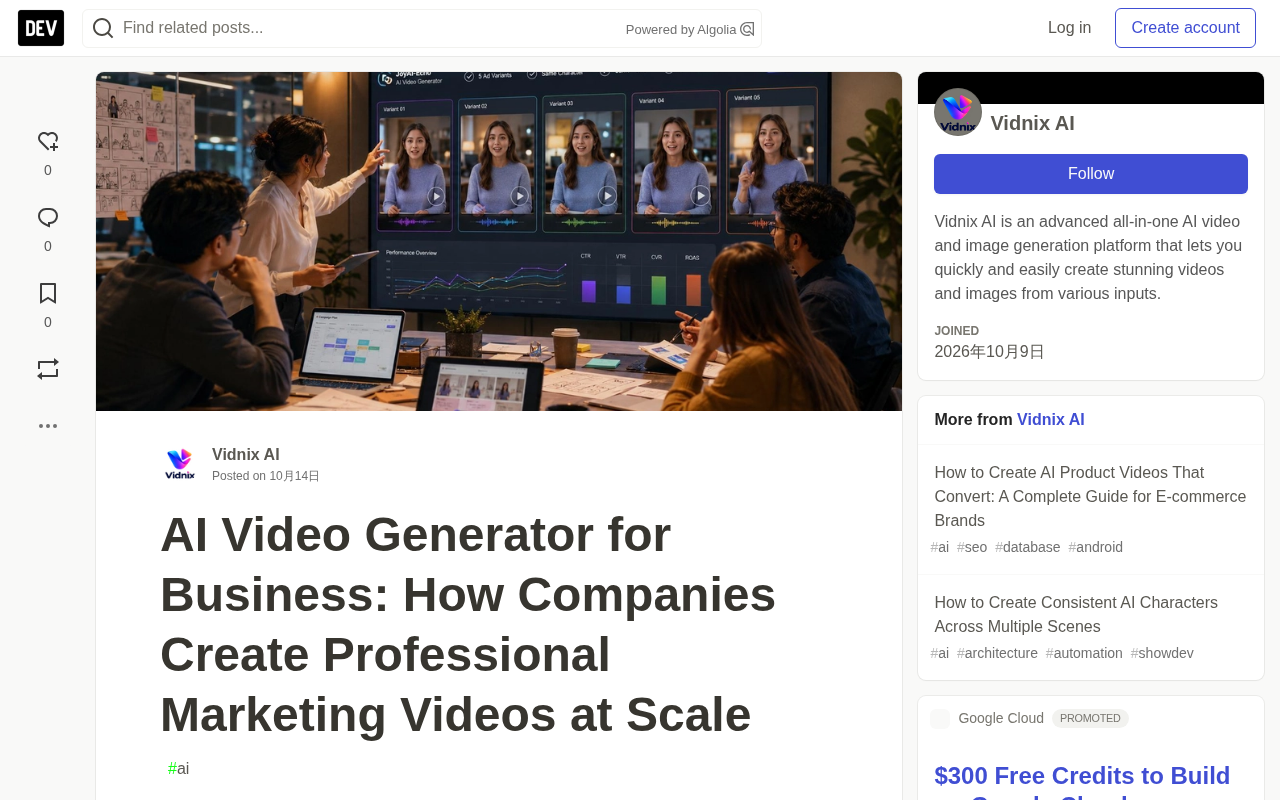
Marketing video production has long been plagued by high costs, long timelines, and heavy staffing requirements—hiring a camera crew, securing a location, shooting products, and post-production editing can easily take weeks from start to finish. AI video generation tools are changing this landscape, allowing marketing teams to rapidly produce multiple video concepts using product images and text descriptions, turning "shooting a video" into "batch-testing creative ideas."
Why Businesses Are Turning to AI Video Generation
Video has become foundational infrastructure for brands across websites, social media, ad placements, and product pages. Brands need video to cover social media campaigns, product ads, landing pages, online stores, customer education, and brand storytelling—but output consistently fails to keep pace.
Traditional video production involves videographers, editors, designers, actors or models, studio equipment, and post-production. For small and medium-sized businesses, the cost of producing multiple marketing videos quickly escalates. Meanwhile, modern marketing's demand for content volume continues to expand: a single product may need multiple ad versions, formats adapted for different social platforms, seasonal campaigns, customer-facing videos, and short-form content.
AI video generation compresses these barriers. According to source analysis, businesses no longer need a full production team to produce professional-looking videos, and the creative testing cycle has shrunk from "weeks" to "hours."
Where Businesses Use AI Video Generators
AI video tools aren't limited to a single industry—companies across different sectors are using them to transform their marketing workflows.
E-commerce Product Videos
For online stores, product videos can significantly improve customer understanding and engagement. Instead of showing only static product images, brands can generate product showcase videos, lifestyle scenes, demo videos, and promotional ads.
A typical example: a skincare brand can transform a product image into a premium ad-style video, placing the product in a refined environment. AI video generation lets e-commerce brands create more compelling product experiences without traditional shoots.
Social Media Marketing Videos
TikTok, Instagram Reels, and YouTube Shorts demand high-frequency posting. Marketing teams need to consistently produce short promotional videos, educational content, brand awareness videos, and trend-related content. AI video generators help businesses maintain a steady posting cadence while reducing production workload.
Batch Ad Creative Production
Ad performance largely depends on creative testing. Take a premium coffee machine as an example: businesses can use AI to generate multiple versions—a luxury kitchen lifestyle version, a morning routine narrative version, and a product feature demo version. Without investing in three separate productions, they can explore multiple creative directions with AI.
Product Demos and Brand Storytelling
Many customers want to understand how a product works before purchasing. AI-generated videos can help companies create content for product tutorials, feature explanations, and step-by-step demos—particularly valuable for SaaS products, tech companies, and online businesses.
For brand storytelling, AI video generators help marketing teams produce brand introduction videos, campaign narratives, and promotional visuals, translating concepts and scripts into compelling visual content faster.
AI Video Generation vs. Traditional Video Production
| Dimension | Traditional Video Production | AI Video Generation |
|---|---|---|
| Production cost | High | Lower |
| Production speed | Days to weeks | Much faster |
| Creative testing | Limited | Multiple versions can be generated |
| Resources required | Production team | Leaner marketing team |
| Content scaling | Difficult | Easier |
Traditional video production still has its value for large-scale commercial projects, but AI video generation offers a faster, more flexible option for everyday marketing content.
What to Look for When Choosing an AI Video Generator
Not all AI video tools are suited for professional marketing use. Businesses should focus on several key capabilities when selecting one.
Professional visual quality. Marketing videos represent brand image. AI video generators built for business should offer realistic motion, high-quality visuals, professional composition, and consistent scenes.
Image-to-video capability. Many businesses already have product photos, brand assets, and marketing images. Image-to-video technology lets companies transform existing assets into compelling video content.
Multiple creative styles. Different campaigns require different visual directions—cinematic ads, product showcases, social media content, creative storytelling. Flexible generation capabilities help teams cover different marketing objectives.
Efficient workflows. Marketing teams need efficiency. A practical AI video workflow should allow businesses to upload images or describe ideas, quickly generate videos, review results, create new versions, and optimize campaigns.
How Image-to-Video technology works. Image-to-video is one of the primary technical approaches in current AI video generation. Its core is enabling a model, given a static image and a text prompt, to predict and generate consecutive frames that match the description. Mainstream solutions typically rely on diffusion models: the model first learns from massive "image-video" paired data how objects move and how light and shadow change, then during generation starts from noise and progressively reconstructs a dynamic sequence consistent with the input image's style. Compared to pure text-to-video, image-to-video's value lies in its ability to lock in product appearance, brand colors, and composition, avoiding generated results that don't match the actual product—this is especially critical for e-commerce and advertising scenarios. Existing product images, packaging images, and model images can therefore be directly converted into video assets without re-shooting.
The role of prompt engineering in marketing videos. When using AI video tools, the descriptive text users input directly affects the style, camera feel, and context of the generated result. Marketing teams need to translate "the feeling they want" into specific visual instructions, such as the subject, environment (luxury kitchen/morning bedroom), camera movement (push in/orbit), lighting atmosphere (natural light/warm tones), and emotional tone. The more specific the prompt, the more likely the model will generate visuals matching the brand's tone. This is also why AI video hasn't completely replaced creatives: aesthetic judgment and requirement breakdown still depend on humans; the tool only automates the execution phase.
How to Create Marketing Videos with Vidnix
Vidnix helps businesses transform ideas and visual assets into AI-generated videos without complex editing workflows. A typical workflow has four steps:
Step 1: Start with an idea or product image. Businesses can provide a text description, product image, or creative concept.
Step 2: Generate AI video scenes. Vidnix uses AI-driven generation capabilities to transform concepts into dynamic video content.
Step 3: Create multiple marketing versions. Companies can experiment with different visual styles, story concepts, and product presentation approaches.
Step 4: Deploy videos across marketing channels. Generated videos can support social media campaigns, product pages, ad creatives, and brand marketing.
The Future of AI Video Production for Businesses
AI video generation is becoming part of modern marketing workflows. Future enterprise teams will increasingly use AI to produce more content with smaller teams, personalize marketing videos, create ads faster, and test creative ideas efficiently.
AI video generators don't replace creativity—they give businesses new tools to create, experiment, and scale marketing content.
Frequently Asked Questions
Can businesses use AI-generated videos for advertising? Yes. Businesses can use AI-generated videos for product ads, social media campaigns, promotional content, and marketing activities.
Is AI video production cheaper than traditional production? In many marketing scenarios, AI video generation can reduce production costs by cutting expensive shooting and editing steps.
Which AI video generator should businesses choose? It depends on business needs. Focus on professional-grade output quality, image-to-video capability, flexible creative options, and efficient workflows.
Can AI generate product videos from images? Yes. Many AI video generators can transform product images into dynamic marketing videos.
Do you need editing experience to use an AI video generator? No. Modern AI video tools are designed to simplify video creation, enabling marketing teams without professional editing skills to produce content.
One-line Summary
AI video generation lets businesses rapidly batch-produce marketing videos from images and text, compressing creative testing from weeks to hours.
Paragraph Summary
The article points out that traditional marketing video production is costly, time-consuming, and dependent on camera and editing teams, making it difficult to meet the growing content demands of social media, ad placements, and e-commerce pages. AI video generation tools produce videos from product images and text descriptions, helping businesses accelerate across e-commerce product showcases, TikTok/Reels/Shorts short videos, multi-version ad creative testing, product demos, and brand storytelling. The article uses a comparison table to illustrate AI's advantages in cost, speed, creative testing, and scalability, and provides four dimensions for selection: professional visual quality, image-to-video capability, multiple creative styles, and efficient workflows. Finally, using Vidnix's four-step process as an example, it emphasizes that AI doesn't replace creativity but enables marketing teams to iterate quickly and scale content.
Related articles

Workbuddy for Absolute Beginners: How a Desktop AI Agent Fits Into Real Workflows
A beginner's guide to the Workbuddy desktop AI agent: installation, claiming credits, file management, and building automated workflows—compared with CodeX for fit and cost, helping professionals shift from AI question-askers to AI managers.

OpenAI's New Agent Stack: Computer Use, Decisions API, and Ultra-Fast Workflows
OpenAI Dev Day unveiled a new agent stack: Computer Use outperforms humans, Decisions API delivers ultra-low-latency classification via Luna, Agents API opens the same Computer Use capabilities, and GPT-6.1 Sol costs only one-seventh of Astra. Core updates, benchmark data, and developer insights.

Liang Wenfeng Open-Sources DeepInfo Inference Framework, Takes On U.S. Ban
DeepSeek open-sources its DeepInfo inference framework after its models, featuring GPU/CPU cross-pipelining, small-model prediction with large-model verification, and full Huawei Ascend and NVIDIA chip support—facing the U.S. federal ban head-on. This article analyzes its significance for AI deployment and open-source strategy.