Chunk: A macOS Time-Blocking App That Unifies Tasks and Calendar

A local-first, no-subscription Mac time-blocking app that unifies tasks, calendar, and Claude AI planning.
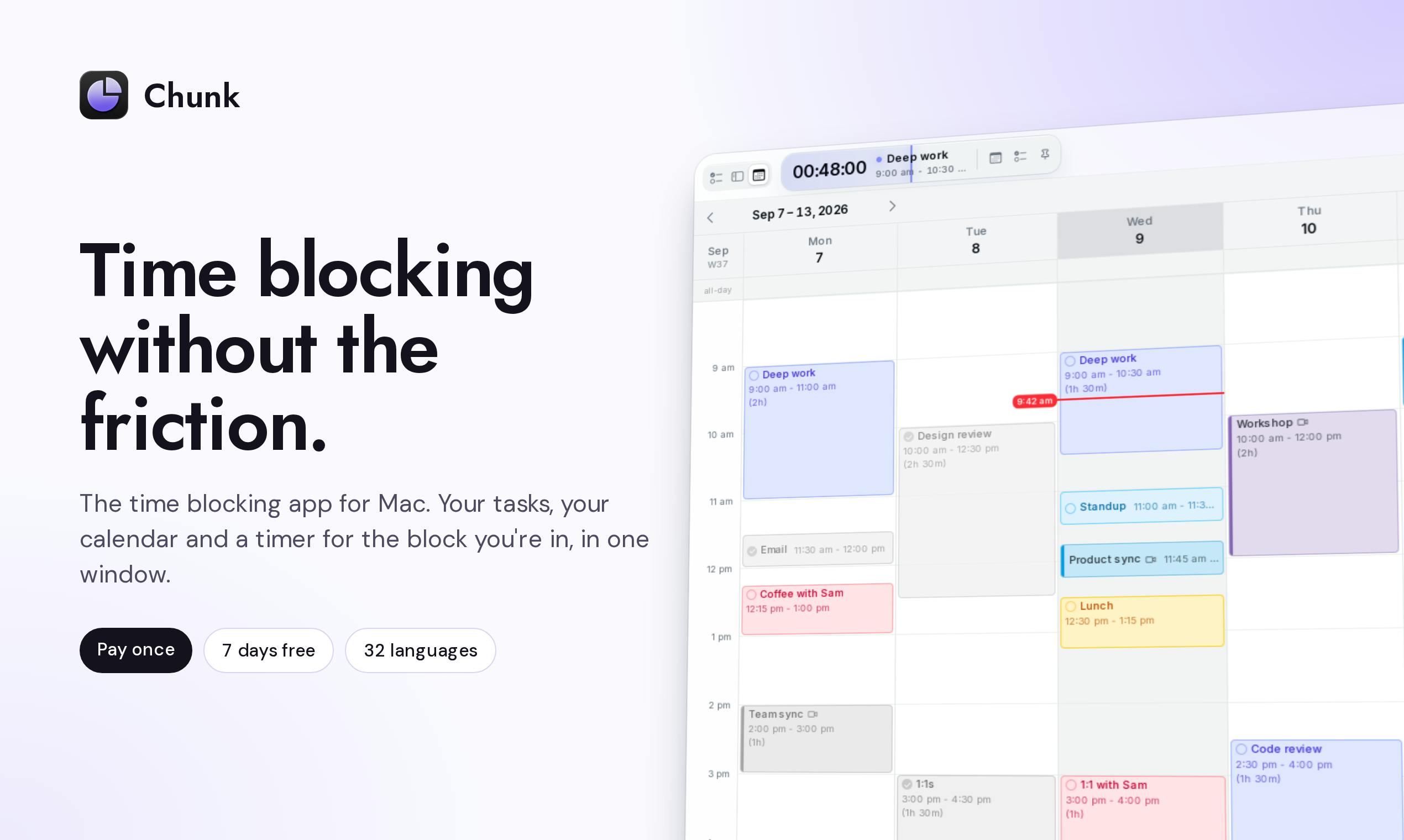
Chunk is a time-blocking tool for macOS that brings tasks and calendar together in one interface — drag any to-do onto your timeline and it becomes a time block with a countdown. It offers two-way sync with Google Calendar, Outlook, and Apple Calendar, plus Apple Reminders integration. All data stays on your Mac and syncs via your own iCloud account, not the developer's servers. Claude AI can help plan your week, and you can save favorite schedules as reusable templates. With no subscription and a 7-day free trial requiring no credit card, it's designed for privacy-conscious Apple users who believe in time-blocking.
A Native Mac App Built Around Time-Blocking
Chunk is a time-blocking app for macOS with a straightforward premise: bring your tasks and calendar together in one place. It debuted on Product Hunt at #10, earning 73 upvotes and 3 comments, and is categorized under Mac, Productivity, and Calendar tools.
Time-blocking is a well-validated time management method — rather than maintaining an endless to-do list, you schedule specific tasks into defined calendar slots, forcing yourself to actually allocate time for each one. Chunk turns this methodology into a direct, tactile interaction: drag a task onto your daily timeline and it becomes a time block, complete with a countdown showing how much time remains.
The time-blocking method was systematically articulated and popularized by productivity researcher Cal Newport in his book Deep Work. The core argument is that each workday should be divided into dedicated blocks, with each block devoted to a single task. Newport and others argue that the problem with traditional to-do lists is that they tell you what to do but never force you to answer when you'll do it or how long it will take — leaving tasks perpetually unresolved in your mind. Anchoring tasks to specific time slots simulates the pressure of an external deadline and forces you, at the planning stage, to confront whether you actually have enough time. That's a constraint pure list management simply can't provide. Chunk internalizes this cognitive framework directly into its product interaction design.
Two-Way Sync and Data Ownership
One of Chunk's most practical capabilities is two-way sync with mainstream calendar services. It supports Google Calendar, Outlook, and Apple Calendar, and can also pull tasks from Apple Reminders. That means you don't have to manually shuttle to-dos between multiple apps — system-level information gets consolidated onto Chunk's timeline automatically.
Also worth noting is its data philosophy. Chunk emphasizes that "your data stays on your Mac," syncing across devices through your own iCloud account rather than uploading anything to the developer's servers. For users who are increasingly concerned about privacy and data ownership, this local-first design is a clear differentiator — and it sidesteps the risks of data leakage or vendor lock-in that come with third-party cloud services.
Local-First is an architectural philosophy that has gained traction in software design in recent years, formally articulated by the Ink & Switch research team in their 2019 paper of the same name. Its core principle: user data lives primarily on local devices, with the cloud serving as a sync medium rather than the sole authoritative source. This stands in contrast to the traditional SaaS model, where data lives on servers and the client is merely a terminal. The practical benefits of local-first architecture include offline availability, faster response times, data accessibility even if the developer shuts down, and reduced single-point data breach risk. Chunk leverages iCloud for cross-device sync, effectively using Apple's infrastructure as the sync layer rather than running a centralized server — consistent with local-first principles. It also anchors the credibility of its privacy promises to Apple's infrastructure reputation, rather than relying on the developer's own security capabilities.
AI Planning and Template-Based Workflows
Chunk introduces AI-assisted planning: users can ask Claude to help schedule an entire week. This is a natural use case for combining time-blocking apps with large language models — offloading the weighing and prioritization involved in "how should I allocate my week" to AI for a first draft, which the user then refines.
Beyond AI planning, Chunk also supports templates. If you're happy with how a particular day is structured, you can save it as a template and reuse it with one click. For people with relatively consistent work rhythms and recurring weekly tasks, templates can significantly reduce the mental overhead of rebuilding a schedule from scratch every day.
Chunk chose to integrate Anthropic's Claude rather than the more widely known ChatGPT. Claude tends to perform well on long-context understanding and following complex structured instructions — well-suited for tasks like "given my task list and constraints, generate a structured weekly plan" that require multi-step reasoning. The key value of bringing AI planning into a time-blocking tool is reducing the cognitive burden of planning the planning itself. Many people procrastinate on scheduling not out of laziness, but because facing a task list with unclear priorities triggers decision paralysis. An AI-generated draft that you can critique and revise effectively breaks that deadlock. That said, the quality of AI planning depends heavily on how clearly the user describes their tasks and how well the model understands personal energy patterns — active user refinement is still necessary.
Pricing: No Subscription, One-Time Model
At a time when SaaS products almost universally default to subscriptions, Chunk opts for a no-subscription model with a 7-day free trial and no credit card required. This pricing approach is appealing to users burned out on subscription fatigue — especially in the productivity tools space, where many people simply don't want to pay a monthly fee for a calendar app indefinitely.
That said, the available information doesn't disclose the specific purchase price or licensing terms after the trial period ends — something potential users will want to confirm before committing.
Quick Take: Who Is Chunk For?
Chunk has a sharp focus: it serves Mac users who are deeply embedded in the Apple ecosystem, value privacy, and buy into the time-blocking methodology. Two-way calendar sync, Apple Reminders integration, local iCloud sync, and Claude-powered planning together form a fairly complete functional loop.
From a product standpoint, its differentiation isn't about being "yet another calendar app" — it comes from a combination of three things: local-first data handling, a no-subscription business model, and a lightweight drag-to-block interaction. For users accustomed to tools like Fantastical or Akiflow but wary of subscription costs or cloud storage, Chunk is worth trying. It's still in early stages (only 3 reviews so far), and its feature maturity and long-term maintenance track record will take time to establish.
Related articles

Chain of Thought Isn't Just for AI: How Humans Can Use CoT to Improve Thinking Quality
Chain of Thought isn't just a prompt trick for large models. Starting from a Hacker News discussion, this article analyzes why CoT works for human thinking too, breaks down actionable ways to transfer it, and highlights the key differences between human CoT and machine CoT.
Cloudflare Teams Up with OpenAI: Closi…
Cloudflare Teams Up with OpenAI: Closing the Loop from Vulnerability Discovery to Defense with AI
Cloudflare uses OpenAI Daybreak to investigate security vulnerabilities and generate reviewable remediation plans, while developers use Codex to boost coding efficiency and quality.

Orca Multi-Agent Orchestration in Practice: A Guide to Parallel Collaboration with Claude and Codex
Orca is Stable AI's free open-source agent workbench supporting 34 agents like Claude Code and Codex in parallel. Learn its Git worktree isolation, multi-model orchestration, and mobile management.