Chunking Is the Product, the Model Is Just the Engine

RAG's bottleneck is chunking strategy, not the embedding model—structure-aware splitting and pipeline ownership are the keys to quality.
The article argues that RAG systems fail in production not because the embedding model is weak, but because the chunker cuts sentences in the wrong places. Structure-aware chunking respects the document's logical boundaries—headings, clauses, tables—avoiding table fragmentation, footnote poisoning, and lost cross-references. Metadata boosts retrieval more than a reranker. Evaluation should use adversarial questions, and when recall@5 fails, go fix your scissors—not the model.
Your RAG demo worked on ten clean PDFs. Then legal uploaded a 400-page policy document full of footnotes, appendices, and cross-references, and the chunker turned it into mush. The model didn't fail—your scissors did.
Chunking is where domain knowledge enters the RAG system. Structure-aware segmentation (headings, clauses, tables), overlap tuned for citation needs, metadata that survives retrieval—these are the product itself. You can swap embedding models all day long, but if the chunker cuts a sentence in the middle of Section 4.2, the user gets confident nonsense.
For many enterprise documents, 512-1024 tokens is a common sweet spot. But tables and policy documents often require structure awareness, not fixed size. Add metadata (document ID, section path, effective date) and retrieval quality improves more than adding another reranker.
This article is based on community analysis from ayraix.com.
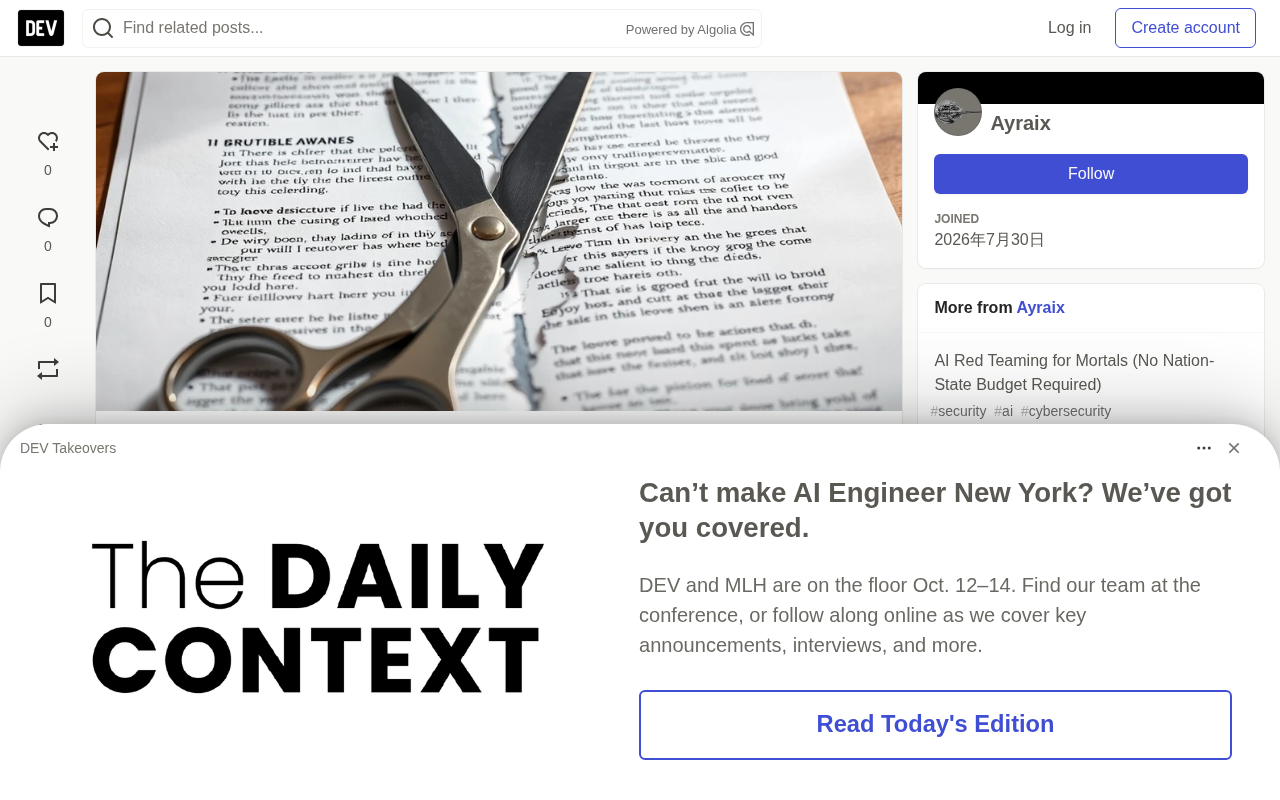
Chunk Like a Librarian, Not a Shredder
Respect document structure. Keep tables intact, or explicitly generate summaries for them. Propagate headings into chunk headers so the embedding carries context. Test retrieval with real questions—not "what does this document say," but "based on policy, can we reimburse client dinners in Q3?"
The difference between fixed-size chunking and structure-aware chunking is this: what the model sees depends entirely on what your pipeline feeds it.
Chunking Quality Checklist
Can a human answer the question from this chunk alone? If not, neither can the model.
- Semantic boundaries—headings, numbered clauses, API endpoint blocks
- Purposeful overlap—bridging context, not duplicating entire sections
- Version tags—stale chunks are worse than no chunks
- Human spot-checks—sample 50 chunks before trusting the index
RAG is a publishing problem wearing an AI coat. Editorial discipline beats bigger embedding vectors.
| Comparison | Fixed Token | Structure-Aware |
|---|---|---|
| Policy documents | Cut mid-clause | Clauses intact |
| Tables | Fragmented | Preserved or summarized |
| Citations | Vague | Linked to sections |
What is structure-aware chunking? Structure-aware chunking means that when splitting a document, you prioritize identifying and respecting the document's own logical boundaries—heading hierarchy, numbered clauses, table borders, list items, code blocks—rather than simply cutting by a fixed character or token count. Compared to fixed-size chunking, its core assumption is: the document author has already marked semantic units with structure, and those markers are more reliable than any statistical split.
In practice, structure-aware chunking usually works in two steps: first use a parser (such as a layout-aware parser for PDFs or a DOM parser for HTML) to extract a hierarchical document tree, then decide merge-or-split strategy by node type. For example, a clause can be a single chunk in its entirety, but if it exceeds the token limit, prefer splitting at sub-clause boundaries rather than mid-sentence.
The cost is increased pipeline complexity: you need to maintain parsing rules for each document type, and when the document format changes, the parser must be updated in sync. But for corpora like policies, contracts, and API docs where structure itself carries semantics, this investment is almost always worth it—because the ceiling on retrieval quality is set by chunk boundaries, not by the embedding model.
The Table, Appendix, and Footnote Trap
Legal and financial documents are chunked differently than blog posts. A table split across two embedding vectors is worse than no table at all—the model will fabricate relationships between isolated rows. An appendix cited from page 200 needs parent metadata, not isolated fragments. Footnotes that redefine terms mid-document, if treated as body text, poison retrieval.
The key is this: invest in a parser that understands your document type—contracts, policies, API references, SAP configuration guides—rather than a generic splitter. Parser quality is chunk quality.
- Table strategy—keep intact, or generate natural language summaries for each table
- Cross-references—store "see Section 4.2" as links in metadata, not isolated text
- Effective dates—version your chunks; retrieval must filter superseded policies
- Language tags—multilingual corpora need chunk-level locale, not document-level guessing
Your chunker is the editor. A bad editor makes a PhD-level model look like an intern.
Why do split tables make the model "fabricate relationships"? An embedding vector is essentially a semantic aggregate: when a piece of text is encoded as a vector, the model learns the co-occurrence and modification relationships between entities within it. Every row of a complete table carries the semantic roles defined by column headers (such as "amount," "applicable conditions," "effective date"), and this role information is bound together in vector space.
Once a table is cut by token, the second chunk may be left with just a string of isolated numbers and phrases, stripped of the meaning the column headers conferred. When the model retrieves this block, it can only guess at the relationships between these numbers based on surface-level words—so it misreads "adjacent rows" as "causal relationships" or "the same entity," generating plausible but wrong conclusions.
Similarly, when footnotes are treated as body text, they poison retrieval by "redefining terms": the model cannot distinguish between "in this document X means A" and "in some footnote X means B," and ultimately gives contradictory answers. There are two directions for a solution: keep tables intact and attach natural language summaries; or store footnotes as metadata of the parent chunk, injecting context on demand during retrieval rather than letting them stand as independent chunks.
Evaluation Questions That Actually Cut Deep
Stop using "summarize this document." Use adversarial retrieval questions: contradictory clauses, exceptions buried in appendices, numbers that appear only in tables. If recall@5 fails on these questions, no reranker can save you—go fix your scissors.
What this means for you: before indexing ten thousand documents, manually sample fifty chunks. If a human can't answer the question from a single chunk, rewrite the split logic. Run chunk versioning in CI when parsers change—re-embedding is expensive; catching bad splits early is cheap.
Chunk Audit Prompt
"Which section does this chunk come from, and what question can it answer?"—if you can't tell, neither can the model.
Why is recall@5 a key indicator of chunk quality? recall@5 measures whether the top 5 chunks returned by retrieval include the "golden chunk" that can answer the question. It directly reflects whether chunk boundaries are correct—if the sentence needed to answer is cut into another chunk, recall@5 will fail no matter how strong the embedding model is.
Unlike precision, recall focuses on "did we find it," which is precisely the bottleneck of RAG's first stage: the generative model can only answer based on what was retrieved, and it can never recover facts that retrieval missed. A reranker can only re-rank within the already-recalled candidate set; it cannot pull a correct answer back that never entered the top K.
Therefore, when recall@5 on adversarial questions is low, the correct action is to go back to the chunking strategy: check whether the section containing the golden answer was split, whether tables were fragmented, whether cross-references were lost. Only after recall@5 meets the bar does optimizing the embedding model or reranker become a meaningful investment.
Pipeline Ownership
Assign a named owner for the ingestion pipeline—not "the AI team." When legal updates a policy PDF, who re-chunks and re-embeds? If no one is responsible, your index will quietly rot while the chat model gets upgraded every quarter.
What this means for you: monitor index age by document source. Alert when critical corpora exceed the SLA without re-indexing. RAG quality decays silently; dashboards should scream before users do.
Multilingual Chunking
Mixed-language corpora need chunk-level language detection—not document-level guessing. Embed with a language-appropriate model or a unified multilingual encoder, and test your abbreviations in every locale you operate in.
What this means for you: evaluate retrieval separately by language. A chunker that works in English and fails in German will quietly kill a global rollout.
Fix chunking before fixing the chat model—the narrator can't recover facts that retrieval never found.
What this means for you: when RAG is mission-critical to production, give the chunking pipeline its own on-call rotation.
Fix the Scissors Before Blaming the Model
The 400-page policy document broke not because the embedding model was weak—but because the chunker cut a sentence in the middle of Section 4.2 and handed the model confident nonsense. What this means for you: before trusting an index of ten thousand documents, manually sample fifty chunks. If a human can't answer the question from a single chunk, neither can the model, no matter what reranker you add.
The key is this: assign an owner to the ingestion pipeline the way you would to a production service. When a policy updates and no one re-chunks it, RAG quality decays silently—the chat model gets praised for its stability while the index quietly rots underneath.
Your chunker is the editor. A bad editor makes a PhD-level model look like an intern.
Chunk boundaries determine what your RAG system can retrieve. Separate a footnote from its table and the context breaks; keep them together and the embedding gets diluted.
The table-footnote trap: a legal document may require trying 20+ chunking strategies before finding one that preserves cross-references without losing retrieval precision.
Your action: Take your five worst RAG failures in production—the queries that returned irrelevant chunks or missed critical context. For each one, trace the failure back to a chunking decision: was a boundary misplaced? Was the chunk too big or too small? Was cross-reference context lost? Document the patterns, then fix the chunking strategy for that document type. Repeat until the production failure rate drops below 5%.
One-line Summary
RAG's bottleneck is chunking strategy, not the embedding model—structure-aware splitting and pipeline ownership are the keys to quality.
Paragraph Summary
The article argues that RAG systems fail in production not because the embedding model is weak, but because the chunker cuts sentences in the wrong places. Structure-aware chunking respects the document's logical boundaries—headings, clauses, tables—avoiding table fragmentation, footnote poisoning of retrieval, and lost cross-references. Metadata (document ID, section path, effective date) can improve retrieval quality more than a reranker. Evaluation should use adversarial retrieval questions, and when recall@5 fails, no reranker can fix it. The ingestion pipeline needs a named owner, version control, and chunk version management in CI, or the index will silently rot when policies are updated. Multilingual corpora also require chunk-level language detection and per-language evaluation. The core action: sample 50 chunks and review them manually, trace production failures to specific chunking decisions, and fix the scissors—not the model.
Related articles

Chain of Thought Isn't Just for AI: How Humans Can Use CoT to Improve Thinking Quality
Chain of Thought isn't just a prompt trick for large models. Starting from a Hacker News discussion, this article analyzes why CoT works for human thinking too, breaks down actionable ways to transfer it, and highlights the key differences between human CoT and machine CoT.
Cloudflare Teams Up with OpenAI: Closi…
Cloudflare Teams Up with OpenAI: Closing the Loop from Vulnerability Discovery to Defense with AI
Cloudflare uses OpenAI Daybreak to investigate security vulnerabilities and generate reviewable remediation plans, while developers use Codex to boost coding efficiency and quality.

Orca Multi-Agent Orchestration in Practice: A Guide to Parallel Collaboration with Claude and Codex
Orca is Stable AI's free open-source agent workbench supporting 34 agents like Claude Code and Codex in parallel. Learn its Git worktree isolation, multi-model orchestration, and mobile management.