Cindy: An Out-of-the-Box Open-Source AI Agent Gaining 471 Stars in a Single Day

TypeScript open-source AI Agent project Cindy focuses on being out of the box, gaining 471 stars in a single day.
This article introduces makecindy/cindy, a rapidly rising open-source AI Agent project on GitHub. Written in TypeScript, it focuses on being out of the box—developers can run an agent with real task-processing capabilities after cloning the repository, without building scheduling logic from scratch or spending days integrating tools. The project gained 471 Stars in a single day, reaching 3,733 total with 559 Forks. The article argues that this popularity reflects developers' strong desire for ready-to-use tools and addresses the pain point of high startup costs in Agent implementation; the TypeScript choice makes it easy for web developers to get started, and the Fork data indicates the community has begun secondary development. However, public information is limited, and details such as tool invocation, multi-Agent collaboration, and long-term memory remain unclear—whether it can grow from a star project into a production-grade tool remains to be verified.
Out of the Box, Cindy Redefines the AI Agent Startup Experience
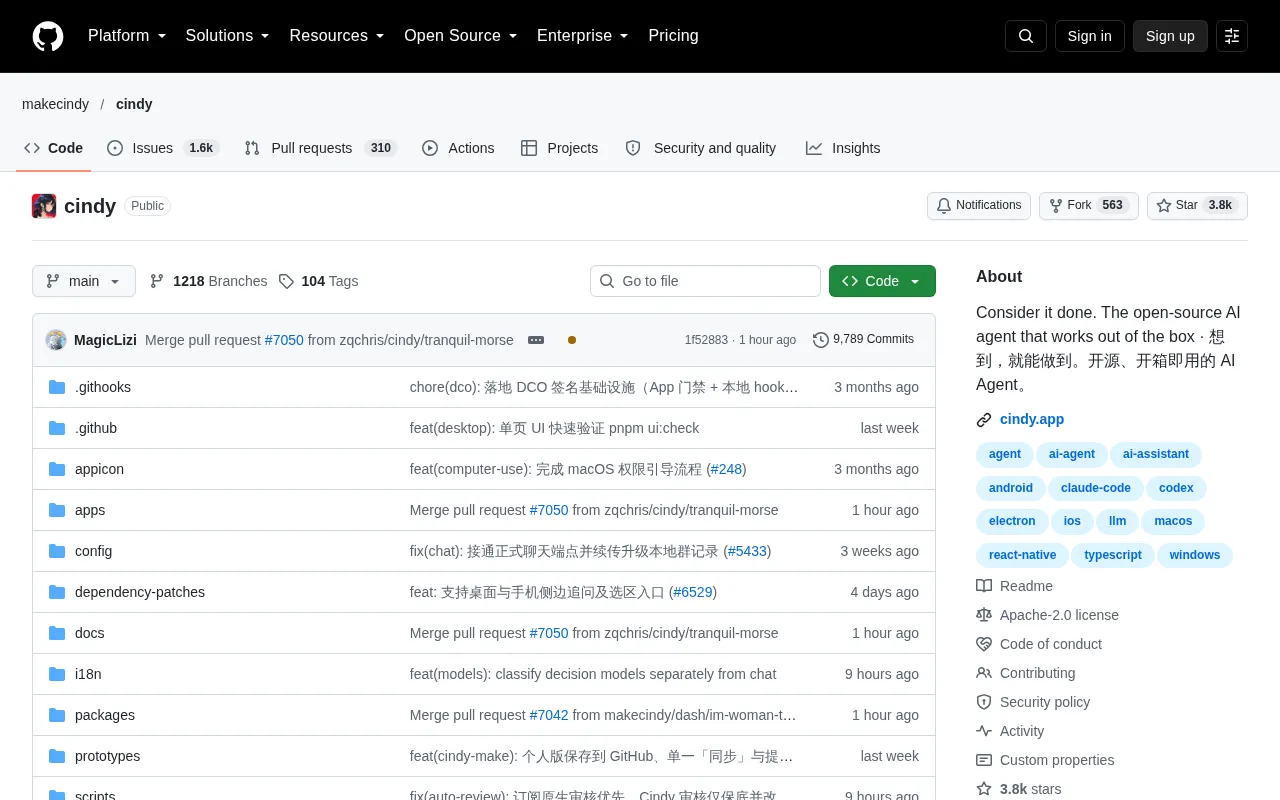
On GitHub, a new project is attracting developer attention at an astonishing pace: makecindy/cindy, an open-source AI Agent written in TypeScript, gained 471 Stars today, bringing its total Star count to 3,733 with 559 Forks. Its slogan is concise and powerful—"Consider it done."
Unlike many Agent frameworks that require complex configuration and local environment setup, Cindy focuses on being "out of the box." This means developers don't need to write scheduling logic from scratch or spend days integrating tools—after cloning the repository, they can quickly run an intelligent agent with real task-processing capabilities. This low-barrier feature hits a major pain point in the current AI Agent implementation process: plenty of ideas, but startup costs are too high.
Why Is "Out of the Box" So Rare in the Agent Space?
Over the past year, AI Agent frameworks have emerged endlessly, but most projects remain at the stage of being "demo-friendly but complex in production." Developers often need to integrate LLM APIs themselves, configure toolchains, design memory mechanisms, and even rewrite the core loop. Cindy's emergence attempts to standardize and productize this process.
From a technology selection perspective, the choice of TypeScript is no accident. It ensures type safety while naturally fitting the web development ecosystem, making it easy for frontend developers to get started quickly. Combined with the project's 559 Forks, it can be inferred that the community has already begun secondary development or customization based on Cindy—usually a strong signal that a project has real application value.
Typical Startup Costs of an AI Agent Framework
A complete AI Agent typically requires five major components: the LLM integration layer (API keys, model routing, streaming responses), the tool invocation layer (Function Calling or MCP protocol wrappers), memory mechanisms (short-term conversation context and long-term vector storage), task planning and scheduling loops (ReAct, Plan-and-Execute and other paradigms), and runtime observability (logging, tracing, retries). Most open-source frameworks only provide abstractions for one or two of these layers, forcing developers to assemble the rest themselves and handle version compatibility, error retries, Token billing, and other tedious issues. This is the root of the "half an hour to demo, two months to launch" phenomenon, and also why "out of the box" is so rare in the Agent space—it requires framework authors to make a large number of default decisions in advance and strike a balance between flexibility and usability.
TypeScript's Position in the Agent Ecosystem
Mainstream Agent frameworks (such as LangChain, AutoGen, CrewAI) mostly favor Python because Python holds advantages in model training, data processing, and the research community. But Agent deployment scenarios often lie on the web application side: chat interfaces, browser automation, SaaS integrations. TypeScript offers static type checking, a mature npm package ecosystem, and increasingly complete LLM toolchains such as Vercel AI SDK and LangChain.js, enabling frontend and full-stack developers to build Agents without switching tech stacks. Cindy's choice of TypeScript is essentially about capturing developer growth outside the Python ecosystem—a strategy highly consistent with its positioning of "lowering the startup barrier."
Signals Behind Community Popularity: What Kind of Agent Do Developers Need?
A single-day gain of 471 stars is an "explosive" performance on GitHub. Behind this data reflects developers' strong desire for "ready-to-use" tools. As LLM capabilities gradually homogenize, Agent competitiveness is shifting from "can it do it" to "is it easy to use." Cindy's positioning happens to capture this shift: it doesn't pursue the most complex architecture but focuses on lowering the usage barrier.
However, public information about the project is currently limited, and it's unclear which tool invocations it specifically supports, whether multi-Agent collaboration is built in, and how long-term memory is implemented. These details will determine whether Cindy can grow from a "star project" into a "production-grade tool."
How to Interpret GitHub Star Growth
Hundreds of Stars in a single day usually means the project has appeared on channels like GitHub Trending or Hacker News, representing a short-term exposure effect and not directly equivalent to code quality or production readiness. More valuable indicators include the ratio of Forks to Stars, Issue and PR activity, release version stability, and whether there is enterprise user endorsement. Cindy's Fork/Star ratio is about 15%, which is above average, indicating that a considerable portion of visitors aren't just "bookmarking" but intend to actually modify the code. However, judging whether an Agent project can move toward production-grade still requires observing its documentation completeness, test coverage, and version iteration pace.
Quick Start and Future Outlook
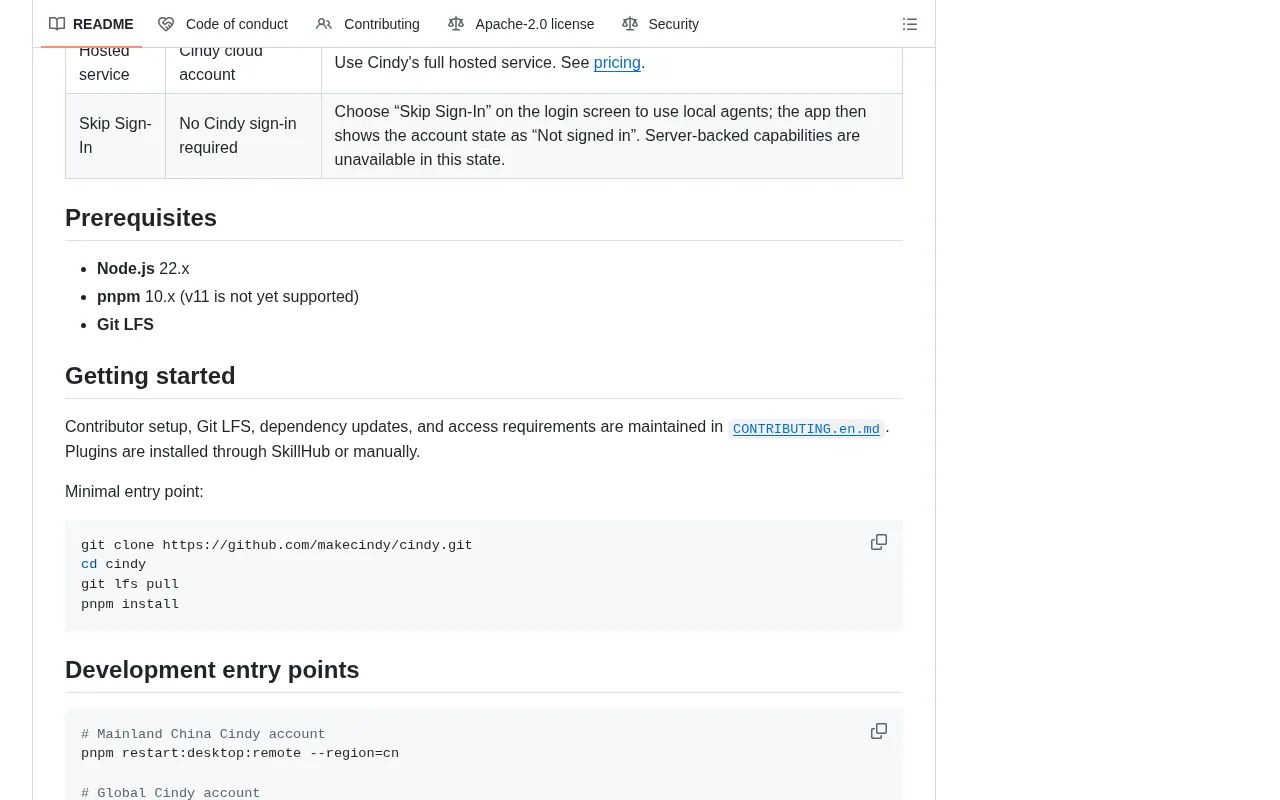
For developers who want to try it out, it's recommended to visit the GitHub repository directly to check the README and example code. TypeScript projects can usually be installed quickly via npm or yarn, and Cindy is expected to provide a similar standardized process.
As Agent competition enters its second half, usability and extensibility will become the dividing line. Cindy has already secured its entry ticket with "out of the box," and what it needs to prove next is: in real complex tasks, can it also truly deliver on "Consider it done"?
Related articles

The Touchscreen MacBook and Apple's Delightful Mess: A Deliberate Gamble
The Vergecast unpacks the touchscreen MacBook Pro's launch logic, the ProLed naming controversy, the iPad squeezed between iPhone and Mac, and how Apple stays competitive with premium hardware in the AI era.

Fifty Years Studying Power: Robert Caro's Writing and Insights on Power
Robert Caro reflects on 50 years studying power: Lyndon Johnson's persuasion and leverage, Robert Moses's transformation from idealist to ruthless builder, the dilemmas of large-scale construction, and his methods of compressing themes and solitary focus in biography writing.

Can a $20,000 Robot Do Your Chores? The Test Results Are Surprising
A YouTube test video shows how a $20,000 robot responds to commands like washing dishes, turning off lights, taking out trash, and feeding the dog. This article analyzes its real capability boundaries, the state of voice interaction technology, and how far household robots are from mainstream adoption.