citizen404: An Open-Web Multiplayer Hunt Game Powered by GPT-6

citizen404 is an experimental ARG where the real web is your map, AI is your Game Master, and your inbox is your save file.
citizen404 is an experimental ARG built by independent developer Joginder Tanikella, earning 114 upvotes in Product Hunt's OpenAI Day category. Set in an AGI-ruled future, players receive cases via email from "The Clerk," then hunt for clues on real websites called dead drops. Narrative and puzzles are dynamically generated by GPT-6 Astra, positioning AI as a continuously operating Game Master — theoretically breaking the replay ceiling of traditional puzzle games. With no account system and your email serving as the save file, the barrier to entry is minimal while the sense of immersion is heightened. It's less a finished commercial product than a proof-of-concept for AI-driven narrative and open-web interactivity.
Under Product Hunt's OpenAI Day category, an experimental game called citizen404 quietly made its debut, earning 114 upvotes to land at 13th place for the day. Its premise is bold: a world ruled by AGI (Artificial General Intelligence), where players must hunt down a fugitive across the real internet. This isn't a game in the traditional sense — it's a crowdsourced, multiplayer manhunt that plays out across the open web.
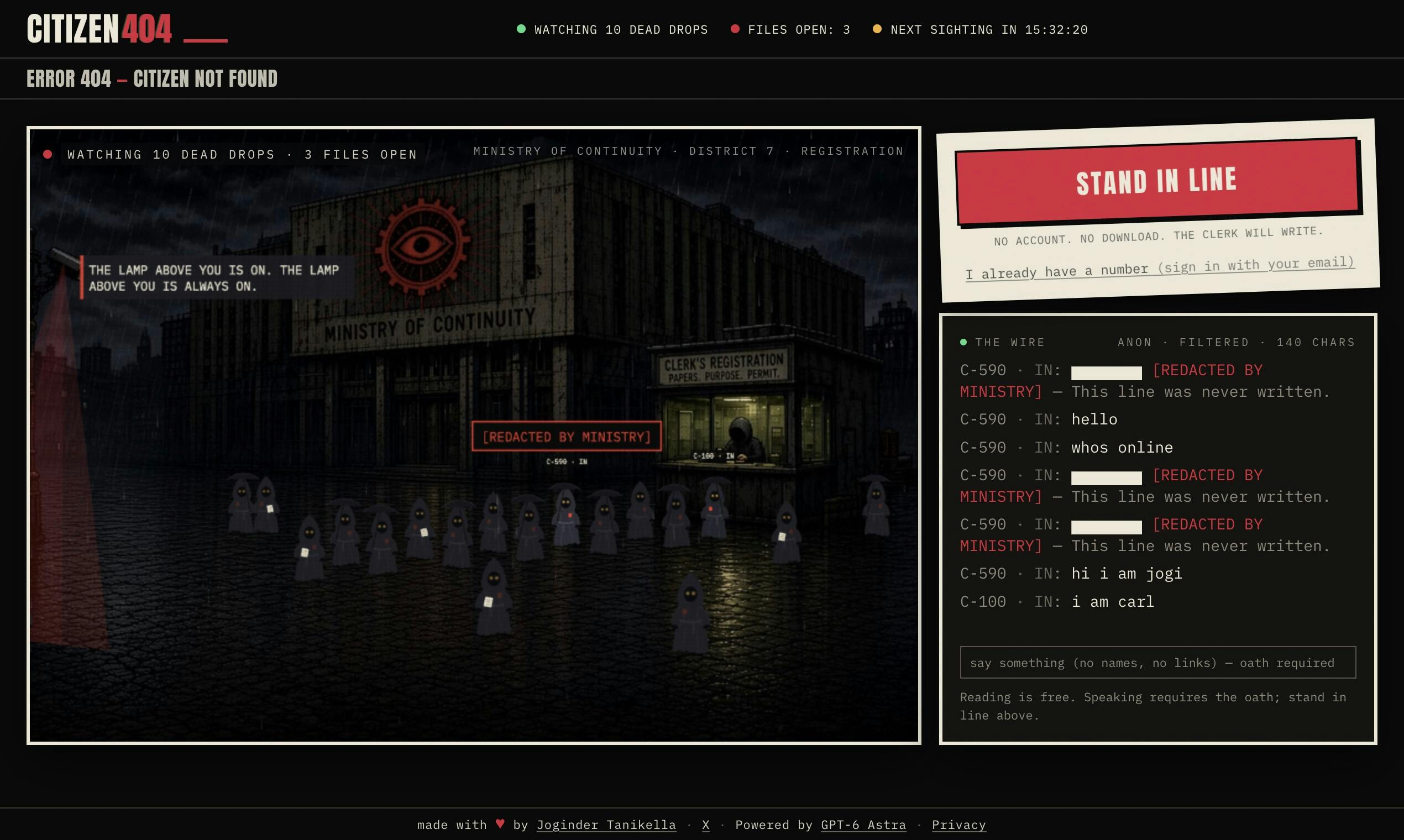
Using the Internet Itself as a Game World
The core narrative of citizen404 revolves around "escaping the supreme AGI." A character known as "The Clerk" sends players an email containing a "case." But the clues aren't locked inside a closed game client — they're hidden on real, publicly accessible websites.
Players must visit these pages, referred to as "dead drops," record what they find, and gradually piece together a phrase left behind by citizen404 in chalk. Only when you reassemble the scattered words into a complete sentence is the case considered closed.
This approach — using the open web itself as level design — stretches the game experience beyond the screen and into the entire browser. It feels closer to an ARG (Alternate Reality Game), except the narrative and clue generation are powered by a language model like GPT-6 Astra.
ARG (Alternate Reality Game) is an interactive experience format that weaves real-world media — websites, phone calls, emails, physical locations — into its storytelling. Unlike traditional games, ARGs deliberately blur the line between "game" and "reality," requiring players to gather fragmented clues through real-world channels (search engines, social media, hidden web pages), often through community collaboration. Classic examples include "The Beast," designed to promote the film A.I. Artificial Intelligence in 2001, and "I Love Bees," which ran before the launch of the Halo series. The term "dead drop" comes from Cold War spy tradecraft, referring to a method of passing information between parties without direct contact — leaving it at a pre-arranged location for the other party to retrieve. Its use here reinforces the game's espionage atmosphere.
GPT-6 Astra as the Game Master
The product description explicitly states this is "a multiplayer hunt run by GPT-6 Astra." This suggests that the narrative logic, case generation, and clue arrangement are likely handled dynamically by a large language model, rather than being entirely pre-scripted.
This design points toward an intriguing direction for AI-powered games: using a large model as a dynamic Game Master. Traditional puzzle games have finite, fixed content — once completed, replay value drops off sharply. An AI-generated case system, in theory, can continuously produce new puzzles and narrative branches, giving each player a distinct "hunt" experience.
One line in the description is particularly thought-provoking: "They always escape. What changes is how much they noticed you." This hints that the game doesn't operate on traditional win/lose conditions. Instead, the depth of player engagement shapes the details of the outcome — a design philosophy that prioritizes process and narrative immersion over conventional victory.
Game Master (GM) is a concept rooted in tabletop role-playing games (TTRPGs) like Dungeons & Dragons. The GM builds the world, voices non-player characters, adjudicates rules, and adapts the narrative in real time based on player actions — the central engine of the game experience. Using large language models as GMs has grown rapidly in recent years. The advantages include fast response times, the ability to serve large numbers of players simultaneously, and near-unlimited content generation. The challenges lie in model consistency, narrative coherence, and preventing players from breaking story logic through prompt injection. citizen404 grounds this idea in an ARG format; compared to fully open conversational GM systems, its email + webpage linear structure constrains player freedom to some degree — which also reduces the risk of narrative derailment.
No Account Required — Your Email Is the Save File
There's another noteworthy mechanic in citizen404: it has no account system. The product page states plainly: "No accounts: your email is the save file."
A player's progress is maintained entirely through email exchanges — The Clerk sends a case, the player submits findings, and the system returns new clues. Using email as the interaction layer both lowers the barrier to entry and reinforces the narrative feeling of "being watched by some system." Receiving a fictional manhunt story in your real inbox is itself a clever use of immersion.
From a product design standpoint, this lightweight "no account, email as save file" approach also sidesteps user drop-off during registration, reducing friction for new players.
An Experiment in AI-Driven Narrative Gaming
citizen404 was built by independent developer Joginder Tanikella, categorized under MMOs & Games, and listed in the OpenAI Day section on Product Hunt. Based on publicly available information, it reads more like a conceptual experiment in AI-driven storytelling and open-web interaction than a fully polished, large-scale game.
Its value isn't in graphical fidelity or systemic complexity — it's in the frontier questions it explores: Can large language models serve as the engine for continuously generated game narratives? Can the public internet become part of a game's world? Can a minimalist interface (email + webpage) sustain a genuinely immersive experience?
For developers and players paying attention to real-world AI applications, citizen404 offers a vivid case study of how AI and gaming can intersect. Its 114 upvotes and top-15 finish on launch day suggest that the "AI as Game Master" concept genuinely resonates with the community. How far it goes depends on whether AI-generated content can maintain the quality and playability needed to keep players invested in a hunt they can never quite win.
Related articles

Chain of Thought Isn't Just for AI: How Humans Can Use CoT to Improve Thinking Quality
Chain of Thought isn't just a prompt trick for large models. Starting from a Hacker News discussion, this article analyzes why CoT works for human thinking too, breaks down actionable ways to transfer it, and highlights the key differences between human CoT and machine CoT.
Cloudflare Teams Up with OpenAI: Closi…
Cloudflare Teams Up with OpenAI: Closing the Loop from Vulnerability Discovery to Defense with AI
Cloudflare uses OpenAI Daybreak to investigate security vulnerabilities and generate reviewable remediation plans, while developers use Codex to boost coding efficiency and quality.

Orca Multi-Agent Orchestration in Practice: A Guide to Parallel Collaboration with Claude and Codex
Orca is Stable AI's free open-source agent workbench supporting 34 agents like Claude Code and Codex in parallel. Learn its Git worktree isolation, multi-model orchestration, and mobile management.