Clamor: A New Marketing Tool That Turns Social Signals into Actionable Insights

Clamor is a marketing analytics tool that turns social signals into actionable insights, with login-free analysis and NL Q&A.
Clamor launches on Product Hunt as an action-oriented social analytics platform built by marketers for marketers. It helps users understand not just what happened in social data but why it matters and what to do next. Key upgrades include login-free analysis of public social accounts, Ask Clamor natural language Q&A, and a cleaner experience. An API enables integration into existing toolchains. Facing established competitors and emerging AI tools, Clamor remains early-stage and must balance usability with professional depth.
In an era of exploding social data, the challenge for marketers is no longer acquiring data—it's extracting truly valuable insights from it. Clamor, newly launched on Product Hunt, targets exactly this pain point, promising to transform messy social signals into actionable business decisions.
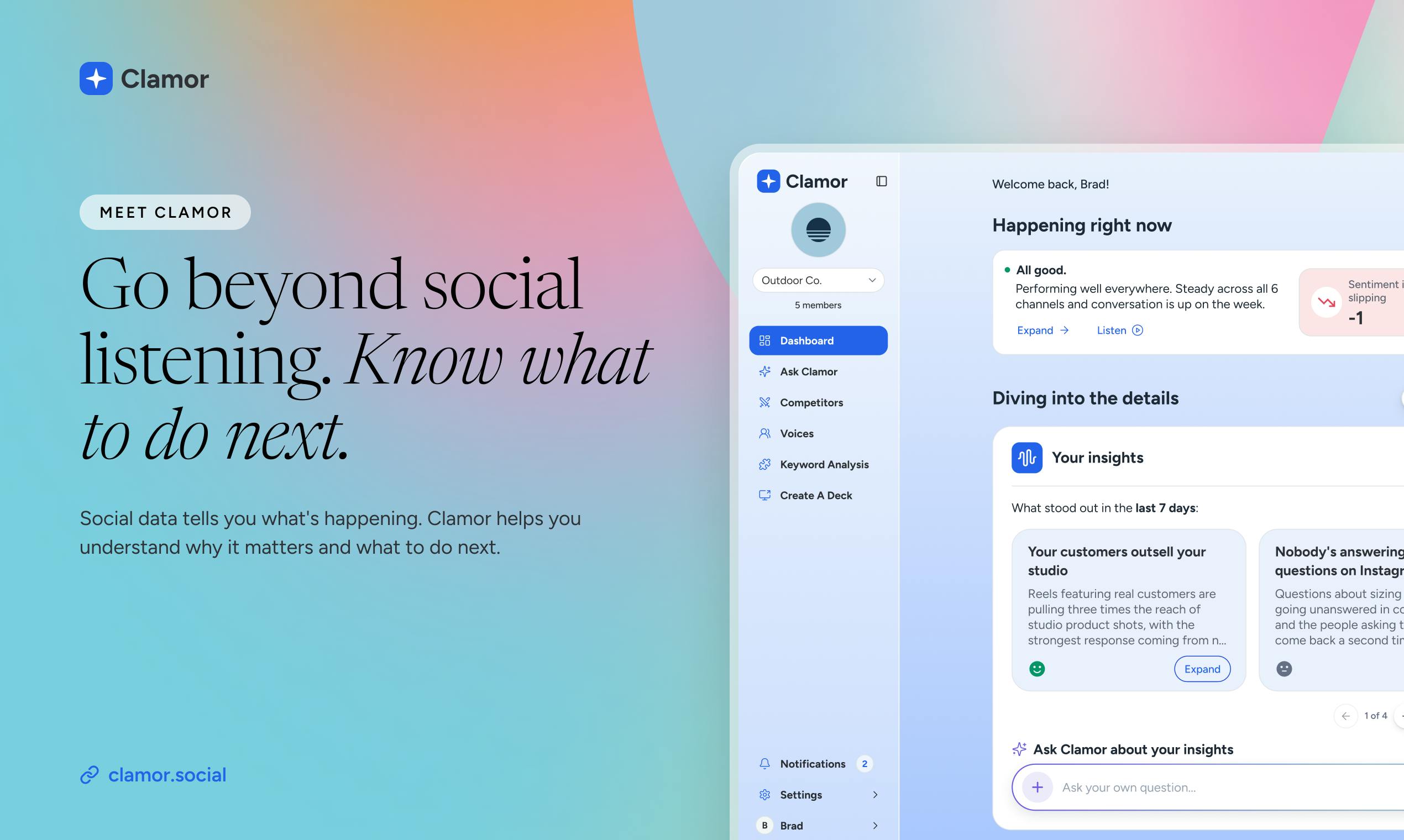
From Data Collection to Insight Generation: Clamor's Positioning
Clamor's core philosophy is clear: social data tells you what happened, while Clamor helps you understand why it matters and what to do next. Built by marketers for marketers, this tool aims to shorten the path from data to decision.
According to its Product Hunt page, Clamor's typical use cases include analyzing public social accounts, exploring insights, getting quick answers, and integrating into existing tools via API. It's not content with being just a data aggregator—it positions itself as an "action-oriented" analytics platform.
Social Listening refers to the technical practice of monitoring public discussions about brands, competitors, and industry keywords on social media platforms to understand audience sentiment, trends, and needs. Traditional tools like Brandwatch and Sprout Social typically offer dashboards for keyword tracking, sentiment analysis, and volume statistics, focusing on "monitoring and presentation." Clamor's emphasis on "actionable insights" goes a step further, attempting to translate raw social signals into concrete marketing action recommendations—a process that relies on natural language processing and generative AI technologies for semantic understanding of unstructured text.
Three Major Feature Upgrades: Faster Insight Acquisition
Clamor highlights several key improvements in this release:
- Analyze public social accounts without logging in: This lowers the barrier to entry, allowing marketers to quickly research competitors or industry accounts without cumbersome authorization processes.
- Ask Clamor intelligent Q&A: Users can explore insights by asking questions in natural language from anywhere, akin to having an analyst assistant for social data.
- A cleaner experience: The product has been redesigned with streamlined interaction flows aimed at helping users find answers faster and spend less time on data collection.
Additionally, Clamor offers an API that allows teams to integrate insights directly into their own toolchains, opening possibilities for scaled application.
Analyzing public social accounts without logging in is technically predicated on the accessibility of platform public data. Most social platforms (such as Twitter/X, Instagram, TikTok) impose strict restrictions on unauthorized access, typically requiring OAuth authorization or API keys. Clamor's claim of analysis without login may rely on public web scraping or limited public interfaces provided by platforms. While this approach lowers the barrier to use, it also faces risks including limited data completeness, platform anti-scraping measures, and compliance with privacy regulations such as GDPR—especially when analyzed subjects involve EU users.
Ask Clamor intelligent Q&A represents the application of Natural Language Query (NLQ) interfaces in analytics tools. Users ask questions in everyday language (e.g., "What were the hot discussion topics about sustainable beauty in the past week?"), and the system translates them into queries and summaries over social datasets. Such features are typically built on large language model (LLM) and retrieval-augmented generation (RAG) architectures: relevant fragments are first retrieved from structured or unstructured social data, then the model generates summarized answers. Its accuracy depends heavily on underlying data quality and retrieval strategies—also a key indicator for evaluating the professional depth of such tools.
Why Marketers Need "Actionable Insights"
Social listening tools are not scarce, but many products stop at dashboards and sentiment analysis. Clamor's differentiation lies in its emphasis on "what to do next." For example, when a spike in discussion volume on a topic is detected, Clamor not only presents the trend but may also suggest related accounts or content strategy recommendations through Ask Clamor.
This approach aligns with the current integration trend in marketing technology stacks: tools no longer exist in isolation but embed into CRMs, content management, or advertising platforms via APIs, allowing insights to directly trigger action.
Market Opportunities and Challenges
Clamor enters a highly competitive space, with established players like Brandwatch and Sprout Social as well as numerous emerging AI-driven analytics tools. Its advantage may lie in its lightweight experience and optimization for marketers' workflows. However, with only 70 upvotes and 3 comments on Product Hunt, it remains at an early stage and needs to prove the accuracy and depth of its insights.
For small and medium-sized marketing teams, the ability to analyze public accounts without login is quite attractive, but data privacy and platform compliance will be long-term challenges. Whether Clamor can find the balance between "ease of use" and "professional depth" will determine how far it can go.
Conclusion
Clamor represents an evolutionary direction for social analytics tools: from displaying data to driving decisions. Its API integration and natural language query features align with the trend of AI-empowered marketing. However, as a new product, its actual effectiveness remains to be validated by users. If you're looking for a more direct way to understand the meaning behind social signals, Clamor is worth watching.
One-line Summary
Clamor is a marketing analytics tool that turns social signals into actionable insights, featuring login-free analysis and natural language Q&A.
Paragraph Summary
Clamor launched on Product Hunt as an "action-oriented" social analytics platform built by marketers for marketers. Its core philosophy is not only to tell users what social data "happened" but to help understand "why it matters" and "what to do next." The new version introduces three major improvements: login-free analysis of public social accounts, lowering the barrier to use; Ask Clamor intelligent Q&A enabling users to explore insights through natural language; and a cleaner interaction experience for faster answers. Additionally, Clamor provides an API to integrate insights into existing toolchains. The product faces dual competition from established rivals like Brandwatch and Sprout Social as well as emerging AI tools; with only 70 upvotes and 3 comments on Product Hunt, it remains at an early stage and must find the balance between usability and professional depth.
Related articles

Michael Nielsen Takes Down His Classic Neural Network Textbook, Sparking Community Discussion
Michael Nielsen's classic free textbook Neural Networks and Deep Learning has been taken offline, sparking discussion on Hacker News about the reasons and impact.

Inside the AI Training Data Market: The Trade-off Between Exclusivity and Discounts
G2i founder Gabe Greenberg reveals the dual-track pricing of the AI training data market: labs pay a premium for exclusive data or accept discounts that allow others to buy it.

SessionGraph: Unifying All Coding Agent Sessions in One Interactive Graph
SessionGraph aggregates coding agent sessions into an interactive graph, helping developers review, debug, and manage AI coding workflows across sessions. This article examines its positioning, value, and open questions.