Clara AI SDR Deep Dive: How an AI Sales Rep Converts Website Visitors in Real Time

Clara AI SDR uses AI Agents to convert website visitors into qualified sales pipeline in real time.
Clara AI SDR is a new AI Agent product that launched at #2 on Product Hunt, targeting the critical gap between B2B website traffic and actual conversions. It proactively engages visitors in real time — qualifying leads, delivering product demos, handling objections, and booking meetings — all without forms, waiting, or extra headcount. The product represents the broader trend of vertical AI Agents delivering measurable business outcomes in structured, revenue-linked workflows.
The Core Pain Point of B2B Inbound Sales: The Gap Between Traffic and Closed Deals
For any B2B company, there's always a chasm between website traffic and actual closed deals. Users visit the website, browse product pages, but the vast majority never fill out a form. Even when they do, the sales team's follow-up often lags by hours or even days — precisely during the golden window when prospects are most interested and most likely to convert.
B2B Inbound Sales is a customer acquisition model contrasted with Outbound Sales. Its core logic is attracting potential customers to proactively visit a company's website through content marketing, SEO, social media, and other channels, then capturing leads through forms, live chat, and similar mechanisms. According to HubSpot's industry research, only 2-5% of B2B website visitors voluntarily submit a form, and among those submitted leads, sales teams take an average of over 42 hours to respond. A classic MIT study found that following up within 5 minutes of lead generation yields a contact success rate 100 times higher than following up 30 minutes later. This explains why "real-time conversion" holds such significant commercial value in the B2B space.
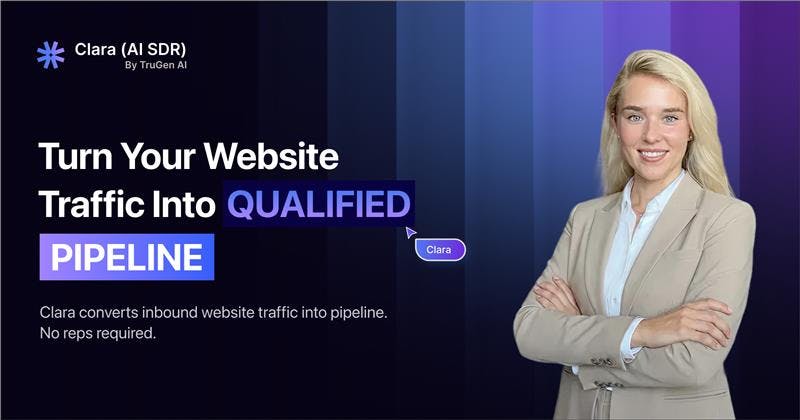
Clara AI SDR (AI Sales Development Representative), which recently debuted at #2 on Product Hunt, targets precisely this pain point. Its core promise: converting inbound website traffic into qualified pipeline in real time. As of now, the product has received 155 upvotes and 18 comments, categorized under Developer Tools and Artificial Intelligence.
Clara AI SDR's Core Features: From Passive Waiting to Proactive Real-Time Conversion
Redefining the Inbound Sales Process
The traditional inbound sales process typically looks like this: visitor fills out a form → enters the CRM → sales rep schedules follow-up → arranges a demo → handles objections → books a meeting. The entire chain has multiple steps, takes a long time, and each step risks losing the customer.
Clara's approach is to use an AI Agent to compress this entire pipeline into "real-time" execution. According to the official description, it can proactively engage visitors while they're browsing the website, completing the following full set of actions:
- Engaging: Instead of relying on visitors to fill out forms themselves, it proactively initiates conversations;
- Qualifying: Determining whether a visitor is a valuable potential customer;
- Demoing: Delivering real-time product walkthroughs;
- Handling objections: Addressing customer concerns and questions;
- Booking meetings: Directly locking in time for deeper follow-up conversations.
The three "No's" in its messaging — No forms, No waiting, No extra headcount — precisely hit the three major cost anxieties growth-stage companies face in their sales operations.
It's important to understand the SDR role's position within the B2B sales system. An SDR (Sales Development Representative) is specifically responsible for the top of the sales funnel. Unlike the AE (Account Executive) who handles closing, the SDR's core responsibilities are lead qualification and meeting booking — identifying potential buyers from a large pool of raw leads who fit the Ideal Customer Profile (ICP) and advancing them to the next stage of the sales process. An SDR's annual compensation (base salary plus commission) in the US market typically ranges from $60,000 to $90,000, and when you add training, management, and tool costs, the total annual cost per SDR can reach $120,000-$150,000. This makes AI SDR highly attractive from a cost-replacement perspective.
24/7 Non-Stop AI Selling Capability
Another key selling point Clara emphasizes is "24/7 selling." This is a natural advantage of AI Agents over human SDRs: no timezone constraints, no need for breaks, and the ability to handle large volumes of concurrent visitors simultaneously. For companies targeting global markets with visitors from different time zones, this means no more funnel leakage from "visitors who came at 3 AM getting followed up the next business day."
Additionally, Clara offers seamless CRM integration, which is critical for enterprise adoption — conversations generated by AI, lead scoring, and meeting scheduling can automatically flow into the existing sales system, rather than creating yet another data silo. CRM (Customer Relationship Management) systems are the core infrastructure for B2B companies managing the customer lifecycle, with Salesforce and HubSpot being the two platforms with the highest market share. A "data silo" refers to when data generated by a new tool cannot be connected to existing systems, forcing sales teams to manually sync information across multiple platforms, leading to decreased efficiency and data inconsistency. For AI SDR, seamless CRM integration means conversation records, lead scores, meeting arrangements, and other information need to be automatically written into the corresponding contact records and opportunity stages in the CRM, ensuring human salespeople have complete context when they take over — this involves technical adaptation work including API integration, field mapping, and workflow triggers.
Why AI SDR Has Become a Hot Category
A Typical Scenario for AI Agent Commercialization
Clara's popularity is no accident — it represents a typical direction for AI Agent commercialization. Sales processes are inherently highly structured, goal-oriented, and directly tied to revenue, making them one of the scenarios where large language model capabilities most easily translate into quantifiable ROI.
Unlike general-purpose chatbots, an AI SDR needs to simultaneously accomplish three tasks within a conversation: "understanding intent," "assessing value," and "advancing the process." This requires the model to not only converse but also possess certain sales strategy and decision-making capabilities — from a technical perspective, this is a real-world test of the evolution from "Chatbot" to "Agent."
Traditional chatbots are typically based on rule engines or simple intent recognition models, only able to handle preset conversation paths. The fundamental difference with AI Agents lies in their autonomous planning and decision-making capabilities — they not only understand user input but can also dynamically choose the next action based on current conversation state, user profile, and business objectives. This capability relies on large language models' reasoning ability (Chain-of-Thought reasoning), tool-calling capability (Function Calling), and memory and context management mechanisms. In sales scenarios, the Agent needs to make real-time judgments: Is this visitor worth engaging with further? Which product feature should be demonstrated? When should the conversation be advanced to booking a meeting? This multi-step decision-making is the core differentiator of Agent architecture from traditional Chatbots.
Does AI SDR Replace or Augment Human Sales Teams?
It's worth considering whether Clara's "No extra headcount" implies replacing human sales roles. A more pragmatic interpretation might be: AI SDR takes on the large volume of repetitive, low-value initial screening and first-touch work, freeing human salespeople to focus on high-value activities that require complex negotiation and trust-building.
In other words, it's more likely to reshape the division of labor within sales teams rather than simply cutting headcount. For startups and SMBs with limited budgets who cannot build large SDR teams, this model of "using AI to fill the sales front-end" is particularly attractive.
Clara AI SDR's Opportunities and Questions to Be Validated
As a product that just launched on Product Hunt, Clara's actual effectiveness still needs market validation. Several key questions deserve attention:
- Conversion quality vs. conversion quantity: AI-initiated engagement can boost interaction rates, but whether AI-qualified "leads" are truly high quality directly determines whether it can deliver on its "qualified pipeline" promise. In B2B sales terminology, "pipeline" refers to the sum of potential deals across various sales stages, while "qualified pipeline" specifically refers to high-quality opportunities that have been screened and confirmed to have genuine purchase intent and capability. The industry typically classifies leads into two tiers: MQL (Marketing Qualified Lead) and SQL (Sales Qualified Lead), with the MQL-to-SQL conversion rate averaging only around 13% in B2B. Clara's promise to generate "qualified pipeline" means it needs to complete assessments across dimensions like BANT (Budget, Authority, Need, Timeline) during conversations, which places high demands on AI's conversational depth;
- Authenticity of the conversation experience: Overly rigid or obviously robotic sales pitches may actually damage brand image and drive away high-quality visitors;
- Boundaries of objection handling: Whether the AI's response capability is sufficiently reliable when facing deep technical questions from professional buyers;
- Depth of CRM integration: The degree of compatibility with mainstream CRMs (such as Salesforce, HubSpot) will directly affect enterprise deployment costs.
Conclusion: The Value of Vertical-Scenario AI Agents Lies in Measurable Business Outcomes
Clara AI SDR is another attempt at taking AI Agents from concept to commercial closed-loop. It embeds large language models' conversational and decision-making capabilities into the inbound conversion stage of B2B sales — the point where value is most easily lost — with clear logic and precise pain point targeting.
For practitioners focused on AI application deployment, these "vertical-scenario AI Agents" are more worth studying than general-purpose assistants — their success or failure doesn't depend on how smart the model is, but on whether they can produce measurable value within real business processes. Whether Clara can truly turn website visitors into sales pipeline — the answer will be written in its future customer renewal rates.
Related articles

Felix Rieseberg Personal Homepage
Felix Rieseberg's personal homepage sparks attention on Hacker News. This article covers the Slack engineer's technical background, the rise and fall of nativefier, and the value of a developer homepage as a tech calling card.

@ai-sdk/vue 3.0.306 Patch Release Syncs with [email protected] Update
@ai-sdk/vue 3.0.306 released, synced with [email protected]. A routine patch release for the Vercel AI SDK ecosystem with no public API changes; the Vue adapter layer stays version-aligned with the core package.

Gemini 4 Argon API Launches: The Era of Million-Token Output Begins
Google launches Gemini 4 Argon with sparse MoE architecture, up to 1M output tokens, and a 68.90% Vals Index score, available across API, AI Studio, and the Gemini app.