Clarity: Real-Time Voice Enhancement That Lets AI Hear Only the Target Speaker

Clarity-1 delivers real-time noise removal and target speaker extraction to sharpen voice AI agent input quality.
Clarity is an audio pre-processing tool built for voice AI agent developers. Its core model, Clarity-1, handles two tasks in real-time streaming: removing background noise and precisely extracting a target speaker's voice from multi-person audio environments. Unlike conventional noise reduction, it treats other speakers' voices as noise too — directly solving the problem of voice agents struggling to hear a specific user in open offices or home settings. Positioned as a modular infrastructure component that plugs into existing voice pipelines, it aims to improve ASR and LLM output quality by cleaning up the input signal. The product just launched, and key details like latency, edge-case accuracy, and pricing have yet to be disclosed.
When Voice AI Meets Noisy Environments
Voice AI agents are rapidly expanding into customer service, call centers, voice assistants, and beyond — but a persistent pain point continues to limit their real-world performance: the world is never acoustically clean. Background noise, nearby conversations, and environmental echo all degrade the accuracy of speech recognition and understanding models. A voice agent that performs brilliantly in the lab can go practically "deaf" in a real phone call.
Clarity, which recently launched on Product Hunt, takes direct aim at this problem. Its tagline is blunt and compelling — "Mute the room, keep the speaker, in real time." Built by Alexander Netz, the product earned 67 upvotes and ranked 20th on its launch day, categorized under AI, Tech, and Audio.
What Clarity-1 Actually Does
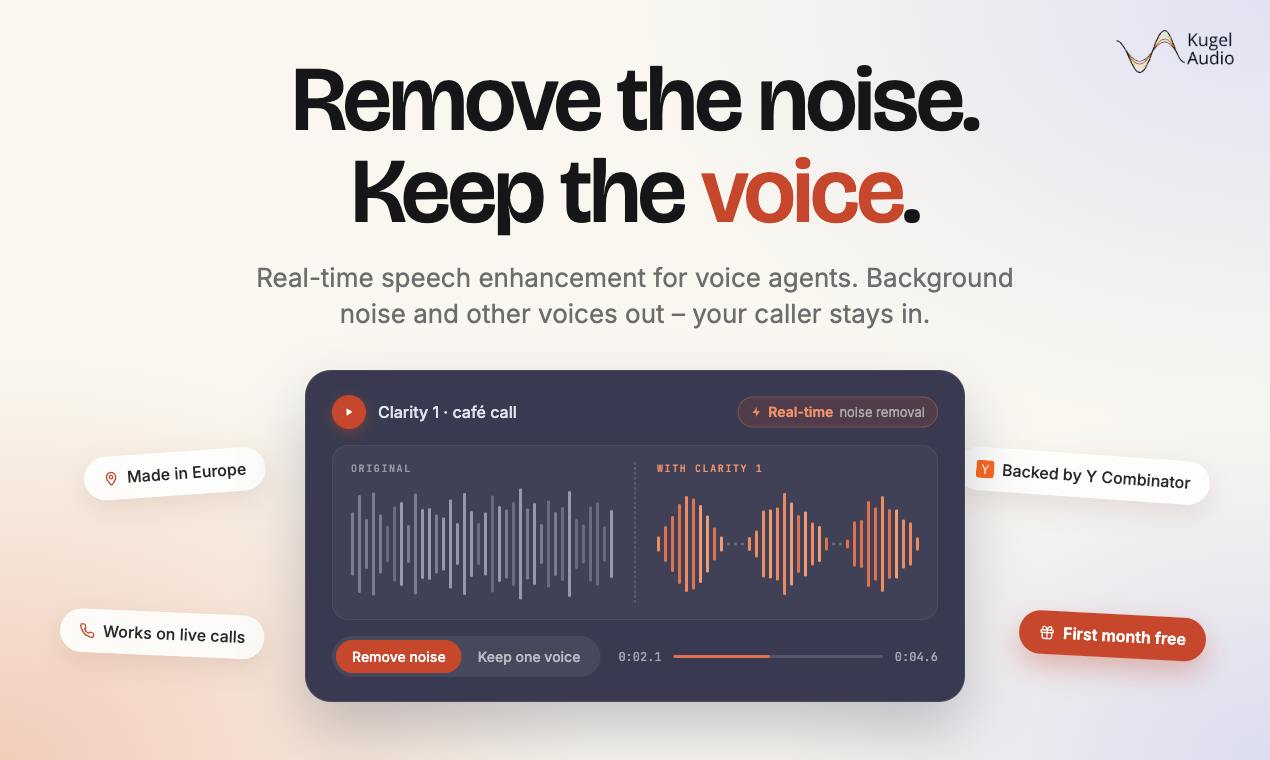
At the core of Clarity is a model called Clarity-1, built around two key capabilities: real-time speech enhancement and target speaker extraction.
The first handles background noise removal. The second goes a step further — in a call where multiple people are speaking, it identifies and retains only the target speaker's voice, filtering out everyone else. For a voice agent, this means receiving a clean, single-source audio stream, dramatically reducing the likelihood of misrecognition.
According to official descriptions, Clarity-1 "streams as audio arrives" — processing audio in real time rather than waiting for a full recording to complete before batch-processing it. This streaming architecture is a hard requirement for voice agent use cases: any noticeable latency disrupts the natural rhythm of conversation. The product's website also provides before/after audio comparisons, giving users a direct sense of the noise reduction and voice extraction results.
Why Target Speaker Extraction Matters
Most traditional noise-reduction solutions can only handle stationary noise (like fan hum or white noise). When it comes to structured interference like another person talking — whose spectral characteristics closely resemble the target speaker's — they tend to fall short. Target speaker extraction technology locks onto a specific voice signature or acoustic profile, treating non-target voices as noise. This is a significantly harder problem than standard noise reduction, and considerably more valuable — especially in open-plan offices, homes, or any multi-person environment where calls frequently happen.
Academically, Target Speaker Extraction (TSE) typically relies on one of two approaches: speaker-conditioned separation, where a brief reference audio clip of the target speaker (just a few seconds) is provided at inference time, the model generates a speaker embedding, and that embedding guides a separation network to "pull out" the corresponding voice from the mixed signal; or spatial separation via microphone arrays, which distinguishes speakers in the spatial domain using multi-channel input — but requires specific hardware. For single-microphone software solutions, the former approach is far more common, with representative open-source work including SpeakerBeam and TD-SpeakerBeam. Clarity-1's specific technical path hasn't been publicly disclosed, but the claim of "keeping only the target speaker" implies the system needs some form of speaker identity information at runtime — whether that's a pre-registered voice profile or automatic locking within the first few seconds of a call. The robustness of this mechanism directly determines how reliable the product will be in real-world scenarios.
Positioning as a Layer for Voice Agents
Clarity explicitly positions itself as a pre-processing layer for voice agents, not a consumer-facing call noise-cancellation app. This is a deliberate and interesting product decision.
As LLM-powered voice dialogue systems proliferate, the "listening" component of a voice agent has become an easy-to-overlook yet pivotal link in the chain. Even the most capable language model can't produce quality output when the transcription it receives is riddled with errors. By concentrating on audio pre-processing — a relatively specialized but essential layer — Clarity aims to indirectly improve the overall performance of voice agent systems by improving input signal quality.
For developers, tools like this are appealing precisely because they function as modular components that can be plugged into existing voice pipelines without having to train a noise-reduction model from scratch. Streaming processing, low latency, and optimization for voice interference are all production-ready characteristics.
A typical voice AI agent signal processing pipeline chains together four stages: audio capture → pre-processing (noise reduction / echo cancellation / speaker extraction) → automatic speech recognition (ASR, e.g., Whisper, Deepgram) → LLM inference → text-to-speech (TTS) output. Clarity targets that second stage. Historically, this layer has relied on WebRTC's built-in AEC/ANS modules or traditional algorithms like RNNoise, which perform poorly against complex voice interference. Bringing deep learning into the pre-processing layer offers a compelling advantage: ASR word error rate (WER) is extremely sensitive to input signal-to-noise ratio — a 5 dB improvement in SNR can reduce WER by 20–40%, and improvements at the pre-processing stage produce a multiplier effect across the entire pipeline. This explains why purpose-built infrastructure products focused on this single point have genuine standalone commercial value.
A Measured Take: What Still Needs to Be Verified
As a newly launched product, Clarity has limited publicly available information. Several key questions remain unanswered: What is the actual latency introduced by real-time processing in milliseconds? How does target speaker extraction perform in edge cases — multiple simultaneous speakers, highly similar voice profiles? And what does pricing and integration look like — API, SDK, or on-premise deployment?
67 upvotes and 5 comments represent moderate traction. It signals that the product is addressing a genuine need, but it's far from being market-validated. For teams considering adoption, the most prudent approach is to test the before/after audio comparisons on the website using real audio from your own use case before committing to a deeper evaluation.
Summary
Clarity represents a maturing niche in the voice AI toolchain: rather than building an all-encompassing dialogue system, it focuses on doing one thing exceptionally well — cleanly hearing the target speaker. At a moment when voice agents are rapidly moving into production, infrastructure products focused on input signal quality like this could become an easy-to-overlook yet indispensable piece of the puzzle for many teams. Whether it can find the right balance among accuracy, latency, and cost will depend on more real-world deployments to tell.
Related articles

@ai-sdk/vue 3.0.306 Patch Release Syncs with [email protected] Update
@ai-sdk/vue 3.0.306 released, synced with [email protected]. A routine patch release for the Vercel AI SDK ecosystem with no public API changes; the Vue adapter layer stays version-aligned with the core package.

Gemini 4 Argon API Launches: The Era of Million-Token Output Begins
Google launches Gemini 4 Argon with sparse MoE architecture, up to 1M output tokens, and a 68.90% Vals Index score, available across API, AI Studio, and the Gemini app.

DukaanAI: Turning Product Photos into Inventory Lists with Open-Source AI
DukaanAI is an AI inventory tool for small retailers that turns product photos into inventory entries using the open-source Gemma 3 model, with local inference, editable fields, and CSV export.